
What Is Internal Linking?
Internal linking is much more than simply connecting one webpage to another. It serves as the foundation of a website’s architecture and acts as a roadmap for both users and search engine crawlers. Every internal link creates a relationship between pages, helping search engines understand how content is connected and which pages hold greater importance within the overall site structure.
Think of internal links as roads connecting different locations in a city. Without roads, it becomes difficult to navigate from one place to another. Similarly, without internal links, search engines may struggle to discover pages efficiently, and users may leave the site before finding the information they need.
Modern websites often contain hundreds or even thousands of pages. Internal linking ensures that these pages are not isolated but work together as a unified content ecosystem. Whether a website is a blog, an eCommerce store, a SaaS platform, or a corporate website, internal links help guide visitors through relevant content while improving SEO performance.
Additionally, internal links provide context. When a page about “technical SEO” links to a page about “site speed optimization,” search engines understand that these topics are related. Over time, these relationships help establish subject matter expertise and topical authority.
 Uncategorized
KR Krishna Kushwaha| Jun 01, 2026| 12 min read
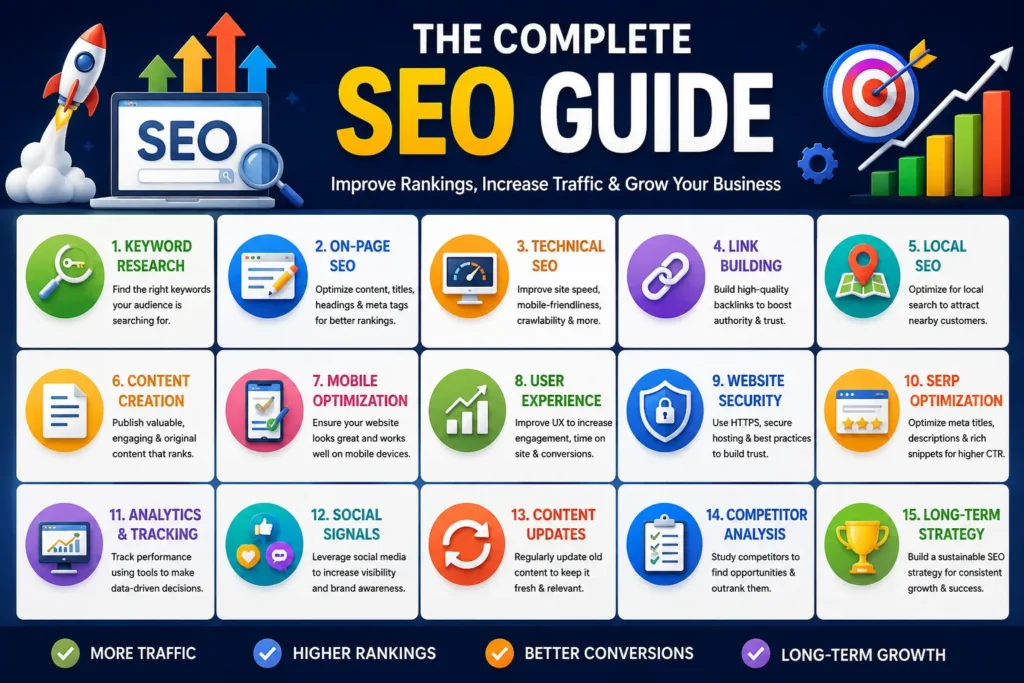
Search Engine Optimization (SEO): The Complete Guide to Improving Website Rankings and Organic Traffic
Why Internal Linking Matters for SEO
Many website owners focus heavily on acquiring backlinks while overlooking internal links. However, internal linking is one of the few SEO factors completely under your control. Unlike external links, which require outreach and relationship-building efforts, internal links can be created, modified, and optimized whenever needed.
Search engines use internal links to discover content, evaluate relationships between pages, and determine which pages deserve higher visibility. Strong internal linking can improve rankings without creating additional content or obtaining new backlinks.
A strategic internal linking structure also enhances website efficiency. Search engine bots have limited crawl resources. By linking pages intelligently, you help search engines prioritize important content and allocate crawl resources more effectively.
Furthermore, internal linking supports content longevity. Older articles that might otherwise lose visibility can continue attracting traffic through links from newly published content. This creates a sustainable cycle where all content contributes to the website’s overall SEO strength.
SEO
KR Krishna Kushwaha| Jun 01, 2026| 9 min read
What Is SEO?
Helps Search Engines Discover Pages
Search engines rely on crawlers to navigate websites. These crawlers move from page to page by following links. When a page has no internal links pointing to it, crawlers may never find it, reducing its chances of being indexed and ranked.
Internal links ensure that every important page remains accessible. This becomes particularly important for large websites with complex structures. Product pages, blog posts, resource guides, and service pages all need internal pathways that connect them to the rest of the site.
A strong linking structure also helps newly published content get indexed faster. When a new page receives links from existing high-authority pages, search engines can discover it more quickly. This accelerates the indexing process and improves the likelihood of ranking sooner.
Website owners should regularly review their content to identify pages that may be difficult to access. Every valuable page should have multiple internal links leading to it from relevant sections of the site.
 Uncategorized
KR Krishna Kushwaha| Jun 01, 2026| 9 min read
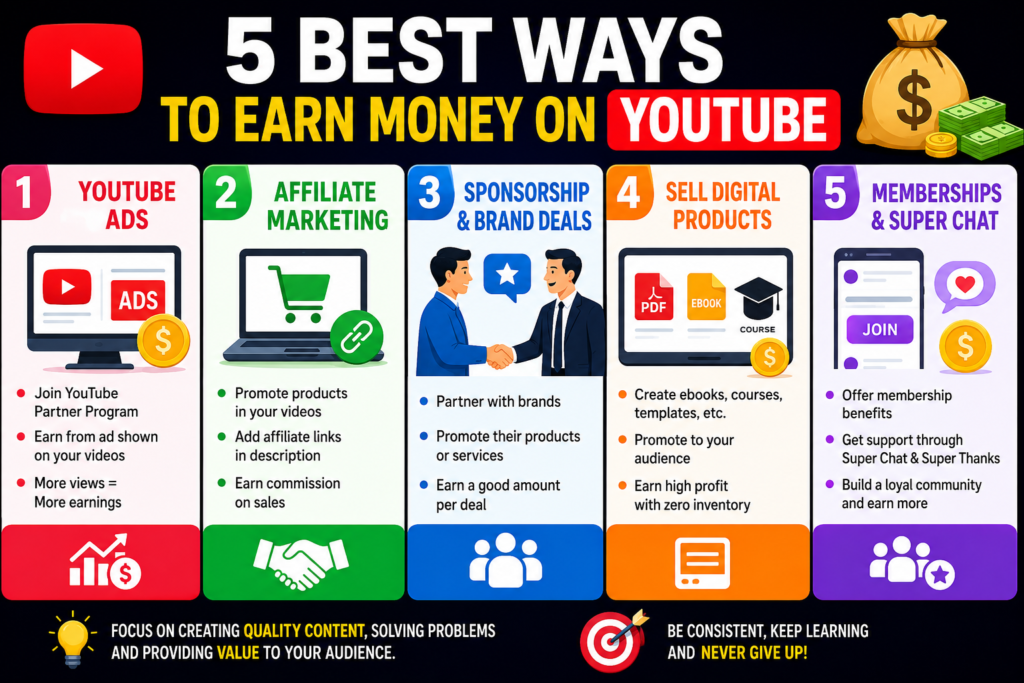
How to Earn Money on YouTube: The Complete Guide to YouTube Monetization in 2026
Distributes Link Equity
One of the most significant SEO benefits of internal linking is the distribution of link equity. When a page receives backlinks from external websites, it accumulates authority. Internal links allow that authority to flow throughout the website.
For example, a homepage often receives the majority of external backlinks. By strategically linking from the homepage to category pages, service pages, and important content, some of that authority is transferred deeper into the website.
This process helps improve the ranking potential of pages that may not attract many backlinks independently. Instead of relying solely on external link-building campaigns, businesses can leverage existing authority through smart internal linking.
Link equity distribution is especially valuable for commercial pages. Product pages, lead-generation pages, and service pages often benefit significantly when supported by authoritative blog content and resource pages.
 SEO
SEO
KR Krishna Kushwaha| Jun 01, 2026| 7 min read
On-Page SEO for “How to Earn Money on YouTube” – Complete 2000+ Word Guide
Improves Website Architecture
A well-structured website is easier for both users and search engines to understand. Internal linking contributes directly to website architecture by defining the hierarchy and relationships between pages.
An organized structure typically follows a pyramid model. At the top sits the homepage, followed by categories, subcategories, and individual pages. Internal links reinforce these relationships and help search engines identify which pages are most important.
Good website architecture also improves user navigation. Visitors can move naturally from broad topics to more specific information without confusion. This creates a seamless browsing experience that encourages longer sessions and deeper engagement.
As websites grow, maintaining architectural consistency becomes increasingly important. Strategic internal linking ensures that new content integrates smoothly into the existing structure rather than creating disconnected sections.
 SEO
SEO
KR Krishna Kushwaha| Jun 02, 2026| 9 min read
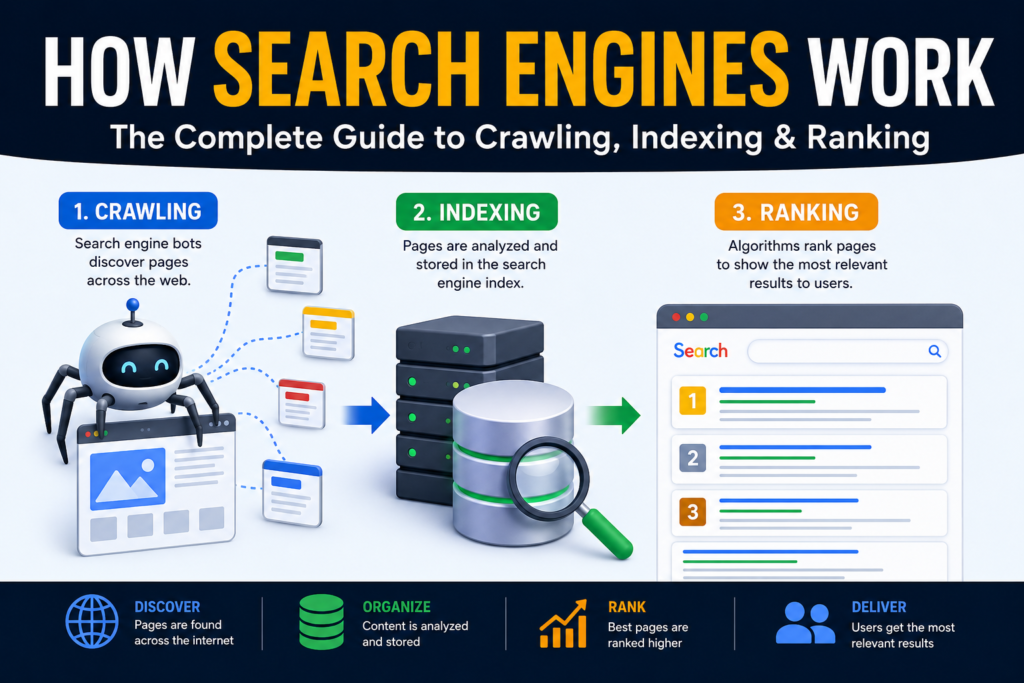
How Search Engines Work
Enhances User Experience
User experience has become a critical ranking factor in modern SEO. Internal links contribute significantly to user satisfaction by helping visitors find additional information related to their interests.
Imagine a user reading an article about content marketing. If the article includes links to keyword research, SEO writing, and content distribution strategies, the visitor can continue learning without needing to perform additional searches.
This convenience improves engagement metrics such as time on site, pages per session, and return visits. Users are more likely to trust and interact with websites that make information easily accessible.
Internal links also support different stages of the customer journey. Informational content can guide visitors toward commercial pages, helping businesses nurture prospects and increase conversions naturally.
Establishes Topical Authority
Search engines increasingly evaluate websites based on expertise and depth of coverage. Internal linking helps demonstrate topical authority by connecting related content into comprehensive subject clusters.
For example, a website focused on digital marketing may publish dozens of articles about SEO. By linking these articles together, the site creates a clear signal that it possesses extensive knowledge in that area.
Topical authority is particularly important in competitive industries. Websites that cover a subject comprehensively often outperform competitors that publish isolated pieces of content.
The more effectively content is interconnected, the easier it becomes for search engines to understand the breadth and depth of expertise being demonstrated.
Building an Effective Internal Linking Strategy
An effective internal linking strategy requires planning and consistency. Rather than adding links randomly, businesses should establish clear objectives and create a framework that supports both SEO and user experience goals.
Start by mapping your content inventory. Identify cornerstone pages, supporting articles, conversion pages, and informational resources. Understanding how these assets relate to one another makes it easier to build meaningful connections.
Consistency is also essential. Internal linking should become part of the content creation workflow. Every new article should include links to existing content, and older content should be updated to reference new resources whenever relevant.
Over time, this systematic approach creates a strong network of interconnected pages that benefits both search visibility and audience engagement.
The Hub-and-Spoke Model
The hub-and-spoke model is one of the most effective frameworks for internal linking because it mirrors how users naturally explore information. The hub acts as a central resource that covers a broad topic, while the spokes address specific subtopics in greater detail.
This structure improves content organization and provides clear navigation pathways. Users can begin with an overview and then explore individual aspects of the topic according to their interests.
From an SEO perspective, the hub-and-spoke model strengthens topical authority. Search engines can clearly see the relationship between pages and understand that the website offers comprehensive coverage of the subject.
Businesses implementing this model often see improvements in keyword rankings, user engagement, and content discoverability because every piece of content supports the broader topic ecosystem.
Internal Linking Best Practices
Successful internal linking requires balancing SEO objectives with user needs. Every link should provide value and help users achieve their goals more efficiently.
One best practice is to prioritize relevance over quantity. A smaller number of highly relevant links typically performs better than dozens of unrelated links. Users appreciate recommendations that genuinely enhance their experience.
Another important practice is maintaining consistency in anchor text while avoiding over-optimization. Anchor text should clearly communicate the destination page’s topic without appearing manipulative.
Regular audits are equally important. As websites evolve, links may become outdated, pages may be removed, and new opportunities may emerge. Ongoing maintenance ensures that the internal linking structure remains effective.
Common Internal Linking Mistakes
Despite its importance, internal linking is often implemented incorrectly. One common mistake is excessive linking. Too many links can dilute authority and overwhelm readers, making it difficult for them to identify the most important resources.
Another mistake is relying exclusively on automated linking tools. While automation can save time, it often lacks the contextual understanding necessary for creating meaningful connections.
Many websites also neglect older content. New articles receive attention and links, while older resources gradually become isolated. Regular content updates help maintain a balanced authority flow throughout the website.
Finally, irrelevant linking can damage both user experience and SEO performance. Every link should serve a clear purpose and support the topic being discussed.
Advanced Internal Linking Techniques
Advanced internal linking strategies go beyond basic navigation and contextual linking. They focus on maximizing authority flow, strengthening topical clusters, and supporting business objectives.
One effective technique involves identifying high-authority pages and using them to support underperforming content. This can accelerate ranking improvements for important pages.
Another advanced strategy is content gap linking. Whenever new content is published, marketers should immediately identify opportunities to connect it with existing resources. This ensures that the new page becomes part of the site’s content ecosystem from day one.
Advanced practitioners also use data-driven approaches, analyzing traffic patterns, engagement metrics, and ranking changes to refine their internal linking structures continuously.
Measuring Internal Linking Success
Internal linking should be evaluated using measurable performance indicators. Tracking results helps determine whether your strategy is achieving its intended objectives.
Organic traffic growth is one of the most obvious indicators. Pages receiving stronger internal link support often experience improvements in search visibility and traffic.
Engagement metrics also provide valuable insights. Increased session duration, reduced bounce rates, and higher pages-per-session figures suggest that users are finding internal links useful.
Keyword rankings, crawl statistics, and indexation rates can further reveal the impact of internal linking improvements. By monitoring these metrics consistently, businesses can identify opportunities for optimization and maximize long-term SEO performance.
An internal linking strategy is the process of connecting pages within the same website through hyperlinks to improve navigation, user experience, and search engine optimization (SEO). These links help visitors discover relevant content while guiding search engine crawlers through your website structure. A well-planned internal linking strategy allows search engines to understand the relationship between pages, identify important content, and index pages more efficiently.
Internal links also distribute link equity (or authority) across your website. When high-authority pages link to other relevant pages, some of that authority is passed along, helping those pages rank better in search results. Additionally, internal linking reduces bounce rates, increases page views, and keeps users engaged longer. For businesses and content creators, a strong internal linking strategy is one of the most effective ways to improve organic visibility without relying solely on external backlinks.
There is no fixed number of internal links that every page should contain. The ideal number depends on the length, purpose, and structure of the content. A comprehensive blog post may naturally contain 10 to 30 internal links, while shorter pages may only need a few. The key is relevance rather than quantity.
Every internal link should provide additional value to the reader and help them find related information. Adding too many links can overwhelm users and dilute link equity, while too few links may limit navigation and content discovery. Focus on linking to pages that support the topic being discussed. Search engines favor logical, user-focused linking structures that help visitors continue their journey through your website naturally.
Anchor text is the clickable text used in a hyperlink. The best anchor text clearly describes the content of the destination page while fitting naturally within the surrounding text. Descriptive anchor text helps users understand where the link leads and gives search engines context about the linked page.
For example, instead of using generic phrases like “click here” or “read more,” use specific phrases such as “technical SEO checklist” or “keyword research guide.” However, avoid excessive use of exact-match keywords because over-optimization can appear unnatural. A balanced approach that includes branded terms, partial-match keywords, and descriptive phrases creates a healthier internal linking profile. Well-optimized anchor text improves both usability and SEO performance.
Orphan pages are webpages that have no internal links pointing to them. Because search engines discover pages primarily through links, orphan pages are often difficult to crawl and index. Even if the content is valuable, it may struggle to rank because search engines view it as disconnected from the rest of the website.
Internal linking solves this problem by integrating orphan pages into the site’s content structure. Website owners should regularly conduct SEO audits to identify pages with little or no internal link support. Once identified, relevant links can be added from blog posts, category pages, service pages, or navigation menus. This not only improves discoverability but also helps distribute authority to those pages. Eliminating orphan pages is a crucial step in building a strong and SEO-friendly website architecture.
Internal linking improves rankings by helping search engines understand your site’s structure, content relationships, and page importance. When important pages receive links from multiple relevant pages, search engines interpret them as valuable resources. This can increase their chances of ranking higher for targeted keywords.
Internal links also enhance crawlability, making it easier for search engines to discover new and updated content. Additionally, they distribute authority throughout the website, helping weaker pages gain visibility. From a user perspective, internal links encourage deeper engagement by directing visitors to relevant resources, increasing time on site and reducing bounce rates. These positive user signals, combined with improved content accessibility, contribute to stronger SEO performance and higher organic search rankings over time.
Leave a Reply