Introduction
Search engines are the foundation of the modern internet. Every day, people use search engines to answer questions, research products, find local businesses, learn new skills, and solve problems. Whether someone wants to know the weather forecast, compare smartphones, learn SEO, or find a nearby restaurant, a search engine is usually the first place they turn.
The ability of search engines to provide relevant results within milliseconds is the result of highly sophisticated technology. Behind every search query lies a complex process involving data collection, analysis, machine learning, artificial intelligence, indexing systems, and ranking algorithms. These systems work together continuously to ensure users receive the most accurate and useful information possible.
For website owners, bloggers, digital marketers, businesses, and content creators, understanding how search engines work is not just interesting—it is essential. Search engine optimization (SEO) depends on understanding the mechanisms that search engines use to crawl, index, and rank content. The more you understand these processes, the better you can optimize your website for visibility and organic traffic.
In this guide, we will take an in-depth look at every stage of the search process, from discovering web pages to displaying search results, while exploring the technologies and ranking factors that influence search engine performance.
What Is a Search Engine?
A search engine is a software application designed to help users locate information on the World Wide Web. It acts as a bridge between internet users and the vast amount of content available online. Instead of manually browsing millions of websites, users can simply enter a search query and receive a list of relevant results.
Search engines perform several critical functions. They continuously scan the internet, collect information from web pages, organize that information into massive databases, and use algorithms to determine which pages should appear in response to a specific query.
Modern search engines are far more advanced than simple keyword-matching systems. They can understand context, user intent, synonyms, spelling variations, location data, and even conversational language. This allows them to deliver highly relevant results even when users do not phrase their queries perfectly.
The success of a search engine depends on its ability to provide accurate, trustworthy, and relevant information. This is why search engines invest heavily in artificial intelligence, machine learning, and ranking technologies.
The Three Main Functions of Search Engines
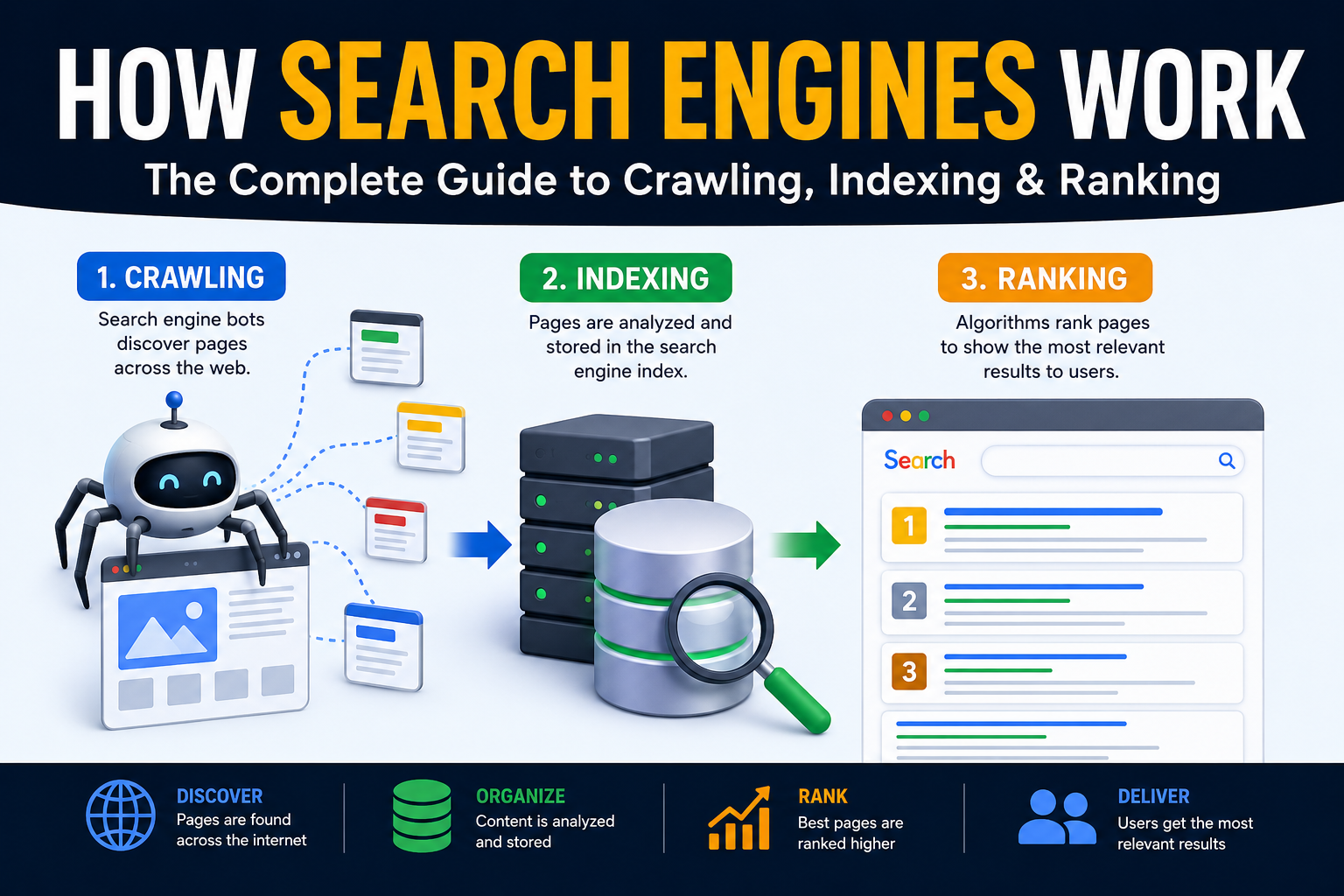
Every search engine relies on three fundamental processes: crawling, indexing, and ranking. These processes form the backbone of search technology and determine how information moves from a website to search results.
Without crawling, search engines would not know that a webpage exists. Without indexing, they would have no organized way to store and retrieve information. Without ranking, users would be overwhelmed by millions of results with no indication of which ones are most useful.
These processes occur continuously. Search engines are constantly discovering new pages, updating existing content, removing outdated information, and refining rankings based on changing user behavior and technological advancements.
Understanding these three functions is essential because every SEO strategy ultimately aims to improve performance within these stages.
Step 1: Crawling
Crawling is the first stage of the search engine process. During this stage, automated programs known as web crawlers explore the internet to discover new and updated content. Crawlers move from one webpage to another by following hyperlinks, much like a person browsing the web.
The internet contains billions of pages, and new content is published every second. Search engines must continuously crawl websites to keep their databases current. This is an enormous challenge requiring advanced infrastructure and sophisticated scheduling systems.
Crawlers not only discover pages but also collect information about them. They analyze content, links, metadata, images, and other elements that help search engines understand the page.
Efficient crawling ensures that newly published content can appear in search results quickly. If a page is not crawled, it cannot move to the indexing stage and therefore cannot rank in search results.
How Crawlers Discover Pages
Search engines use multiple methods to discover webpages. Internal links, external backlinks, XML sitemaps, URL submissions, and previously indexed pages all help crawlers find new content.
A website with strong internal linking allows search engines to navigate efficiently between pages. Conversely, orphan pages—pages with no internal links—may be difficult for crawlers to discover.
External links from other websites are also important. When a reputable website links to a new page, search engine crawlers often discover that page quickly. This is one reason backlinks remain valuable in SEO.
XML sitemaps provide a structured roadmap of important pages. Website owners can submit these files directly to search engines, helping ensure critical pages are discovered and crawled.
Crawl Budget
Crawl budget refers to the number of pages a search engine is willing and able to crawl on a website within a given timeframe. While small websites rarely need to worry about crawl budget, large websites with thousands or millions of pages must manage it carefully.
Search engines allocate crawl resources based on factors such as website authority, server performance, content quality, and update frequency. A highly authoritative news website may be crawled multiple times per day, while a small website may only be crawled occasionally.
Optimizing crawl budget involves eliminating duplicate pages, improving site architecture, fixing broken links, and ensuring important pages are easily accessible.
Step 2: Indexing
After a page is crawled, search engines evaluate its content and determine whether it should be added to the index. The index is essentially a massive database containing information about billions of webpages.
Indexing is much more than simply storing a webpage. Search engines analyze the page’s topic, keywords, structure, quality, and relevance. They identify important concepts, entities, and relationships within the content.
The indexed version of a page may differ from the live version because search engines process and interpret the content before storing it. They also evaluate duplicate content and determine which version should be indexed.
A page that is not indexed cannot appear in search results. Therefore, ensuring that important pages are properly indexed is one of the most important aspects of SEO.
What Search Engines Analyze During Indexing
Search engines analyze hundreds of elements during indexing. They examine text content, images, videos, structured data, headings, metadata, internal links, and external references.
Advanced natural language processing systems help search engines understand context and meaning rather than relying solely on keywords. For example, a page about “Apple” may refer to the fruit or the technology company, and search engines use contextual clues to determine the correct meaning.
Search engines also evaluate quality signals such as originality, expertise, authority, and trustworthiness. These signals help determine whether a page deserves visibility in search results.
Step 3: Ranking
Ranking is the process of determining which indexed pages should appear in search results and in what order. This is perhaps the most complex stage of search engine operations.
When a user enters a query, the search engine retrieves potentially relevant pages from its index. It then evaluates these pages using hundreds of ranking factors. The goal is to identify the pages most likely to satisfy the user’s intent.
Ranking algorithms consider factors such as relevance, authority, freshness, usability, page speed, backlinks, content quality, and user engagement. These factors work together to create a highly refined search experience.
Because ranking systems are constantly evolving, SEO is an ongoing process rather than a one-time task.
Major Ranking Factors
Search engines use hundreds of ranking signals, but several major categories consistently influence performance.
High-quality content remains one of the strongest ranking factors. Content that thoroughly answers user questions and provides unique value tends to perform well.
Backlinks continue to act as endorsements from other websites. A strong backlink profile often indicates trust and authority.
User experience signals such as page speed, mobile friendliness, and ease of navigation help search engines evaluate how useful a website is for visitors.
Content freshness can also influence rankings, particularly for news, technology, finance, and rapidly changing topics.
Understanding Search Intent
Search intent is one of the most important concepts in modern SEO. It refers to the reason behind a user’s search query.
Search engines aim to satisfy intent rather than simply match keywords. This means understanding what users are trying to accomplish when they perform a search.
For example, someone searching “best laptops under $1000” is likely comparing options before making a purchase. Someone searching “buy laptop online” is much closer to completing a transaction.
By aligning content with user intent, websites can significantly improve rankings and engagement.
Google’s Search Algorithm
Google’s algorithm is one of the most sophisticated information retrieval systems ever created. It incorporates artificial intelligence, machine learning, language processing, and hundreds of ranking signals.
The algorithm is continuously updated to improve result quality and combat spam. Major updates can significantly impact website rankings, making it important for SEO professionals to stay informed.
Google’s systems evaluate not only what content says but also how trustworthy, authoritative, and useful it is. This focus on quality has become increasingly important as the web continues to grow.
The Role of Artificial Intelligence
Artificial intelligence has transformed search technology. Modern search engines use AI to understand language, predict intent, analyze content quality, and personalize results.
Machine learning systems can identify patterns in user behavior and continuously improve search relevance. AI also helps search engines detect spam, understand images, process voice searches, and interpret complex queries.
As AI continues to evolve, search engines will become even better at understanding human language and delivering personalized experiences.
Technical SEO and Search Engines
Technical SEO ensures that search engines can efficiently crawl, index, and understand a website. Even excellent content may struggle to rank if technical issues prevent search engines from accessing it properly.
Technical SEO includes optimizing site speed, mobile usability, structured data, XML sitemaps, canonical tags, HTTPS security, and URL structure.
A technically sound website creates a strong foundation for all other SEO efforts. Without this foundation, content and link-building strategies may not achieve their full potential.
Conclusion
Search engines are among the most powerful technologies ever developed. They organize vast amounts of information and make it accessible to users within seconds. Through crawling, indexing, and ranking, search engines transform billions of webpages into meaningful search results that help people solve problems, learn new information, and make decisions.
For website owners and marketers, understanding how search engines work is essential for achieving online visibility. Successful SEO is built on creating valuable content, providing an excellent user experience, and ensuring search engines can effectively crawl and index a website.
As artificial intelligence, machine learning, voice search, and semantic understanding continue to advance, search engines will become even more sophisticated. However, one principle will remain constant: websites that provide genuine value to users will have the greatest opportunity to succeed in search results.
Leave a Reply