Introduction
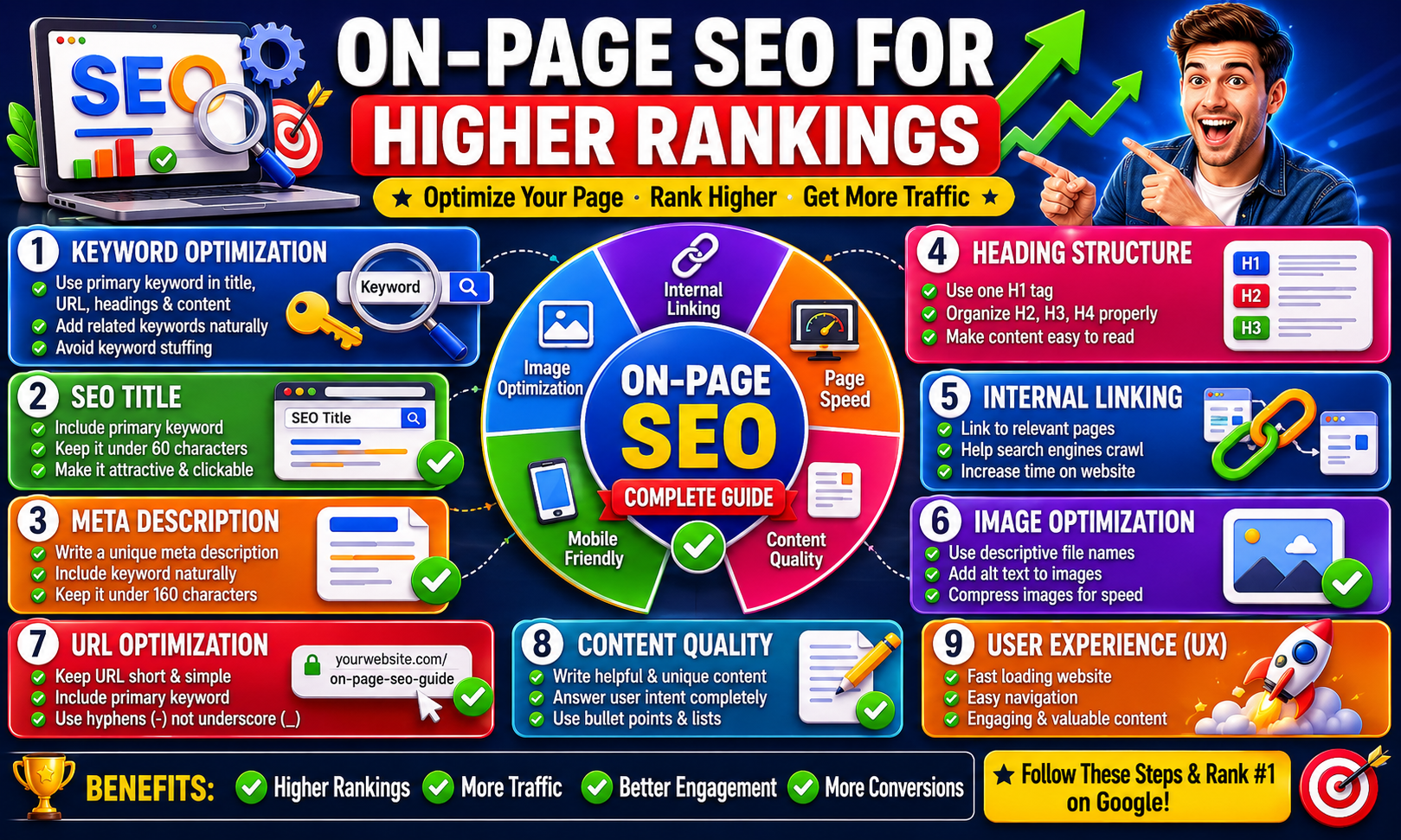
On-page SEO is one of the most important factors for ranking a website on search engines like Google. Even if you create excellent content, it may struggle to rank if your on-page SEO is not properly optimized. When writing an article about “How to Earn Money on YouTube,” proper on-page SEO helps search engines understand your content and increases your chances of appearing in search results.
This guide explains every aspect of on-page SEO using the keyword “How to Earn Money on YouTube.” By following these best practices, you can improve search rankings, attract more visitors, increase click-through rates, and drive long-term organic traffic.
What Is On-Page SEO?
On-page SEO refers to all optimization activities performed directly on a webpage to improve its visibility in search engines.
Unlike off-page SEO, which focuses on backlinks and external signals, on-page SEO focuses on:
- Content optimization
- Keyword placement
- Meta tags
- Headings
- URL structure
- Internal linking
- Image optimization
- User experience
The goal is to help search engines understand the page while providing a better experience for users.
Why On-Page SEO Matters
Without proper on-page SEO, even high-quality content may struggle to rank.
Benefits include:
- Higher Google rankings
- More organic traffic
- Better click-through rates
- Improved user engagement
- Increased conversions
- Enhanced user experience
Search engines use on-page signals to determine the relevance and quality of a webpage.
Step 1: Keyword Research
Before creating content, identify the primary keyword.
Primary Keyword
How to Earn Money on YouTube
Secondary Keywords
- Make Money on YouTube
- YouTube Monetization
- YouTube Income
- YouTube Earnings
- YouTube Partner Program
- YouTube Sponsorships
- Affiliate Marketing on YouTube
- Earn Money Online
- YouTube Business
- Passive Income
Using both primary and secondary keywords helps search engines understand the topic comprehensively.
Step 2: Optimize the SEO Title
The SEO title is one of the strongest ranking signals.
Optimized SEO Title
How to Earn Money on YouTube: Complete Guide to YouTube Monetization (2026)
Why This Title Works
- Contains primary keyword
- Includes year for freshness
- Creates curiosity
- Explains article value
Best Practices
- Keep between 50–60 characters
- Place keyword near the beginning
- Make it compelling
Step 3: Create an SEO-Friendly URL
URLs should be simple, descriptive, and keyword-rich.
Good URL
https://yourwebsite.com/how-to-earn-money-on-youtubeBad URL
https://yourwebsite.com/post?id=12345URL Optimization Tips
- Use lowercase letters
- Include primary keyword
- Avoid unnecessary words
- Keep it short
Step 4: Write an Optimized Meta Description
Meta descriptions influence click-through rates.
Example Meta Description
Learn how to earn money on YouTube through ads, affiliate marketing, sponsorships, memberships, and digital products. Complete monetization guide for beginners.
Best Practices
- Include primary keyword
- Keep under 160 characters
- Explain article benefits
- Encourage clicks
Step 5: Optimize the H1 Heading
The H1 is the main page heading.
Example
How to Earn Money on YouTube
Why It Matters
Google uses the H1 to understand the page topic.
Best practice:
- Use one H1 per page
- Include primary keyword
Step 6: Use Proper Heading Structure
Headings improve readability and SEO.
Example structure:
H1
How to Earn Money on YouTube
H2
What Is YouTube Monetization?
H2
Best Ways to Earn Money on YouTube
H3
YouTube Ads
H3
Affiliate Marketing
H3
Brand Sponsorships
H2
Frequently Asked Questions
This hierarchy helps both users and search engines navigate content.
Step 7: Optimize the First 100 Words
Google pays attention to the beginning of your content.
Example:
“Learning how to earn money on YouTube has become a popular goal for content creators worldwide. With multiple monetization opportunities such as advertising, affiliate marketing, sponsorships, and memberships, YouTube offers significant earning potential for beginners and experienced creators alike.”
Notice the keyword appears naturally.
Step 8: Create High-Quality Content
Content quality is the foundation of SEO.
Google rewards content that:
- Solves problems
- Provides useful information
- Demonstrates expertise
- Satisfies search intent
Characteristics of High-Quality Content
- Comprehensive
- Accurate
- Well-structured
- Easy to read
- Updated regularly
Step 9: Optimize Keyword Placement
Place keywords naturally throughout the content.
Important Locations
- SEO title
- URL
- Meta description
- H1 heading
- First paragraph
- Subheadings
- Image alt text
- Conclusion
Avoid keyword stuffing.
Bad Example
“How to earn money on YouTube is the best way to earn money on YouTube because earning money on YouTube is easy.”
Good Example
“Many creators earn income through YouTube monetization, affiliate marketing, and sponsorship opportunities.”
Step 10: Internal Linking Strategy
Internal links connect pages within your website.
Benefits
- Improves navigation
- Passes authority
- Helps indexing
- Increases page views
Example:
Link from your article to:
- What Is SEO?
- Affiliate Marketing Guide
- Blogging Guide
- Digital Marketing Basics
Step 11: Use External Links
External links point to authoritative resources.
Examples:
- Official YouTube Help Center
- Google Search Central
- YouTube Creator Academy
Benefits include:
- Increased credibility
- Better user experience
- Improved trust signals
Step 12: Image Optimization
Images play a major role in on-page SEO.
Use Descriptive File Names
Bad:
IMG001.jpgGood:
how-to-earn-money-on-youtube-guide.webpAdd Alt Text
Example:
How to earn money on YouTube through monetization and affiliate marketingAlt text helps:
- Accessibility
- Image rankings
- Search engines understand content
Compress Images
Benefits:
- Faster loading speed
- Better user experience
- Improved Core Web Vitals
Use formats such as:
- WebP
- JPEG
- SVG
Step 13: Improve Content Readability
Readability directly affects engagement.
Best Practices
- Short paragraphs
- Bullet points
- Numbered lists
- Clear headings
- Simple language
Readable content keeps visitors on the page longer.
Step 14: Optimize for Featured Snippets
Featured snippets appear at the top of search results.
Example:
How Do You Earn Money on YouTube?
You can earn money on YouTube through advertising revenue, affiliate marketing, sponsorships, memberships, digital products, and merchandise sales.
Short, direct answers increase snippet opportunities.
Step 15: Add FAQ Section
FAQs help target long-tail keywords.
Examples:
How much money can beginners make on YouTube?
Beginners can earn from a few dollars to hundreds of dollars monthly depending on views and monetization methods.
Do I need 1000 subscribers to make money on YouTube?
You need specific requirements for ad monetization, but affiliate marketing and sponsorships can generate income before reaching 1000 subscribers.
Step 16: Implement Schema Markup
Schema provides additional context to search engines.
Recommended schema:
- Article Schema
- FAQ Schema
- Breadcrumb Schema
Benefits:
- Rich results
- Improved visibility
- Higher click-through rates
Step 17: Optimize Core Web Vitals
Google uses Core Web Vitals as ranking signals.
Largest Contentful Paint (LCP)
Measures loading speed.
Target:
Under 2.5 seconds
Interaction to Next Paint (INP)
Measures responsiveness.
Cumulative Layout Shift (CLS)
Measures visual stability.
Target:
Less than 0.1
Step 18: Mobile Optimization
Most users browse on mobile devices.
Ensure:
- Responsive design
- Fast loading
- Easy navigation
- Readable text
Mobile-first indexing makes mobile optimization essential.
Step 19: Add Table of Contents
Benefits:
- Better user experience
- Faster navigation
- Potential sitelinks in Google
Example:
- What Is YouTube Monetization?
- Best Ways to Earn Money
- YouTube Ads
- Affiliate Marketing
- Sponsorships
- FAQs
Step 20: Optimize User Experience
Google increasingly measures user satisfaction.
Improve:
- Navigation
- Design
- Page speed
- Readability
- Engagement
Better user experience often leads to better rankings.
Common On-Page SEO Mistakes
Keyword Stuffing
Overusing keywords can harm rankings.
Duplicate Content
Unique content performs better.
Missing Meta Descriptions
Always write custom meta descriptions.
Poor Heading Structure
Use proper H1, H2, and H3 hierarchy.
Unoptimized Images
Large images slow websites.
Slow Page Speed
Optimize performance regularly.
Complete On-Page SEO Checklist
Content
✅ Primary keyword included
✅ Secondary keywords used
✅ 2000+ words
✅ Comprehensive coverage
Meta Tags
✅ Optimized SEO title
✅ Meta description
✅ SEO-friendly URL
Headings
✅ One H1
✅ Multiple H2s
✅ Supporting H3s
Images
✅ Compressed images
✅ Alt text added
✅ WebP format
Technical SEO
✅ Mobile-friendly
✅ Fast loading
✅ Schema markup
✅ Internal links
✅ External links
Conclusion
On-page SEO is essential for ranking content about “How to Earn Money on YouTube.” By optimizing titles, URLs, headings, content structure, keywords, images, internal links, and user experience, you significantly increase your chances of achieving higher rankings and attracting organic traffic.
Successful SEO is not about manipulating search engines; it is about creating valuable, well-structured content that satisfies user intent. When you combine high-quality content with strong on-page SEO practices, your website becomes more visible, more trustworthy, and more likely to rank on the first page of Google.
Leave a Reply