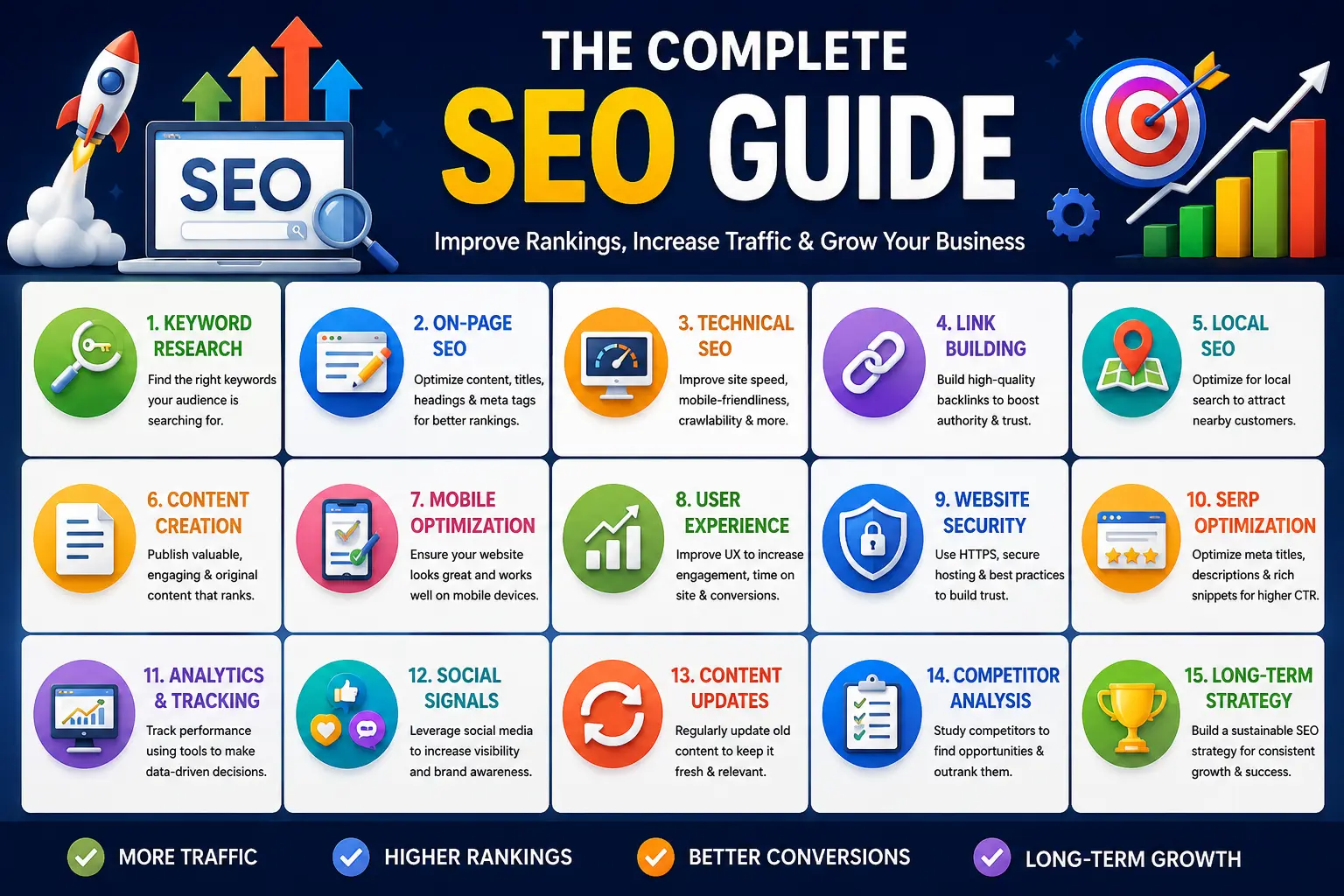
Search Engine Optimization (SEO) is much more than simply adding keywords to a webpage. It is a comprehensive digital marketing strategy that helps search engines understand your content and determine whether it deserves to rank for specific search queries. SEO combines technical improvements, content creation, website optimization, user experience enhancements, and authority-building activities to improve visibility in search results.
When users search online, they are looking for answers, solutions, products, services, or information. Search engines aim to provide the most relevant and useful results possible. Websites that demonstrate expertise, trustworthiness, and relevance are more likely to appear at the top of search engine results pages (SERPs).
SEO is an ongoing process because search engine algorithms constantly evolve. What worked a few years ago may no longer be effective today. Modern SEO focuses heavily on user experience, content quality, and meeting search intent rather than manipulating rankings through outdated tactics.
Businesses of all sizes use SEO to increase online visibility, generate leads, attract customers, and build brand authority. Whether you run a local business, an eCommerce store, a personal blog, or a large corporate website, SEO plays a critical role in online success.
Why Is SEO Important?
The internet contains billions of web pages competing for attention. Without SEO, even the best website may remain invisible to potential visitors. SEO helps bridge the gap between your content and your audience by making your website discoverable through search engines.
One of the biggest advantages of SEO is that it attracts users who are already interested in your products, services, or content. Unlike traditional advertising, where messages are pushed to consumers, SEO connects with people actively searching for solutions.
SEO also offers one of the highest returns on investment among digital marketing channels. While it may take time to see results, successful SEO campaigns can continue generating traffic and leads for months or even years without ongoing advertising costs.
Furthermore, strong SEO improves brand credibility. Users often trust websites that rank highly in search results because they perceive them as authoritative and reliable. High rankings can therefore increase trust and encourage users to engage with your content or business.
How Search Engines Work
Search engines use highly sophisticated systems to organize and rank information from across the web. Their primary goal is to provide users with the most relevant answers to their queries as quickly as possible.
Every day, search engines crawl billions of pages, process vast amounts of data, and update their indexes. Advanced algorithms analyze hundreds of ranking signals to determine which pages should appear for specific searches.
These algorithms consider numerous factors, including content relevance, website authority, user experience, page speed, backlinks, mobile usability, and search intent. The process happens within milliseconds whenever a user performs a search.
Understanding how search engines work allows website owners to optimize their content effectively and improve their chances of ranking higher.
Crawling
Crawling is the discovery phase of search engines. Automated programs known as crawlers, spiders, or bots continuously browse the web looking for new and updated content.
These bots follow links from page to page and collect information about websites. If your website has poor navigation or lacks internal links, crawlers may struggle to find important pages.
Regular crawling helps search engines stay updated with changes on websites. Whenever you publish new content, update existing pages, or modify your website structure, crawlers revisit your site to gather fresh information.
A properly optimized website makes it easier for search engines to crawl pages efficiently, leading to better indexing and visibility.
Indexing
Once a webpage is crawled, search engines analyze its content and store it in a massive database called an index. The index functions like a giant digital library where information is organized and categorized.
During indexing, search engines evaluate:
- Page content
- Keywords
- Images
- Videos
- Structured data
- Internal links
- External links
Not every crawled page gets indexed. Search engines may exclude pages that contain duplicate content, technical issues, or insufficient value for users.
Ensuring that important pages are indexed is a critical part of SEO because pages that are not indexed cannot appear in search results.
Ranking
Ranking determines the order in which search results appear. Search engines analyze hundreds of factors to identify the most useful and relevant pages for a given query.
Key ranking considerations include:
- Relevance to the search query
- Content quality
- Authority and trustworthiness
- User experience
- Page speed
- Mobile optimization
- Backlink quality
Search engines constantly refine their ranking systems to improve search result quality and prevent manipulation.
The goal of SEO is not simply to rank higher but to provide content that genuinely deserves a top position because it offers value to users.
On-Page SEO
On-page SEO involves optimizing individual pages to improve search visibility and user experience. It includes everything from content creation to HTML optimization.
Effective on-page SEO helps search engines understand page topics while making content easier for users to read and navigate.
Important elements include:
- Keyword placement
- Content quality
- Internal linking
- Title tags
- Meta descriptions
- Header structure
- Image optimization
On-page SEO serves as the foundation of every successful SEO strategy. Without properly optimized pages, even strong backlinks and technical SEO may not produce desired results.
Keyword Optimization
Keyword optimization involves strategically incorporating relevant search terms throughout content. The goal is to help search engines understand the topic of a page without sacrificing readability.
Modern keyword optimization focuses on context rather than exact keyword repetition. Search engines can understand synonyms, related concepts, and user intent.
Best practices include:
- Using keywords naturally
- Including primary keywords in headings
- Incorporating semantic variations
- Avoiding keyword stuffing
- Matching search intent
Proper keyword optimization improves relevance while maintaining a positive user experience.
Title Tags
Title tags are often the first thing users see in search results. A compelling title can significantly improve click-through rates.
A strong title tag should:
- Clearly describe page content
- Include the primary keyword
- Encourage users to click
- Remain within recommended character limits
Search engines use title tags to understand page topics, making them one of the most important on-page SEO elements.
Meta Descriptions
Although meta descriptions are not direct ranking factors, they influence user behavior and search performance.
A well-written meta description:
- Summarizes page content
- Highlights benefits
- Encourages clicks
- Includes relevant keywords
Effective descriptions can improve click-through rates, which may indirectly support SEO performance.
Content Optimization
Content optimization ensures that information is useful, relevant, and accessible to users.
High-performing content typically:
- Addresses user questions
- Covers topics comprehensively
- Uses clear language
- Includes examples and visuals
- Provides actionable insights
Search engines increasingly prioritize content that demonstrates expertise and satisfies user intent.
Regularly updating content also helps maintain relevance and improve rankings over time.
Off-Page SEO
Off-page SEO refers to activities performed outside your website to improve authority and trustworthiness.
Search engines view external signals as indicators of quality. When reputable websites reference your content, it suggests credibility and value.
Common off-page SEO activities include:
- Link building
- Digital PR
- Brand mentions
- Social sharing
- Influencer outreach
Strong off-page SEO can significantly improve rankings, especially in competitive industries.
Backlinks
Backlinks remain one of the most influential ranking factors in SEO.
A backlink acts like a recommendation from another website. When authoritative websites link to your content, search engines view it as a sign of trust.
However, not all backlinks are equal. Links from reputable, relevant websites provide far greater value than links from low-quality sources.
Successful backlink strategies focus on earning links naturally through exceptional content and relationship building.
Technical SEO
Technical SEO ensures that search engines can efficiently crawl, index, and understand a website.
Even the best content may struggle to rank if technical issues prevent search engines from accessing it properly.
Technical SEO includes:
- Site architecture
- XML sitemaps
- Structured data
- Canonical tags
- Mobile optimization
- HTTPS security
- Core Web Vitals
A technically sound website creates a strong foundation for all other SEO efforts.
Image SEO
Images enhance user experience, but they must be optimized properly to support SEO goals.
Search engines cannot interpret images the same way humans can. Therefore, image optimization helps provide context and improve discoverability.
Image SEO includes:
- Descriptive file names
- Alt text
- Compression
- Responsive design
- Structured image data
Optimized images can generate additional traffic through image search and improve page performance.
Local SEO
Local SEO helps businesses connect with customers in specific geographic areas.
When users search for services near them, search engines prioritize local businesses based on relevance, proximity, and prominence.
Effective local SEO strategies include:
- Optimizing business profiles
- Gathering customer reviews
- Creating local content
- Building local citations
- Maintaining consistent business information
Local SEO is especially valuable for restaurants, healthcare providers, service businesses, retailers, and professional practices.
Future of SEO
SEO continues to evolve as technology advances and user behavior changes.
Artificial intelligence, machine learning, voice search, and personalized search experiences are reshaping how search engines understand content.
Future SEO success will depend on:
- Creating genuinely helpful content
- Demonstrating expertise
- Enhancing user experience
- Optimizing for AI-driven search
- Building strong brand authority
While specific ranking factors may change, the fundamental goal of SEO remains the same: helping users find the best possible answers to their questions.
Conclusion
Search Engine Optimization (SEO) is the practice of improving a website’s visibility in search engine results to attract more organic traffic. It involves optimizing content, improving technical performance, building authority through backlinks, and delivering an exceptional user experience.
SEO is not a one-time task but an ongoing process that requires continuous learning, optimization, and adaptation to changing search engine algorithms. Businesses and website owners who invest in SEO can achieve sustainable growth, increased brand visibility, higher credibility, and long-term success online.
Whether you are a beginner starting your first blog or a business owner looking to expand your digital presence, mastering SEO can be one of the most valuable skills in modern digital marketing. By understanding how search engines work and implementing proven SEO strategies, you can improve rankings, attract targeted visitors, and achieve your online goals.
Leave a Reply