Introduction
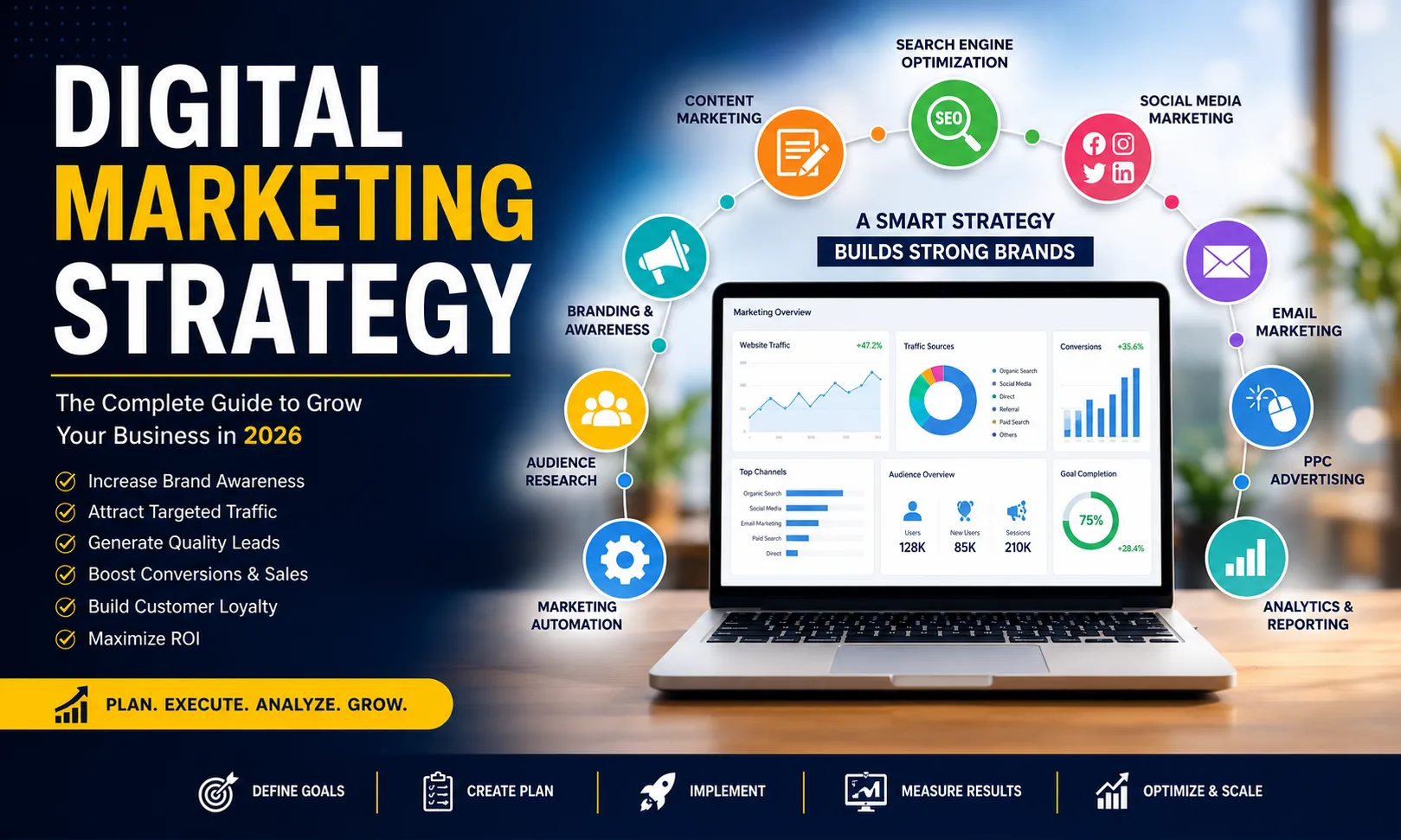
In today’s digital-first world, simply having a website or social media account is no longer enough to grow a business. Whether you own a small local business, run an eCommerce store, operate a startup, or work as a freelancer, success depends on having a clear and well-planned digital marketing strategy.
A digital marketing strategy is more than posting on Facebook or running Google Ads. It is a comprehensive plan that helps businesses attract the right audience, build trust, generate qualified leads, and convert visitors into loyal customers. With rapid changes in artificial intelligence (AI), search engine optimization (SEO), content marketing, social media algorithms, and customer behavior, businesses need a modern strategy that adapts to today’s competitive online environment.
In 2026, companies that rely on data-driven marketing, personalized customer experiences, and high-quality content consistently outperform competitors that market without a clear plan. A successful digital marketing strategy combines multiple channels, including SEO, content marketing, social media, email marketing, paid advertising, influencer marketing, and analytics.
This comprehensive guide explains how to create an effective digital marketing strategy from scratch. Whether you are a beginner or an experienced marketer, you’ll learn practical techniques that can help increase website traffic, improve conversions, strengthen brand awareness, and maximize your marketing return on investment (ROI).
What Is a Digital Marketing Strategy?
A digital marketing strategy is a detailed action plan that outlines how a business will use digital channels to achieve specific marketing objectives.
These objectives may include:
- Increasing website traffic
- Generating qualified leads
- Improving brand awareness
- Growing online sales
- Building customer loyalty
- Expanding into new markets
- Increasing customer engagement
- Improving return on advertising spend (ROAS)
Unlike random marketing activities, a strategy ensures that every campaign works toward measurable business goals.
Example
Imagine two online clothing stores.
The first store posts random content on Instagram, occasionally runs advertisements, and sends emails without planning.
The second store researches its audience, optimizes its website for SEO, publishes helpful blogs, runs targeted advertisements, creates email automation, and tracks campaign performance.
The second business is far more likely to achieve sustainable growth because every marketing activity is part of a structured strategy.
Why Every Business Needs a Digital Marketing Strategy
Businesses today compete in an increasingly crowded online marketplace. Without a clear strategy, marketing budgets can be wasted on activities that produce little or no measurable results.
A well-designed digital marketing strategy provides direction and ensures resources are invested wisely.
1. Better Brand Visibility
Millions of users search online every day for products and services. A strategic online presence helps your business appear where potential customers are already looking.
2. Higher Website Traffic
SEO, content marketing, and social media campaigns attract targeted visitors who are genuinely interested in your products or services.
3. Increased Customer Trust
Consistent branding, valuable content, testimonials, and educational resources establish credibility and authority within your industry.
4. Improved Lead Generation
Instead of reaching random audiences, strategic campaigns target people who are more likely to become paying customers.
5. Better Return on Investment
Marketing budgets become more efficient when campaigns are tracked, analyzed, and optimized using performance data.
6. Competitive Advantage
Businesses with clear marketing strategies respond more quickly to market trends, customer behavior, and new technologies than competitors without a plan.
 SEO
SEO
Krishna Kushwaha| Jul 10, 2026| 20 min read
Digital Advertising: The Complete Guide to Growing Your Business Online in 2026
Benefits of a Well-Planned Digital Marketing Strategy
A professional digital marketing strategy creates long-term business growth rather than temporary marketing success.
Stronger Brand Recognition
Consistent messaging across your website, social media platforms, search engines, and email campaigns helps customers recognize and remember your brand.
Higher Conversion Rates
Targeting the right audience with relevant offers significantly increases the likelihood that visitors will become customers.
Better Customer Relationships
Personalized communication through email, social media, and customer support helps build lasting relationships.
Data-Driven Decision Making
Marketing platforms provide detailed analytics that reveal what is working and what needs improvement.
Businesses can monitor:
- Website traffic
- Conversion rates
- Bounce rate
- Customer acquisition cost (CAC)
- Return on investment (ROI)
- Customer lifetime value (CLV)
These insights support continuous improvement.
Long-Term Business Growth
Unlike one-time advertising campaigns, strategic digital marketing creates sustainable growth through ongoing optimization and customer retention.
Key Components of a Successful Digital Marketing Strategy
A successful strategy integrates several marketing channels that work together.
Search Engine Optimization (SEO)
SEO improves website visibility in search engine results by optimizing content, keywords, technical performance, and backlinks.
Benefits include:
- Organic traffic
- Higher search rankings
- Increased authority
- Long-term visibility
Content Marketing
Content remains one of the most effective digital marketing tools.
Examples include:
- Blog posts
- Guides
- Tutorials
- Videos
- Infographics
- Podcasts
- Case studies
- White papers
High-quality content answers customer questions and builds trust before a purchase decision.
Social Media Marketing
Social media platforms allow businesses to engage directly with their audience.
Popular platforms include:
- X
- YouTube
- TikTok
Successful strategies focus on consistency, storytelling, audience engagement, and valuable content rather than excessive promotion.
Email Marketing
Email marketing remains one of the highest-ROI digital marketing channels.
It helps businesses:
- Nurture leads
- Promote products
- Share educational content
- Recover abandoned carts
- Build customer loyalty
Automation tools enable personalized email sequences based on user behavior.
Paid Advertising (PPC)
Pay-per-click advertising provides immediate visibility through platforms such as search engines and social media.
Benefits include:
- Fast traffic
- Highly targeted audiences
- Flexible budgets
- Measurable performance
- Rapid testing and optimization
Analytics and Reporting
Marketing success depends on accurate performance measurement.
Businesses should regularly analyze:
- Website visitors
- Traffic sources
- Conversion rates
- Advertising costs
- Sales performance
- Customer behavior
Regular reporting allows marketers to refine campaigns and improve results over time.
 SEO
SEO
Krishna Kushwaha| Jul 10, 2026| 18 min read
Internet Marketing: The Ultimate Guide to Growing Your Business Online in 2026
Step-by-Step Guide to Creating a Digital Marketing Strategy
Creating an effective strategy requires careful planning rather than guesswork.
Step 1: Define Your Business Goals
Every marketing campaign should support broader business objectives.
Examples include:
- Increase website traffic by 50%
- Generate 500 qualified leads per month
- Improve online sales by 30%
- Increase newsletter subscribers
- Build stronger brand awareness
Goals should be specific, measurable, achievable, relevant, and time-bound.
Step 2: Identify Your Target Audience
Understanding your audience is essential for creating relevant marketing campaigns.
Consider factors such as:
Demographics
- Age
- Gender
- Income
- Education
- Occupation
- Location
Interests
- Hobbies
- Lifestyle
- Purchasing habits
- Favorite social media platforms
- Preferred content formats
Pain Points
Identify the challenges your customers face and explain how your product or service solves them.
Creating buyer personas helps marketers tailor messaging, offers, and campaigns more effectively.
Step 3: Analyze Your Existing Online Presence
Evaluate current digital assets, including:
- Website performance
- Blog content
- Search engine rankings
- Social media engagement
- Email subscriber growth
- Advertising performance
A digital marketing audit highlights strengths, weaknesses, opportunities, and areas for improvement.
Understanding Your Target Audience
Many businesses fail because they focus too much on selling rather than understanding customer needs.
Audience research enables businesses to create content that addresses real problems and interests.
Useful research methods include:
- Customer surveys
- Website analytics
- Social media insights
- Keyword research
- Customer interviews
- Online reviews
- Community discussions
- Competitor audience analysis
When you understand your audience’s motivations and preferences, you can create more personalized experiences that increase engagement and conversions.
Competitor Analysis
Studying competitors helps identify successful strategies and market opportunities.
Analyze competitors based on:
Website Quality
- User experience
- Design
- Mobile responsiveness
- Page speed
- Navigation
SEO Performance
Review:
- Ranking keywords
- Content quality
- Backlink profile
- Domain authority
- Internal linking
Content Strategy
Evaluate:
- Blog frequency
- Video marketing
- Educational resources
- Lead magnets
- Case studies
Social Media Presence
Observe:
- Posting schedule
- Engagement rate
- Audience interaction
- Content formats
- Brand voice
Paid Advertising
Analyze:
- Ad messaging
- Landing pages
- Promotional offers
- Calls to action
- Visual design
Competitor analysis is not about copying others. Instead, it helps you identify gaps in the market and create unique value that differentiates your business.
Setting SMART Marketing Goals
Without measurable goals, it is impossible to determine whether your marketing strategy is successful.
SMART goals are:
- Specific – Clearly define what you want to achieve.
- Measurable – Track progress using metrics such as traffic, leads, or sales.
- Achievable – Set realistic targets based on your resources.
- Relevant – Align goals with your business objectives.
- Time-bound – Include a deadline to evaluate performance.
For example, instead of saying “Increase website traffic,” a SMART goal would be: “Increase organic website traffic by 30% over the next six months through SEO and content marketing.”
Choosing the Right Digital Marketing Channels
Not every marketing channel is suitable for every business. Select platforms based on where your target audience spends time and how they prefer to consume content.
A balanced strategy often includes:
- SEO for long-term organic growth.
- Content marketing to educate and build authority.
- Social media to engage and grow your community.
- Email marketing to nurture leads and retain customers.
- PPC advertising for immediate visibility and lead generation.
- Video marketing to increase engagement and explain complex topics.
- Influencer collaborations where relevant to expand reach.
The most effective digital marketing strategies integrate these channels so they reinforce one another instead of operating in isolation.
 SEO
SEO
Krishna Kushwaha| Jul 06, 2026| 19 min read
Online Marketing: The Complete Guide to Growing Your Business Online in 2026
SEO Strategy: The Foundation of Long-Term Growth
Search Engine Optimization (SEO) remains one of the most cost-effective digital marketing strategies because it helps businesses attract highly targeted visitors without paying for every click. While paid advertising stops delivering traffic when your budget runs out, SEO continues to generate organic traffic over time.
Perform Comprehensive Keyword Research
Start by identifying the keywords your audience uses when searching for products, services, or information. Use a mix of:
- Short-tail keywords
- Long-tail keywords
- Question-based keywords
- Local keywords
- Transactional keywords
- Informational keywords
Targeting keywords with the right search intent improves both rankings and conversions.
Create High-Quality Content
Search engines reward content that genuinely helps users. Focus on creating:
- In-depth blog posts
- Ultimate guides
- Tutorials
- Product comparisons
- Case studies
- Frequently asked questions
- Industry news
- Evergreen resources
Your content should answer user questions, provide actionable advice, and be easy to read.
Optimize On-Page SEO
Every page should include:
- SEO-friendly title tag
- Compelling meta description
- Clean URL structure
- Proper heading hierarchy (H1, H2, H3)
- Internal links
- External references where appropriate
- Optimized images
- Descriptive alt text
Improve Technical SEO
Technical improvements help search engines crawl and index your website efficiently.
Focus on:
- Fast page speed
- Mobile responsiveness
- Secure HTTPS connection
- XML sitemap
- Robots.txt optimization
- Structured data (Schema Markup)
- Fixing broken links
- Core Web Vitals optimization
Build Quality Backlinks
Earn backlinks through:
- Guest blogging
- Original research
- Shareable infographics
- Expert interviews
- Digital PR
- Resource pages
- Industry partnerships
Quality matters more than quantity. Links from authoritative and relevant websites have the greatest impact.
Content Marketing Strategy
Content marketing is the engine that powers nearly every digital marketing channel. Valuable content attracts visitors, supports SEO, fuels social media, and nurtures leads through email campaigns.
Develop a Content Calendar
A content calendar ensures consistent publishing. Plan topics around:
- Customer pain points
- Seasonal trends
- Product launches
- Industry updates
- Frequently asked questions
Consistency helps build trust and improves search visibility.
Diversify Content Formats
Reach different audience preferences by producing:
- Blog articles
- Videos
- Podcasts
- Infographics
- Webinars
- Downloadable guides
- Email newsletters
- Interactive tools
Repurposing content across multiple formats extends its reach and maximizes return on investment.
Social Media Marketing Strategy
Social media is more than a promotional tool. It is a platform for building relationships, engaging with customers, and strengthening your brand.
Choose the Right Platforms
Select channels that align with your audience:
- Facebook for community building
- Instagram for visual storytelling
- LinkedIn for B2B marketing
- YouTube for educational videos
- Pinterest for evergreen visual content
- X for real-time updates
- TikTok for short-form videos
Quality engagement is more valuable than being active on every platform.
Build an Engaging Content Mix
A balanced posting strategy may include:
- Educational content
- Behind-the-scenes updates
- Customer success stories
- Industry tips
- Product demonstrations
- Live sessions
- Polls and Q&A
- User-generated content
Responding to comments and messages promptly helps build trust and customer loyalty.
 SEO
SEO
Krishna Kushwaha| Jul 04, 2026| 16 min read
Digital Marketing Course: The Complete Beginner to Advanced Guide (2026)
Email Marketing Strategy
Email marketing consistently delivers one of the highest returns on investment among digital marketing channels.
Grow Your Email List
Build your subscriber base using:
- Website sign-up forms
- Free eBooks
- Checklists
- Templates
- Webinars
- Discount offers
- Newsletters
Avoid purchasing email lists, as they often lead to poor engagement and compliance issues.
Segment Your Audience
Send targeted emails based on:
- Purchase history
- Interests
- Location
- Engagement level
- Customer lifecycle stage
Personalized emails generally perform better than generic broadcasts.
Automate Your Campaigns
Use automation for:
- Welcome emails
- Lead nurturing
- Abandoned cart reminders
- Product recommendations
- Birthday offers
- Customer feedback requests
- Re-engagement campaigns
Automation saves time while maintaining consistent communication.
Pay-Per-Click (PPC) Advertising
PPC advertising helps businesses achieve immediate visibility and drive targeted traffic.
Successful campaigns require:
- Clear objectives
- Audience targeting
- Strong ad copy
- High-converting landing pages
- Effective bidding strategies
- Continuous optimization
Regular A/B testing helps improve click-through rates, conversion rates, and overall campaign performance.
Video Marketing
Video has become one of the most engaging content formats online.
Popular video types include:
- Tutorials
- Product demonstrations
- Customer testimonials
- Live streams
- Brand stories
- Frequently asked questions
- Educational explainers
Optimize videos with descriptive titles, captions, and relevant keywords to improve discoverability.
Artificial Intelligence in Digital Marketing
Artificial intelligence is transforming how businesses plan, execute, and optimize marketing campaigns.
AI can assist with:
- Content creation
- Keyword research
- Predictive analytics
- Customer segmentation
- Marketing automation
- Personalized recommendations
- Chatbots
- Ad optimization
While AI improves efficiency, human creativity and strategic thinking remain essential for building authentic customer relationships.
Measuring Marketing Performance
Tracking performance ensures your strategy continues to improve over time.
Important metrics include:
- Organic traffic
- Conversion rate
- Click-through rate (CTR)
- Bounce rate
- Cost per acquisition (CPA)
- Return on investment (ROI)
- Customer lifetime value (CLV)
- Engagement rate
- Email open rate
- Revenue generated
Regular reporting helps identify successful tactics and areas needing improvement.
Common Digital Marketing Mistakes to Avoid
Many businesses struggle because they repeat the same avoidable mistakes.
Ignoring SEO
Without SEO, websites miss valuable organic traffic opportunities.
Publishing Low-Quality Content
Thin, repetitive, or overly promotional content rarely performs well.
Neglecting Mobile Users
A poor mobile experience can reduce engagement and conversions.
Failing to Track Analytics
Without data, it’s difficult to understand which campaigns are successful.
Inconsistent Branding
Different messaging across platforms can confuse customers and weaken trust.
Overlooking Customer Experience
Fast websites, simple navigation, and responsive customer support all contribute to better marketing results.
Future Digital Marketing Trends in 2026
The digital landscape continues to evolve. Businesses should stay informed about emerging trends such as:
- AI-powered personalization
- Voice search optimization
- Visual search technology
- Zero-click search experiences
- Interactive content
- First-party data strategies
- Privacy-focused marketing
- Short-form video content
- Omnichannel customer experiences
- Predictive analytics
Adapting to these trends can help businesses maintain a competitive advantage.
Final Thoughts
A successful digital marketing strategy is not built overnight. It requires research, planning, execution, analysis, and continuous improvement. Businesses that understand their audience, create valuable content, optimize for search engines, leverage social media effectively, and measure performance consistently are well-positioned for long-term success.
Technology will continue to change, but the core principles of understanding customer needs, delivering value, and building trust will remain at the heart of effective digital marketing.
Conclusion
A successful digital marketing strategy is more than a collection of online marketing tactics—it’s a long-term roadmap for achieving sustainable business growth. By combining SEO, content marketing, social media, email marketing, paid advertising, analytics, and AI-powered tools, businesses can attract the right audience, build lasting customer relationships, and increase conversions in a competitive digital landscape.
The most effective strategies are built on clear goals, a deep understanding of the target audience, high-quality content, and continuous optimization. Digital marketing is constantly evolving, with search engine algorithms, consumer behavior, and emerging technologies changing every year. Businesses that regularly analyze performance data, test new ideas, and adapt their strategies will be better positioned to stay ahead of competitors.
Whether you’re a small business owner, startup founder, freelancer, or marketing professional, investing time in developing a comprehensive digital marketing strategy can deliver long-term benefits. Focus on providing genuine value to your audience, maintaining a consistent brand presence across all digital channels, and making data-driven decisions to improve results over time.
Remember, digital marketing success doesn’t happen overnight. It is achieved through consistent effort, strategic planning, ongoing learning, and a commitment to meeting your customers’ needs. Start implementing the strategies outlined in this guide, monitor your progress, and refine your approach as your business grows. With the right strategy in place, your brand can increase visibility, generate high-quality leads, improve customer loyalty, and achieve sustainable success in 2026 and beyond.
Frequently Asked Questions (FAQs)
A digital marketing strategy is a comprehensive plan that outlines how a business will use online channels such as search engine optimization (SEO), content marketing, social media, email marketing, paid advertising (PPC), and analytics to achieve specific business goals. Instead of relying on random marketing activities, a strategy ensures that every campaign contributes to measurable objectives like increasing website traffic, generating qualified leads, boosting sales, or improving brand awareness.
A well-defined digital marketing strategy is important because it helps businesses understand their target audience, allocate marketing budgets effectively, and measure the performance of every campaign. It also improves customer engagement by delivering the right message to the right audience at the right time. Businesses with a clear strategy are better equipped to adapt to changing market trends, search engine algorithm updates, and evolving customer behavior. Whether you’re running a small local business, an eCommerce store, or a global brand, having a structured digital marketing strategy can lead to sustainable growth, stronger customer relationships, and a higher return on investment (ROI).
A successful digital marketing strategy combines multiple channels that work together to achieve business objectives. The first and most important component is SEO (Search Engine Optimization), which helps improve a website’s visibility in search engine results and attracts organic traffic. Content marketing is another essential element, involving the creation of valuable blogs, videos, guides, infographics, and other resources that educate and engage the target audience.
Social media marketing allows businesses to connect directly with customers on platforms like Facebook, Instagram, LinkedIn, YouTube, Pinterest, and TikTok. Email marketing helps nurture leads, build customer loyalty, and promote products through personalized communication. Paid advertising (PPC) provides immediate visibility by targeting specific audiences with search and display ads. Analytics and reporting are equally important because they measure campaign performance, identify strengths and weaknesses, and support data-driven decision-making.
Additionally, modern strategies often include marketing automation, influencer collaborations, video marketing, AI-powered tools, and customer relationship management (CRM) systems. When these components are integrated into a unified plan, businesses can create a seamless customer journey that improves engagement, conversions, and long-term growth.
Small businesses don’t need massive marketing budgets to compete online. The key is to focus on high-impact, cost-effective strategies. Begin by identifying your target audience and setting clear business goals. Next, create a professional, mobile-friendly website optimized for SEO so customers can easily find your business through search engines.
Content marketing is one of the most affordable and effective methods for building authority. Publish helpful blog posts, tutorials, FAQs, and case studies that address customer needs. Use social media consistently to engage with your audience, showcase products or services, and build brand awareness. Email marketing is another low-cost tool that helps maintain customer relationships and encourage repeat purchases through newsletters and personalized offers.
Free or affordable tools like Google Analytics, Google Search Console, Canva, and email marketing platforms can help monitor performance and improve campaigns. Local businesses should also optimize their online presence for local SEO by keeping their business information accurate, encouraging customer reviews, and creating location-specific content.
Rather than trying every marketing channel at once, small businesses should focus on a few platforms where their audience is most active. Consistency, quality content, and regular performance analysis often deliver better results than large advertising budgets.
Measuring the success of a digital marketing strategy requires tracking key performance indicators (KPIs) that align with your business goals. Website traffic is one of the most common metrics, showing how many users visit your site and where they come from. Organic traffic growth often indicates successful SEO efforts, while paid traffic reflects advertising performance.
Conversion rate is another essential metric because it measures the percentage of visitors who complete desired actions, such as making a purchase, filling out a contact form, or subscribing to a newsletter. Businesses should also monitor click-through rate (CTR), bounce rate, customer acquisition cost (CAC), return on investment (ROI), customer lifetime value (CLV), and engagement metrics such as comments, shares, and likes on social media.
Email marketing performance can be measured through open rates, click rates, and unsubscribe rates. PPC campaigns should be evaluated using cost per click (CPC), quality score, conversion value, and return on ad spend (ROAS). Regular reporting helps businesses identify successful campaigns, discover areas for improvement, and make informed decisions based on real data instead of assumptions.
Continuous testing, optimization, and analysis are essential because digital marketing is an ongoing process rather than a one-time activity.
Digital marketing continues to evolve rapidly, and businesses that adapt to new trends gain a competitive advantage. One of the biggest trends in 2026 is the increasing use of artificial intelligence (AI) for content creation, customer support, predictive analytics, personalization, and marketing automation. AI helps businesses deliver more relevant experiences while improving efficiency.
Another major trend is the growth of short-form video content on platforms such as YouTube Shorts, Instagram Reels, and TikTok. Video remains one of the most engaging content formats and plays an important role in brand awareness and customer education. Voice search optimization is becoming increasingly important as more consumers use smart speakers and voice assistants to find information online.
Privacy-focused marketing is also shaping the future of digital advertising. With stricter data privacy regulations and the decline of third-party cookies, businesses must prioritize first-party data collection and transparent customer communication. Interactive content such as quizzes, calculators, polls, and live webinars is helping brands increase engagement and collect valuable audience insights.
Additionally, businesses should invest in mobile-first website design, local SEO, omnichannel marketing, and personalized customer experiences. Companies that embrace innovation while continuing to provide valuable content and excellent customer service will be better positioned to achieve sustainable growth in the years ahead.
Leave a Reply