Introduction
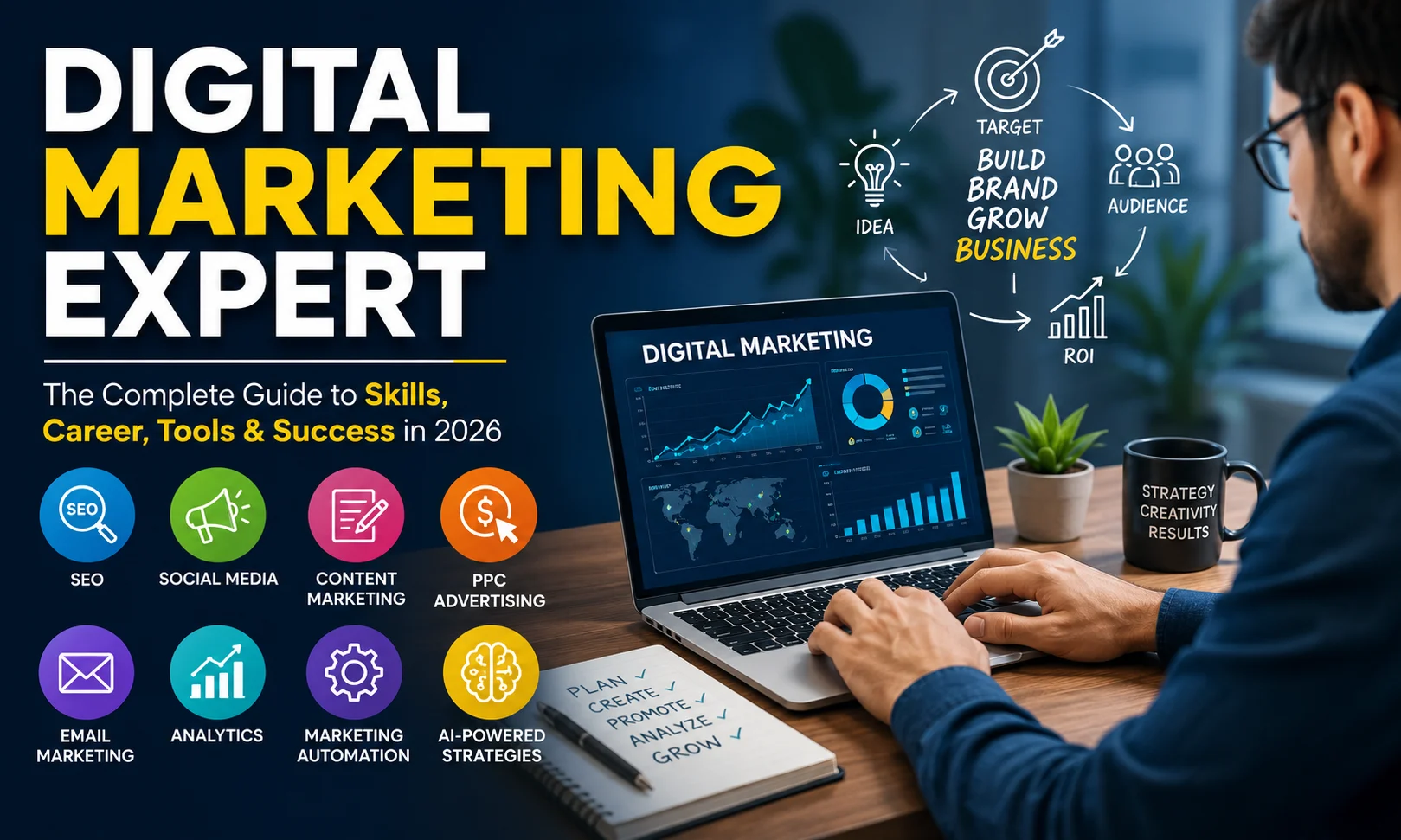
The digital world has transformed how businesses connect with customers. Whether someone is searching for a product on Google, scrolling through Instagram, watching YouTube videos, or opening promotional emails, digital marketing influences almost every online interaction.
As companies increasingly move their operations online, the demand for skilled Digital Marketing Experts continues to grow. From startups and local businesses to multinational corporations, organizations rely on experienced professionals to attract customers, build brand awareness, generate leads, and increase revenue.
A Digital Marketing Expert is much more than someone who posts on social media. They understand customer behavior, analyze data, optimize websites, create compelling content, run advertising campaigns, and continuously improve marketing performance using modern tools and AI-driven insights.
In 2026, digital marketing is one of the fastest-growing career fields worldwide. Businesses invest heavily in online marketing because it delivers measurable results, targeted reach, and better returns than many traditional marketing methods.
This comprehensive guide will help beginners, students, freelancers, entrepreneurs, and professionals understand everything required to become a successful Digital Marketing Expert.
Table of Contents
- Introduction
- What Is a Digital Marketing Expert?
- Why Digital Marketing Experts Are in High Demand
- Roles and Responsibilities of a Digital Marketing Expert
- Search Engine Optimization (SEO)
- Content Marketing
- Social Media Marketing
- Pay-Per-Click (PPC) Advertising
- Email Marketing
- Web Analytics and Reporting
- Essential Skills Every Digital Marketing Expert Needs
- SEO Skills
- Content Writing
- Communication Skills
- Data Analysis
- Creative Thinking
- Adaptability
- Types of Digital Marketing Experts
- SEO Expert
- PPC Expert
- Social Media Marketing Expert
- Content Marketing Specialist
- Email Marketing Specialist
- Marketing Automation Expert
- Educational Requirements
- Best Certifications for Digital Marketing Experts
- Step-by-Step Roadmap to Become a Digital Marketing Expert
- Best Digital Marketing Tools Every Expert Should Know
- How Artificial Intelligence (AI) Is Transforming Digital Marketing
- How to Build a Strong Personal Brand
- Freelancing as a Digital Marketing Expert
- Career Opportunities in Digital Marketing
- Digital Marketing Salary Trends in 2026
- Common Mistakes to Avoid
- Expert Tips for Long-Term Success
- Future of Digital Marketing Beyond 2026
- Why Businesses Need Digital Marketing Experts
- Final Thoughts
- Conclusion
- Frequently Asked Questions (FAQs)
What is a Digital Marketing Expert?
A Digital Marketing Expert is a professional who plans, executes, manages, and optimizes online marketing strategies to help businesses achieve specific goals such as:
- Increasing website traffic
- Generating quality leads
- Growing online sales
- Building brand awareness
- Improving customer engagement
- Enhancing search engine visibility
- Maximizing return on investment (ROI)
Unlike traditional marketing, digital marketing allows professionals to measure nearly every campaign. Experts monitor visitor behavior, conversion rates, advertising costs, user engagement, and customer journeys to improve results continuously.
A skilled digital marketing expert combines creativity with analytical thinking. They understand both technology and consumer psychology, enabling them to create campaigns that resonate with target audiences while achieving business objectives.
 SEO
SEO
Krishna Kushwaha| Jul 04, 2026| 16 min read
Digital Marketing Services: The Ultimate Guide to Growing Your Business Online in 2026
Why Digital Marketing Experts Are in High Demand
Digital transformation has accelerated across industries. Businesses now compete not only locally but also nationally and globally through online channels.
Several factors contribute to the growing demand for digital marketing professionals:
Businesses Need Online Visibility
Consumers typically begin their buying journey by searching online. If a business does not appear in search results or maintain an active online presence, it risks losing customers to competitors.
Digital marketing experts improve visibility through SEO, paid advertising, content marketing, and social media strategies.
Growth of E-commerce
Online shopping continues to expand rapidly across the world. E-commerce stores require digital marketers to:
- Increase traffic
- Optimize conversions
- Reduce advertising costs
- Improve customer retention
- Build email marketing campaigns
Without effective digital marketing, even the best products may struggle to reach potential customers.
AI and Marketing Automation
Artificial Intelligence has revolutionized digital marketing.
Experts now use AI tools to:
- Generate content ideas
- Analyze customer behavior
- Automate email campaigns
- Improve advertising performance
- Predict buying patterns
- Personalize customer experiences
Learning how to work alongside AI has become an essential skill rather than a replacement for marketers.
Data-Driven Decision Making
Modern businesses expect marketing decisions to be supported by data.
Digital marketing experts analyze metrics such as:
- Website traffic
- Click-through rate (CTR)
- Cost per acquisition (CPA)
- Conversion rate
- Customer lifetime value (CLV)
- Return on ad spend (ROAS)
This data helps organizations invest their marketing budgets more effectively.
Roles and Responsibilities of a Digital Marketing Expert
The daily responsibilities vary depending on company size, industry, and specialization. However, most digital marketing experts perform many of the following tasks.
Search Engine Optimization (SEO)
SEO improves a website’s visibility in search engine results.
Common SEO activities include:
- Keyword research
- Technical SEO audits
- On-page optimization
- Internal linking
- Content optimization
- Backlink strategy
- Competitor analysis
- Performance monitoring
SEO remains one of the most valuable long-term marketing strategies because it attracts organic traffic without paying for every click.
Content Marketing
Content is the foundation of successful digital marketing.
Experts create:
- Blog articles
- Landing pages
- Product descriptions
- Case studies
- Infographics
- Videos
- Email newsletters
- Whitepapers
- Guides
High-quality content builds authority while supporting SEO and lead generation.
Social Media Marketing
Social media platforms allow businesses to connect directly with audiences.
Responsibilities include:
- Content planning
- Graphic coordination
- Community management
- Influencer collaboration
- Paid promotions
- Analytics reporting
- Audience engagement
Successful social media marketing focuses on building relationships rather than simply publishing posts.
Paid Advertising
Digital marketing experts manage paid campaigns across multiple platforms.
These include:
- Google Ads
- Meta Ads
- LinkedIn Ads
- YouTube Ads
- Display advertising
- Remarketing campaigns
The objective is to maximize conversions while minimizing advertising costs.
Email Marketing
Email remains one of the highest-return marketing channels.
Experts manage:
- Subscriber segmentation
- Welcome sequences
- Promotional campaigns
- Newsletters
- Lead nurturing
- Automated workflows
- Performance optimization
Personalized emails often achieve significantly better engagement than generic campaigns.
Analytics and Reporting
Every campaign should be measured.
Digital marketing experts regularly review:
- Website performance
- User behavior
- Traffic sources
- Campaign ROI
- Conversion funnels
- Bounce rates
- Sales attribution
These insights guide future marketing decisions.
 SEO
SEO
Krishna Kushwaha| Jul 04, 2026| 14 min read
Digital Marketing Company – The Complete Guide to Growing Your Business Online in 2026
Essential Skills Every Digital Marketing Expert Needs
Success requires a combination of technical knowledge, creativity, communication, and strategic thinking.
Search Engine Optimization (SEO)
Understanding SEO is fundamental.
Important areas include:
- Keyword research
- Search intent
- Technical SEO
- Site architecture
- Core Web Vitals
- Structured data
- Local SEO
- Link building
SEO evolves constantly, making continuous learning essential.
Content Writing
Excellent content drives nearly every digital marketing strategy.
Professionals should know how to write:
- Blog posts
- Sales pages
- Product pages
- Ad copy
- Email campaigns
- Social media captions
- Video scripts
Clear, engaging writing improves both user experience and search performance.
Communication Skills
Digital marketers work with designers, developers, clients, sales teams, and management.
Strong communication helps:
- Explain campaign performance
- Present strategies
- Collaborate effectively
- Build client relationships
- Understand customer needs
Data Analysis
Marketing decisions should be based on evidence rather than assumptions.
Experts interpret analytics to identify:
- Successful campaigns
- Customer trends
- High-performing keywords
- Advertising opportunities
- Areas for improvement
Creative Thinking
Digital marketing combines logic with creativity.
Creative professionals develop:
- Unique campaign ideas
- Compelling headlines
- Visual storytelling
- Viral social content
- Brand messaging
- Customer engagement strategies
Adaptability
Search engine algorithms, advertising platforms, and consumer behavior change frequently.
Successful marketers embrace continuous learning and stay updated with industry developments.
Types of Digital Marketing Experts
Many professionals specialize in one area before expanding into full-service digital marketing.
SEO Expert
Focuses on improving search rankings, organic traffic, website optimization, and technical performance.
PPC Expert
Specializes in paid advertising campaigns across search engines and social media platforms.
Social Media Marketing Expert
Builds brand awareness, audience engagement, and social media growth strategies.
Email Marketing Specialist
Designs automated email campaigns that nurture leads and increase customer retention.
Content Marketing Expert
Creates educational, informative, and persuasive content that attracts and converts audiences.
Analytics Specialist
Uses data to evaluate marketing performance and recommend optimization strategies.
Marketing Automation Expert
Implements automated customer journeys, CRM integrations, lead scoring, and workflow optimization.
Educational Requirements
Unlike many professions, digital marketing does not require a specific university degree.
Many successful experts come from backgrounds such as:
- Business
- Marketing
- Computer Science
- Journalism
- Graphic Design
- Communications
- Economics
- Commerce
Employers increasingly value practical experience, certifications, portfolios, and measurable results over formal education alone.
 SEO
SEO
Krishna Kushwaha| Jul 04, 2026| 18 min read
Digital Marketing Agency: The Ultimate Guide to Growing Your Business Online in 2026
Certifications That Can Strengthen Your Career
Professional certifications demonstrate commitment to continuous learning.
Popular certification categories include:
- Search engine optimization
- Search advertising
- Analytics
- Content marketing
- Email marketing
- Social media marketing
- Marketing automation
- E-commerce marketing
- AI-assisted marketing
- Digital strategy
While certificates are valuable, practical implementation and successful campaigns remain the strongest indicators of expertise.
Beginner Roadmap to Become a Digital Marketing Expert
If you’re starting from scratch, follow this roadmap:
Step 1
Understand digital marketing fundamentals.
Step 2
Learn SEO and keyword research.
Step 3
Practice content writing regularly.
Step 4
Create your own website or blog.
Step 5
Learn website analytics.
Step 6
Understand social media marketing.
Step 7
Experiment with paid advertising.
Step 8
Build a portfolio showcasing real projects.
Step 9
Take internships or freelance projects.
Step 10
Continue learning as technology and marketing evolve.
Consistent practice is the fastest path to becoming a trusted digital marketing professional.
11. Best Digital Marketing Tools Every Expert Should Know
A successful digital marketing expert relies on the right combination of strategy and technology. Modern marketing tools help automate repetitive tasks, improve campaign performance, and provide valuable insights into customer behavior.
SEO Tools
SEO tools help marketers improve website visibility, identify keyword opportunities, monitor rankings, and analyze competitors.
Common features include:
- Keyword research
- Site audits
- Backlink analysis
- Competitor tracking
- Content optimization
- Technical SEO monitoring
- Rank tracking
- Broken link detection
Choosing the right SEO tools enables experts to make data-driven decisions rather than relying on guesswork.
Content Creation Tools
Content remains one of the strongest assets in digital marketing.
Experts use content tools to:
- Generate topic ideas
- Improve grammar
- Optimize readability
- Research trending topics
- Create images
- Design presentations
- Edit videos
- Repurpose existing content
High-quality content builds trust, improves SEO performance, and increases conversions.
Social Media Management Tools
Managing multiple social media accounts manually becomes difficult as businesses grow.
Social media management platforms help with:
- Content scheduling
- Calendar planning
- Team collaboration
- Analytics reporting
- Audience engagement
- Hashtag research
- Campaign tracking
Consistency is one of the biggest factors behind successful social media marketing.
Email Marketing Platforms
Email marketing remains one of the highest ROI digital marketing channels.
Experts use email platforms for:
- Automated campaigns
- Customer segmentation
- Personalized newsletters
- Welcome sequences
- Promotional emails
- Performance analytics
- A/B testing
Well-designed email campaigns can significantly improve customer retention and repeat purchases.
Analytics Platforms
Digital marketing is impossible without accurate measurement.
Analytics platforms help experts monitor:
- Website visitors
- User behavior
- Conversion rates
- Sales funnels
- Traffic sources
- Customer journeys
- Campaign effectiveness
The ability to interpret analytics separates average marketers from true experts.
12. How Artificial Intelligence Is Changing Digital Marketing
Artificial Intelligence (AI) has become one of the most influential technologies in digital marketing.
Rather than replacing marketers, AI enhances productivity by automating repetitive tasks and providing deeper insights.
AI can assist with:
- Content brainstorming
- Copywriting assistance
- Customer segmentation
- Chatbots
- Predictive analytics
- Advertising optimization
- Personalization
- Lead scoring
- Customer support
- Marketing automation
The most successful digital marketing experts combine human creativity with AI-powered efficiency.
13. How to Build a Strong Personal Brand as a Digital Marketing Expert
Your personal brand is often your strongest marketing asset.
A professional online presence increases trust and creates opportunities for freelance work, consulting, speaking engagements, and full-time employment.
Build a Professional Website
Your website should include:
- About page
- Portfolio
- Services
- Blog
- Testimonials
- Contact information
- Case studies
A website demonstrates your expertise better than simply listing skills on a resume.
Publish Valuable Content
Share knowledge consistently through:
- Blog articles
- LinkedIn posts
- YouTube videos
- Social media
- Email newsletters
- Industry insights
- Marketing tips
Educational content positions you as a trusted authority.
Create Case Studies
Instead of simply saying you improved results, show exactly how you achieved them.
A strong case study explains:
- The problem
- Your strategy
- Implementation
- Challenges
- Results
- Lessons learned
Real-world examples are often more persuasive than certifications.
 SEO
SEO
Krishna Kushwaha| Jul 04, 2026| 14 min read
Digital Marketing: The Complete Beginner’s Guide to Growing Your Business Online in 2026
14. Freelancing as a Digital Marketing Expert
Freelancing offers flexibility, independence, and unlimited earning potential.
Many professionals begin with part-time projects before transitioning into full-time consulting.
Popular freelance services include:
- SEO
- Website audits
- Content writing
- Google Ads management
- Social media management
- Email marketing
- Local SEO
- Marketing strategy
- Analytics reporting
- Website optimization
Freelancers who consistently deliver measurable results often grow through referrals and repeat clients.
15. Digital Marketing Career Opportunities
Digital marketing offers a wide range of career paths.
Popular job roles include:
- Digital Marketing Executive
- SEO Specialist
- SEO Manager
- PPC Specialist
- Performance Marketing Manager
- Social Media Manager
- Content Strategist
- Email Marketing Specialist
- Marketing Automation Specialist
- Digital Marketing Manager
- Growth Marketer
- Conversion Rate Optimization Specialist
- E-commerce Marketing Manager
- Brand Marketing Manager
- Marketing Consultant
- Digital Marketing Trainer
- Agency Owner
As experience grows, professionals can move into leadership roles or launch their own agencies.
16. Salary Expectations in 2026
Digital marketing salaries depend on several factors, including:
- Experience
- Skills
- Certifications
- Industry
- Company size
- Geographic location
- Portfolio
- Specialization
Professionals with expertise in SEO, performance marketing, analytics, automation, and AI-assisted marketing often command higher salaries.
Freelancers and consultants may earn more than salaried employees if they build a strong client base and deliver consistent results.
17. Common Mistakes New Digital Marketing Experts Should Avoid
Many beginners slow their progress by making avoidable mistakes.
Trying to Learn Everything at Once
Focus on mastering one skill before expanding into additional specializations.
Ignoring Analytics
Without measuring results, it’s impossible to know whether campaigns are successful.
Publishing Low-Quality Content
Content should solve problems, answer questions, and provide value instead of targeting keywords alone.
Neglecting SEO Basics
Even excellent content may struggle if technical SEO, page speed, and internal linking are ignored.
Depending Only on Paid Advertising
Paid ads can generate quick traffic, but organic marketing builds long-term stability.
Not Building a Portfolio
Employers and clients prefer demonstrated results over theoretical knowledge.
Stopping Learning
Digital marketing evolves rapidly.
Successful experts continually learn new platforms, technologies, and strategies.
18. Tips to Become a Top Digital Marketing Expert
If your goal is long-term success, follow these principles.
Keep Learning
Read industry blogs, attend webinars, watch tutorials, and practice regularly.
Build Real Projects
Create websites, optimize pages, run campaigns, and analyze results.
Hands-on experience accelerates learning.
Learn Consumer Psychology
Understanding customer behavior improves every marketing channel.
Focus on Problem Solving
Businesses hire marketers to solve problems rather than simply perform tasks.
Network with Professionals
Participate in online communities, conferences, and professional groups.
Networking often creates unexpected career opportunities.
Stay Updated
Search engine algorithms, AI tools, and advertising platforms evolve constantly.
Continuous improvement is essential.
19. Future of Digital Marketing Beyond 2026
Digital marketing will continue evolving with new technologies.
Emerging trends include:
- AI-powered personalization
- Voice search optimization
- Visual search
- Interactive content
- Predictive analytics
- Privacy-focused marketing
- First-party data strategies
- Marketing automation
- Conversational AI
- Augmented reality experiences
- Video-first marketing
- Omnichannel customer journeys
Experts who embrace innovation while maintaining strong marketing fundamentals will remain highly valuable.
20. Why Businesses Need Digital Marketing Experts
Businesses increasingly depend on digital experts because online competition continues to intensify.
Digital marketing professionals help companies:
- Increase website traffic
- Generate qualified leads
- Improve sales
- Reduce advertising waste
- Build customer loyalty
- Strengthen brand recognition
- Expand into new markets
- Improve customer experience
- Measure marketing performance
- Increase profitability
Their role extends beyond promotion—they contribute directly to sustainable business growth.
 SEO
SEO
Krishna Kushwaha| Jul 12, 2026| 19 min read
Digital Marketing Strategy: The Complete Guide to Building a Successful Online Marketing Plan in 2026
Final Thoughts
A digital marketing expert combines creativity, analytical thinking, strategic planning, technical knowledge, and a passion for continuous learning. Success does not happen overnight; it is built through consistent practice, experimentation, and adaptation to new technologies.
Whether you aspire to become an SEO specialist, social media strategist, performance marketer, content creator, consultant, freelancer, or agency owner, the opportunities in digital marketing are greater than ever. Businesses of all sizes require professionals who can drive measurable results, making this one of the most rewarding and future-proof career paths.
The key to standing out is not just mastering tools but understanding people. By creating valuable content, making informed decisions based on data, leveraging AI responsibly, and delivering measurable business outcomes, you can establish yourself as a trusted digital marketing expert in 2026 and beyond.
Conclusion
Digital marketing has become one of the most essential business functions in today’s digital-first world. As companies increasingly rely on online channels to attract, engage, and retain customers, the role of a Digital Marketing Expert continues to grow in importance. From search engine optimization (SEO) and content marketing to social media management, paid advertising, email marketing, analytics, and AI-powered automation, successful digital marketers combine creativity with data-driven decision-making to deliver measurable business results.
Becoming a digital marketing expert is not about mastering a single skill—it’s about continuously learning, adapting to new technologies, and understanding customer behavior. The digital landscape evolves rapidly, with search engine algorithms, marketing platforms, and consumer expectations changing every year. Professionals who embrace innovation, stay updated with industry trends, and consistently improve their knowledge will remain highly competitive and in demand.
Whether you are a student exploring career opportunities, a freelancer building a personal brand, an entrepreneur growing your business, or a professional looking to upgrade your skills, digital marketing offers unlimited potential for career growth and financial success. By developing practical experience, building a strong portfolio, earning relevant certifications, and focusing on delivering value, you can establish yourself as a trusted expert in the industry.
The future of digital marketing belongs to professionals who combine strategic thinking, technical expertise, and customer-centric marketing approaches. Start with the fundamentals, practice consistently, measure your results, and never stop learning. With dedication and the right mindset, you can build a rewarding career as a successful Digital Marketing Expert and help businesses thrive in the ever-evolving digital economy.
Frequently Asked Questions (FAQs) About Digital Marketing Experts
A Digital Marketing Expert is a professional who develops, manages, and optimizes online marketing strategies to help businesses increase their online visibility, generate leads, improve brand awareness, and drive sales. Their work spans multiple digital channels, including search engines, social media platforms, email marketing, content marketing, and paid advertising.
The responsibilities of a digital marketing expert typically include conducting keyword research, optimizing websites for search engines (SEO), creating engaging content, managing Google Ads and social media advertising campaigns, analyzing website traffic, tracking campaign performance, and improving conversion rates. They also use analytics tools to measure results and make data-driven decisions that maximize return on investment (ROI).
In today’s competitive digital landscape, businesses of all sizes rely on digital marketing experts to connect with their target audience effectively. Whether working as an employee, freelancer, consultant, or agency owner, a skilled digital marketing expert plays a vital role in helping organizations achieve sustainable online growth and stay ahead of their competitors.
Becoming a successful Digital Marketing Expert requires continuous learning, practical experience, and staying updated with the latest industry trends. Beginners should first understand the fundamentals of digital marketing, including SEO, content marketing, social media marketing, email marketing, pay-per-click (PPC) advertising, and web analytics.
After learning the basics, create your own website or blog to practice SEO, publish content regularly, and monitor website performance using analytics tools. Working on real projects is one of the fastest ways to gain valuable experience and build confidence.
Professional certifications from recognized platforms can strengthen your resume, but employers and clients often value practical skills and measurable results more than certificates alone. Building a portfolio with successful campaigns, case studies, and client testimonials significantly increases your credibility.
In 2026, learning AI-powered marketing tools, automation platforms, and data analysis techniques is also essential. Successful marketers continuously improve their skills, adapt to changes in search engine algorithms, and focus on solving real business problems rather than simply using marketing tools.
A Digital Marketing Expert needs a balanced combination of technical, analytical, and creative skills. Search Engine Optimization (SEO) remains one of the most important competencies because it helps websites rank higher in search results and attract organic traffic. Content writing is equally valuable, as high-quality content supports SEO, engages audiences, and builds brand authority.
Experts should also understand social media marketing, paid advertising, email marketing, conversion rate optimization (CRO), and web analytics. Strong analytical skills enable marketers to interpret campaign data, measure performance, and make informed decisions that improve results.
Communication, problem-solving, creativity, project management, and adaptability are equally important. Since digital marketing evolves rapidly, professionals must stay informed about new technologies, AI tools, automation platforms, privacy regulations, and changing consumer behavior.
Developing both technical expertise and soft skills ensures long-term career success and allows marketers to create effective strategies that deliver measurable business outcomes.
Yes, digital marketing is considered one of the fastest-growing and most rewarding career options in 2026. As businesses continue shifting toward online operations, the demand for skilled digital marketing professionals has increased across industries such as e-commerce, healthcare, education, finance, travel, real estate, and technology.
A career in digital marketing offers diverse opportunities, including roles such as SEO Specialist, Content Strategist, Social Media Manager, PPC Expert, Performance Marketing Manager, Email Marketing Specialist, Marketing Analyst, Digital Marketing Manager, and Marketing Consultant. Professionals can also choose freelancing, remote work, or start their own digital marketing agency.
One of the biggest advantages of digital marketing is its flexibility. Individuals can work with clients from around the world, build multiple income streams, and specialize in areas that match their interests and strengths. Since the industry constantly evolves with AI, automation, and new digital platforms, professionals who commit to continuous learning can enjoy excellent career growth, competitive salaries, and long-term job security.
Artificial Intelligence (AI) has transformed the way digital marketing experts plan, execute, and optimize campaigns. AI-powered tools help marketers automate repetitive tasks, analyze large amounts of customer data, personalize user experiences, and improve overall campaign efficiency.
For example, AI can assist with keyword research, content ideation, copywriting support, customer segmentation, predictive analytics, chatbot interactions, email automation, ad targeting, and performance optimization. These technologies allow marketers to save time while making more accurate, data-driven decisions.
However, AI is not a replacement for human creativity and strategic thinking. Successful digital marketing experts combine AI-generated insights with their own expertise to create authentic content, understand customer emotions, build strong brand identities, and solve complex business challenges.
As AI technology continues to evolve, marketers who learn how to use these tools effectively will gain a significant competitive advantage. The future of digital marketing lies in combining human creativity, ethical marketing practices, and AI-powered efficiency to deliver exceptional customer experiences and sustainable business growth.
Leave a Reply