Introduction
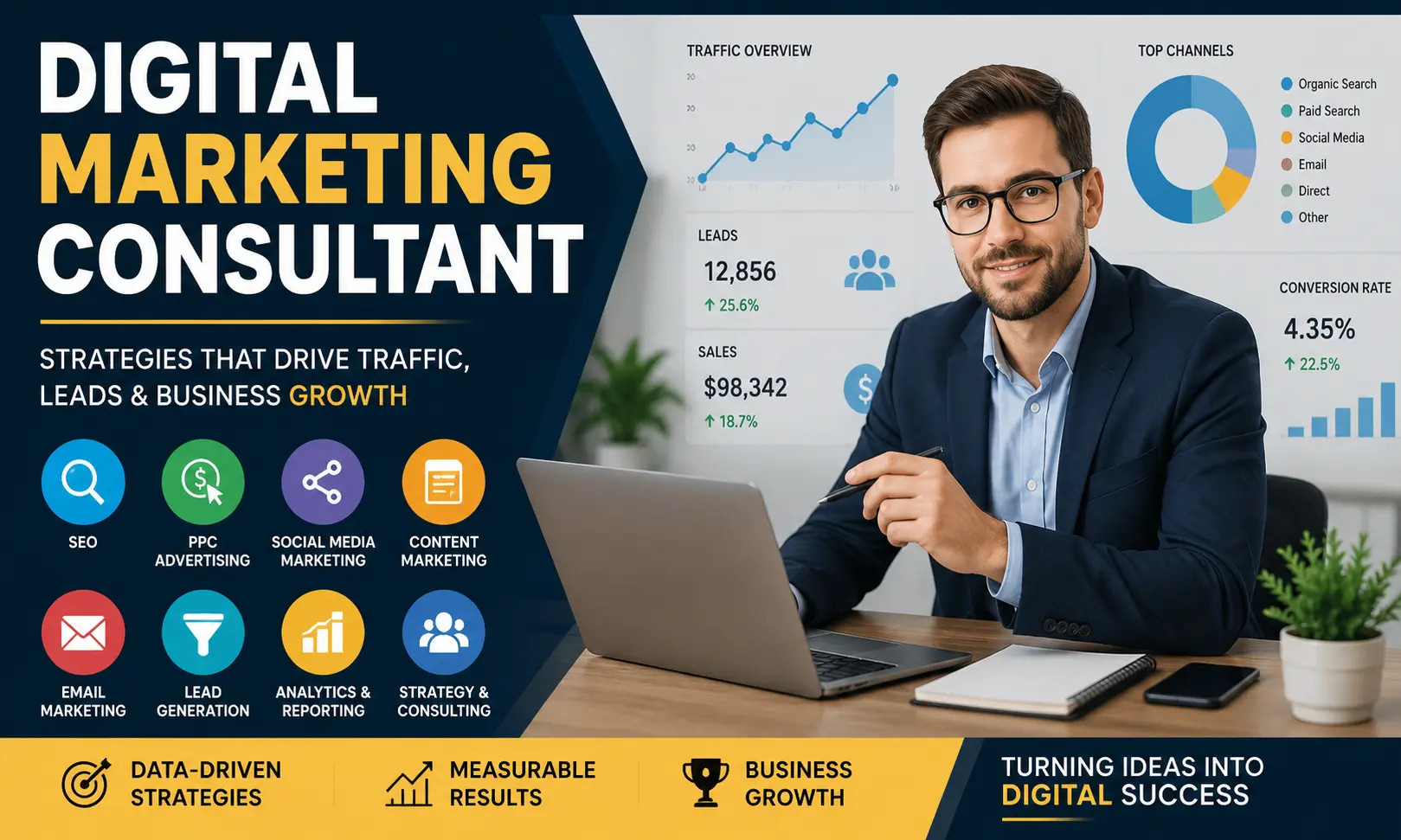
In today’s highly competitive online marketplace, simply having a website or social media presence is no longer enough. Businesses of every size must develop effective digital marketing strategies to attract visitors, generate qualified leads, and convert them into loyal customers. This is where a Digital Marketing Consultant becomes an invaluable asset.
A digital marketing consultant is an experienced professional who helps businesses create, implement, optimize, and scale online marketing campaigns. Their primary objective is to improve online visibility, increase website traffic, generate quality leads, and maximize return on investment (ROI).
As digital platforms continue evolving in 2026, companies face new challenges such as AI-driven search engines, changing Google algorithms, privacy regulations, voice search, and increasing competition. A consultant stays ahead of these trends and helps businesses remain competitive while minimizing costly marketing mistakes.
Whether you own a local business, startup, eCommerce store, SaaS company, educational platform, healthcare clinic, or enterprise organization, hiring a professional digital marketing consultant can significantly improve your marketing performance.
In this comprehensive guide, you’ll learn everything about digital marketing consulting—from core responsibilities and essential skills to strategic planning and business growth techniques.
Table of Contents
- Introduction
- What Is a Digital Marketing Consultant?
- Why Every Business Needs a Digital Marketing Consultant
- Key Roles and Responsibilities of a Digital Marketing Consultant
- Essential Skills Every Digital Marketing Consultant Must Have
- Core Digital Marketing Consulting Services
- SEO Consulting
- PPC Consulting
- Social Media Consulting
- Content Marketing Consulting
- Email Marketing Consulting
- Marketing Automation
- Benefits of Hiring a Digital Marketing Consultant
- How Digital Marketing Consultants Build Winning Strategies
- Digital Marketing Consultant vs. Digital Marketing Agency vs. Freelancer
- Digital Marketing Consultant Pricing Models
- Step-by-Step Digital Marketing Consulting Process
- Best Tools Every Digital Marketing Consultant Uses
- AI and the Future of Digital Marketing Consulting in 2026
- Common Mistakes Businesses Make
- Tips for Choosing the Right Digital Marketing Consultant
- Final Thoughts
- Conclusion
- Frequently Asked Questions (FAQs)
What Is a Digital Marketing Consultant?
A Digital Marketing Consultant is an expert who analyzes a business’s online presence, identifies opportunities for improvement, and develops customized digital marketing strategies to achieve measurable business goals.
Unlike general marketers who focus on executing day-to-day marketing tasks, consultants primarily concentrate on:
- Strategic planning
- Marketing audits
- Campaign optimization
- Performance analysis
- Revenue growth
- Customer acquisition
- Brand positioning
They collaborate closely with business owners, internal marketing teams, designers, developers, and sales professionals to create integrated marketing systems that consistently generate leads and sales.
A consultant doesn’t simply run advertisements or publish social media posts—they evaluate every aspect of the customer journey.
Their work includes:
- Understanding customer behavior
- Researching competitors
- Improving website performance
- Enhancing SEO
- Building marketing funnels
- Increasing conversion rates
- Measuring campaign success
The ultimate goal is sustainable business growth rather than temporary spikes in traffic.
 SEO
SEO
Krishna Kushwaha| Jul 12, 2026| 19 min read
Digital Marketing Expert: The Ultimate Guide to Becoming a Successful Digital Marketing Professional in 2026
Why Every Business Needs a Digital Marketing Consultant
Consumer behavior has changed dramatically over the past decade. Today, buyers research products online before making purchasing decisions. If your business doesn’t appear where customers are searching, competitors will capture those opportunities.
A digital marketing consultant helps businesses:
- Increase online visibility
- Generate qualified leads
- Improve conversion rates
- Reduce marketing waste
- Build stronger brands
- Enhance customer engagement
- Increase revenue
- Improve marketing ROI
Rather than relying on guesswork, consultants use data, analytics, and proven marketing frameworks to make informed decisions.
For example, instead of spending thousands of dollars on ineffective advertising, a consultant identifies the highest-performing marketing channels and allocates budget strategically.
This results in:
- Lower acquisition costs
- Higher conversion rates
- Better customer retention
- Increased profitability
Key Roles and Responsibilities of a Digital Marketing Consultant
A consultant wears many hats throughout the marketing process.
1. Marketing Strategy Development
Every successful business starts with a clear strategy.
Consultants analyze:
- Business goals
- Industry trends
- Target audience
- Competitors
- Marketing budget
- Current performance
They then create customized marketing roadmaps aligned with business objectives.
2. Website Audit
Your website serves as your digital storefront.
Consultants evaluate:
- User experience (UX)
- Navigation
- Loading speed
- Mobile responsiveness
- Technical SEO
- Landing pages
- Conversion opportunities
- Call-to-action placement
Small website improvements often lead to significant increases in conversions.
3. Search Engine Optimization (SEO)
Organic search remains one of the highest ROI marketing channels.
Consultants improve:
- Keyword strategy
- Technical SEO
- On-page optimization
- Internal linking
- Content optimization
- Backlink strategy
- Core Web Vitals
- Local SEO
A well-executed SEO strategy can drive consistent, long-term traffic without relying solely on paid advertising.
4. Content Marketing
High-quality content builds trust and authority.
Consultants create strategies for:
- Blog posts
- Landing pages
- Case studies
- White papers
- Video content
- Email newsletters
- Social media content
- Infographics
Effective content addresses customer questions while guiding prospects through the buying journey.
5. Paid Advertising Management
Paid campaigns deliver immediate visibility when managed correctly.
Consultants oversee:
- Google Ads
- Search campaigns
- Display advertising
- YouTube Ads
- Meta Ads
- LinkedIn Ads
- Retargeting campaigns
- Shopping Ads
They continuously optimize campaigns to reduce cost per click (CPC) and increase conversions.
6. Social Media Strategy
Modern consumers expect brands to maintain active social media profiles.
Consultants help businesses:
- Choose appropriate platforms
- Develop content calendars
- Increase engagement
- Build communities
- Improve brand awareness
- Generate leads
- Measure campaign performance
Rather than chasing vanity metrics, consultants focus on business outcomes.
7. Email Marketing
Email remains one of the highest-performing marketing channels.
Consultants create:
- Welcome sequences
- Lead nurturing campaigns
- Promotional emails
- Customer retention campaigns
- Abandoned cart emails
- Newsletter strategies
Personalized email campaigns often produce excellent ROI.
8. Analytics and Reporting
Data-driven decision-making separates successful businesses from struggling competitors.
Consultants monitor:
- Website traffic
- Conversion rates
- Lead generation
- Sales funnels
- Customer acquisition cost
- Return on ad spend (ROAS)
- Customer lifetime value
- Revenue growth
Monthly reporting helps businesses understand what’s working and what requires improvement.
 SEO
SEO
Krishna Kushwaha| Jul 12, 2026| 19 min read
Digital Marketing Strategy: The Complete Guide to Building a Successful Online Marketing Plan in 2026
Essential Skills Every Digital Marketing Consultant Must Have
The best consultants combine technical expertise with business strategy.
SEO Expertise
Understanding search engine optimization remains essential.
They should know:
- Keyword research
- Technical SEO
- Schema markup
- Content optimization
- Link building
- Search intent
- AI search optimization
Paid Advertising
Strong consultants understand multiple advertising platforms including:
- Google Ads
- Meta Ads
- LinkedIn Ads
- Microsoft Ads
- YouTube Advertising
They know how to optimize campaigns for maximum ROI.
Analytics
Consultants must interpret data accurately.
Essential tools include:
- Google Analytics 4
- Google Search Console
- Looker Studio
- Heatmaps
- CRM reporting
Without analytics, marketing becomes guesswork.
Copywriting
Persuasive writing improves:
- Landing pages
- Advertisements
- Emails
- Product descriptions
- Sales pages
- Blog articles
Great copy converts visitors into customers.
Conversion Rate Optimization (CRO)
Traffic alone doesn’t generate revenue.
Consultants improve:
- Landing pages
- Calls-to-action
- Forms
- User experience
- Checkout processes
- Sales funnels
Even small improvements in conversion rates can dramatically increase profits.
Strategic Thinking
Successful consultants understand business objectives.
Instead of chasing traffic numbers, they focus on:
- Revenue
- Customer growth
- Market share
- Profitability
- Long-term sustainability
Core Digital Marketing Consulting Services
Professional consultants typically offer a range of services tailored to business needs.
SEO Consulting
- Website audits
- Keyword research
- Content strategy
- Link building
- Technical optimization
- Local SEO
PPC Consulting
Services include:
- Google Ads setup
- Campaign optimization
- Budget planning
- Keyword targeting
- Remarketing
- Performance reporting
Social Media Consulting
Consultants help businesses:
- Build brand awareness
- Increase engagement
- Generate leads
- Improve customer relationships
- Create content strategies
Content Marketing Consulting
Includes:
- Editorial planning
- SEO blog strategy
- Topic research
- Content optimization
- Lead magnets
- Video strategy
Email Marketing Consulting
Services include:
- Automation
- Segmentation
- Campaign planning
- Personalization
- A/B testing
- Performance analysis
Marketing Automation
Modern consultants increasingly use automation platforms to:
- Score leads
- Automate emails
- Schedule social media
- Improve CRM workflows
- Track customer journeys
Automation improves efficiency while maintaining personalized customer experiences.
 SEO
SEO
Krishna Kushwaha| Jul 10, 2026| 20 min read
Digital Advertising: The Complete Guide to Growing Your Business Online in 2026
Benefits of Hiring a Digital Marketing Consultant
Businesses that hire experienced consultants often experience measurable improvements in marketing performance.
Access to Specialized Expertise
Instead of learning every marketing discipline internally, businesses gain immediate access to years of professional experience.
Cost Savings
Hiring a full in-house marketing team can be expensive.
A consultant provides strategic guidance without the long-term costs associated with full-time employees.
Faster Results
Experienced consultants avoid common mistakes and implement proven strategies that accelerate growth.
Objective Perspective
Internal teams may overlook opportunities.
Consultants provide unbiased assessments and identify hidden growth potential.
Improved Marketing ROI
Every marketing dollar should generate measurable returns.
Consultants optimize campaigns to maximize profitability while reducing wasted advertising spend.
Scalability
As businesses grow, consultants adjust strategies to support expansion into new markets, products, and customer segments.
How Digital Marketing Consultants Build Winning Strategies
A successful marketing strategy is never based on assumptions. It follows a structured process designed to achieve measurable business goals.
The typical framework includes:
Step 1: Business Discovery
Consultants begin by understanding:
- Company objectives
- Products or services
- Revenue goals
- Target audience
- Current challenges
- Competitive landscape
Step 2: Digital Marketing Audit
Next, they evaluate existing assets:
- Website performance
- SEO health
- Advertising campaigns
- Social media activity
- Email marketing
- Analytics setup
- Conversion funnels
This audit identifies strengths, weaknesses, and opportunities.
Step 3: Market & Competitor Research
Consultants analyze:
- Industry trends
- Customer search behavior
- Competitor keywords
- Content gaps
- Advertising strategies
- Pricing models
Research ensures marketing decisions are based on evidence rather than assumptions.
Digital Marketing Consultant vs. Digital Marketing Agency vs. Freelancer
One of the most common questions businesses ask is whether they should hire a digital marketing consultant, work with a digital marketing agency, or outsource projects to a freelancer. Each option has its own strengths, and the right choice depends on your goals, budget, and business stage.
| Feature | Digital Marketing Consultant | Agency | Freelancer |
|---|---|---|---|
| Strategic Planning | Excellent | Good | Limited |
| Team Support | Limited | Excellent | Individual |
| Cost | Medium | High | Low |
| Personal Attention | Excellent | Moderate | High |
| Scalability | High | Very High | Moderate |
| Long-Term Growth | Excellent | Excellent | Good |
When to Hire a Consultant
A consultant is the ideal choice if you:
- Need a complete marketing strategy
- Want to improve ROI
- Have an in-house marketing team that needs guidance
- Need expert advice before investing heavily in advertising
- Want long-term business growth
When an Agency Makes Sense
An agency is better if you require:
- Full-service marketing
- Large advertising budgets
- Multiple specialists
- Website design and development
- Video production
- Large-scale campaigns
When a Freelancer Is Best
Freelancers are suitable for:
- Small projects
- Blog writing
- Graphic design
- Website updates
- Social media posting
- Limited budgets
 SEO
SEO
Krishna Kushwaha| Jul 10, 2026| 18 min read
Internet Marketing: The Ultimate Guide to Growing Your Business Online in 2026
Digital Marketing Consultant Pricing Models
Consultants offer different pricing structures depending on project complexity and business needs.
Hourly Rate
Businesses pay for the consultant’s time.
Typical services include:
- Marketing audits
- Training sessions
- Strategy meetings
- SEO consultation
Ideal for businesses needing occasional expert guidance.
Monthly Retainer
Many consultants work on a monthly basis.
Monthly services often include:
- SEO optimization
- Campaign monitoring
- Performance reporting
- Strategy meetings
- Content planning
- Marketing improvements
This model is popular because digital marketing requires continuous optimization.
Project-Based Pricing
Some businesses hire consultants for specific projects such as:
- Website launch
- SEO audit
- Marketing strategy
- Brand positioning
- Lead generation systems
- Product launch campaigns
Performance-Based Pricing
Some experienced consultants charge based on results.
Performance metrics may include:
- Leads generated
- Revenue growth
- Sales increases
- Conversion improvements
This model aligns consultant incentives with business success.
Step-by-Step Digital Marketing Consulting Process
Professional consultants follow a structured process to maximize marketing performance.
Step 1: Business Discovery
Every project begins with understanding the business.
Consultants analyze:
- Business goals
- Target audience
- Current marketing
- Competitors
- Revenue objectives
- Existing challenges
Without clear goals, marketing campaigns often fail.
Step 2: Digital Marketing Audit
A comprehensive audit identifies strengths and weaknesses.
Areas reviewed include:
- Website SEO
- Page speed
- Mobile responsiveness
- Content quality
- Keyword rankings
- Backlink profile
- Social media
- Advertising campaigns
- Email marketing
- Analytics
This audit forms the foundation for future improvements.
Step 3: Competitor Analysis
Consultants study successful competitors.
They evaluate:
- Keyword strategy
- Website structure
- Content quality
- Advertising campaigns
- Social media engagement
- Customer reviews
- Product positioning
Learning from competitors helps identify opportunities and avoid mistakes.
Step 4: Marketing Strategy Development
Using collected data, consultants create customized marketing plans.
These strategies define:
- Marketing channels
- Budget allocation
- Target keywords
- Content calendar
- Advertising strategy
- Lead generation process
- KPIs and goals
Every recommendation should align with measurable business outcomes.
Step 5: Campaign Implementation
After planning, consultants begin execution.
Tasks may include:
- SEO improvements
- Google Ads setup
- Social media campaigns
- Email automation
- Landing page optimization
- Conversion tracking
Implementation follows a prioritized roadmap.
Step 6: Continuous Optimization
Digital marketing is never a one-time task.
Consultants regularly:
- Test campaigns
- Improve ad copy
- Optimize landing pages
- Update content
- Refine targeting
- Monitor rankings
- Adjust budgets
Continuous optimization leads to sustained growth.
Step 7: Reporting and Growth Planning
Regular reporting helps businesses understand performance.
Important metrics include:
- Website traffic
- Organic rankings
- Conversion rate
- Leads generated
- Cost per acquisition (CPA)
- Return on Ad Spend (ROAS)
- Revenue
- Customer Lifetime Value (CLV)
Reports should focus on business impact rather than vanity metrics.
Best Tools Every Digital Marketing Consultant Uses
Modern consultants rely on professional tools to improve efficiency and decision-making.
SEO Tools
Popular platforms include:
- Google Search Console
- Google Analytics 4
- Ahrefs
- Semrush
- Screaming Frog
- Moz
These tools help with keyword research, site audits, backlink analysis, and technical SEO.
PPC Tools
Paid advertising tools include:
- Google Ads
- Microsoft Ads
- Meta Ads Manager
- LinkedIn Campaign Manager
These platforms enable precise audience targeting and campaign optimization.
Content Marketing Tools
Useful tools include:
- ChatGPT (for ideation and drafting)
- Grammarly
- Canva
- Notion
- Trello
They support content planning, editing, collaboration, and design.
Analytics and Reporting
Consultants commonly use:
- Google Analytics 4
- Looker Studio
- Hotjar
- Microsoft Clarity
These tools reveal user behavior and campaign performance.
Email Marketing Platforms
Popular options are:
- Mailchimp
- Brevo
- ConvertKit
- ActiveCampaign
- Klaviyo
These platforms automate email sequences and improve customer engagement.
AI and the Future of Digital Marketing Consulting (2026)
Artificial intelligence is reshaping digital marketing, but it is not replacing experienced consultants. Instead, it enhances their ability to make data-driven decisions and automate repetitive tasks.
AI-Assisted Content Creation
AI helps generate:
- Blog outlines
- Ad copy
- Product descriptions
- Social media captions
- Email drafts
Consultants refine this content to ensure originality, brand consistency, and accuracy.
Predictive Analytics
AI can analyze customer behavior and forecast:
- Purchase intent
- Seasonal demand
- Churn risk
- Campaign performance
This enables businesses to make proactive marketing decisions.
Marketing Automation
Automation tools streamline:
- Lead nurturing
- Email campaigns
- CRM updates
- Customer segmentation
- Personalized messaging
Automation saves time while improving customer experiences.
Voice and Visual Search
As voice assistants and image-based search continue to grow, consultants increasingly optimize content for:
- Conversational keywords
- FAQ-rich pages
- Structured data (schema)
- Image SEO
- Local search intent
Privacy and First-Party Data
With increasing privacy regulations and reduced third-party tracking, consultants focus more on:
- First-party data collection
- Consent-based marketing
- Email list growth
- Customer loyalty programs
Common Mistakes Businesses Make
Many businesses struggle with digital marketing because they repeat avoidable mistakes.
Some of the most common include:
- Running ads without a clear strategy
- Ignoring SEO
- Publishing low-quality content
- Failing to track conversions
- Targeting the wrong audience
- Not optimizing for mobile devices
- Inconsistent branding
- Neglecting email marketing
- Expecting instant results
- Making decisions without data
Avoiding these mistakes can significantly improve marketing performance and return on investment.
Final Thoughts
A digital marketing consultant is more than a marketing expert—they are a strategic partner who helps businesses grow through informed planning, continuous optimization, and measurable results.
Whether you’re a startup looking to build an online presence or an established business aiming to scale, working with the right consultant can help you:
- Increase qualified traffic
- Generate more leads
- Improve customer retention
- Maximize advertising efficiency
- Strengthen your brand
- Achieve sustainable long-term growth
The most successful businesses in 2026 are those that combine technology, creativity, analytics, and customer-focused strategies.
Conclusion
Digital marketing is constantly evolving, and businesses that rely on outdated tactics risk falling behind. A skilled digital marketing consultant provides the expertise needed to navigate changing algorithms, emerging technologies, and shifting consumer behavior.
From SEO and content marketing to paid advertising, analytics, and AI-driven optimization, consultants play a vital role in helping businesses build stronger online visibility and achieve measurable business success.
Choosing the right consultant is not simply an expense—it’s an investment in your company’s future. By focusing on strategic planning, data-driven decisions, and continuous improvement, businesses can create scalable marketing systems that generate lasting results.
As we move through 2026 and beyond, organizations that embrace innovation and expert guidance will be best positioned to compete, grow, and thrive in the digital economy.
Frequently Asked Questions (FAQs)
A digital marketing consultant is a professional who helps businesses improve their online presence and achieve marketing goals through strategic planning and data-driven campaigns. Their responsibilities include conducting website audits, performing keyword research, improving search engine optimization (SEO), managing pay-per-click (PPC) advertising, creating content strategies, optimizing conversion rates, and analyzing campaign performance. Unlike a traditional marketer who may focus on daily execution, a consultant develops customized strategies that align with business objectives. They also monitor industry trends, recommend new marketing opportunities, and continuously optimize campaigns to maximize return on investment (ROI). Whether working with a startup, local business, or large enterprise, a digital marketing consultant provides expert guidance to increase website traffic, generate qualified leads, and improve overall business growth.
Hiring a digital marketing consultant offers businesses access to specialized knowledge and years of industry experience without the expense of building a full in-house marketing team. Consultants bring an objective perspective, identify weaknesses in existing strategies, and recommend proven solutions based on analytics rather than assumptions. They stay updated with the latest Google algorithm changes, AI-powered marketing tools, SEO best practices, and digital advertising trends, ensuring that businesses remain competitive. A consultant can also save time by creating clear marketing roadmaps, improving campaign efficiency, reducing wasted advertising spend, and focusing on high-return strategies. For businesses that lack dedicated marketing expertise or need strategic direction, working with a consultant often results in faster growth, better lead generation, and a higher return on marketing investment.
A digital marketing consultant provides a wide range of services tailored to a company’s goals and target audience. Common services include SEO audits and optimization, keyword research, technical SEO improvements, local SEO, content marketing strategy, blog planning, Google Ads management, social media marketing, email marketing automation, conversion rate optimization (CRO), competitor analysis, analytics reporting, and marketing strategy development. Some consultants also specialize in eCommerce marketing, branding, lead generation, AI-driven marketing automation, and sales funnel optimization. The exact services depend on the consultant’s expertise and the business’s requirements, but the primary objective is always to improve online visibility, attract more qualified customers, and increase revenue through measurable marketing initiatives.
The time required to see measurable results depends on the marketing channels being used and the current state of the business’s online presence. Paid advertising campaigns such as Google Ads or social media ads may begin generating leads within a few days or weeks after launch. In contrast, SEO, content marketing, and organic growth strategies generally require three to six months before significant improvements in rankings, website traffic, and conversions become visible. Long-term success also depends on consistent optimization, quality content creation, website performance, and regular analysis of campaign data. A skilled digital marketing consultant sets realistic expectations, tracks key performance indicators (KPIs), and continuously adjusts strategies to ensure sustainable business growth rather than relying on short-term gains.
Selecting the right digital marketing consultant requires careful evaluation of their experience, expertise, communication skills, and proven results. Begin by reviewing their portfolio, client testimonials, case studies, and certifications. Ask about their experience in your industry, the marketing tools they use, and how they measure campaign success. A reliable consultant should provide a customized strategy instead of offering generic solutions for every client. They should also explain their reporting process, key performance metrics, expected timelines, and pricing structure. Transparency, clear communication, and a focus on measurable business outcomes are essential qualities to look for. By choosing a consultant with a strong track record and a data-driven approach, businesses can build long-term marketing strategies that increase brand awareness, generate more leads, improve customer retention, and drive consistent revenue growth.
Leave a Reply