Introduction
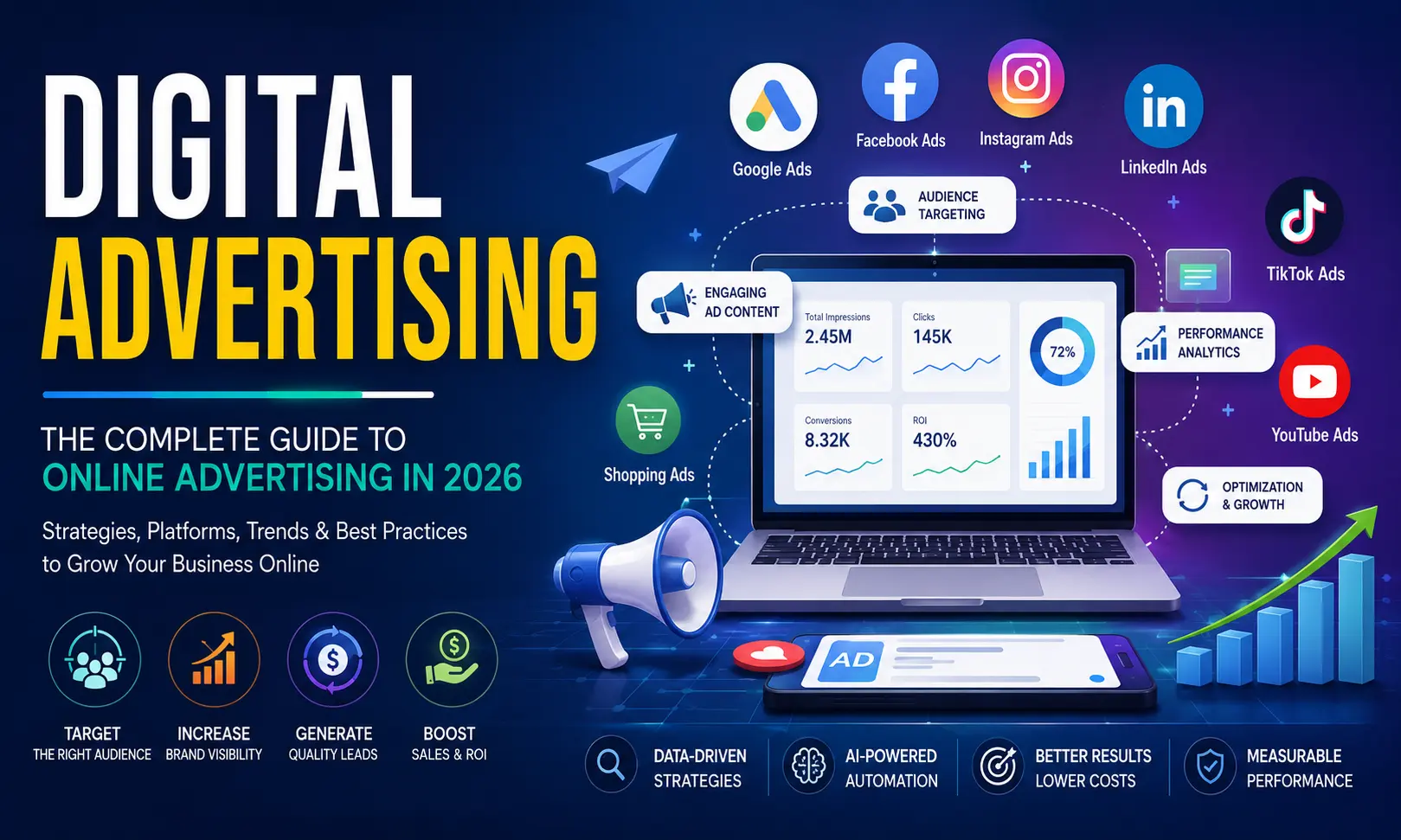
Digital advertising has become one of the most powerful ways for businesses to connect with customers in today’s online-first world. Whether you own a startup, an eCommerce store, a local business, or a global brand, digital advertising allows you to reach the right audience with measurable results.
Unlike traditional advertising methods such as newspapers, television, or radio, digital advertising enables businesses to target users based on their interests, demographics, location, online behavior, and purchasing intent. This level of precision makes online advertising one of the highest ROI marketing strategies available.
In 2026, artificial intelligence, automation, personalized experiences, and data-driven campaigns are transforming the digital advertising landscape. Businesses that understand how to leverage these tools can generate more leads, increase sales, and strengthen customer relationships.
This comprehensive guide explains everything you need to know about digital advertising, from its fundamentals to advanced strategies.
Table of Contents – Digital Advertising
- Introduction
- What is Digital Advertising?
- Why Digital Advertising Matters in 2026
- How Digital Advertising Works
- Key Components of a Digital Advertising Campaign
- Types of Digital Advertising
- Search Engine Advertising
- Display Advertising
- Social Media Advertising
- Video Advertising
- Native Advertising
- Email Advertising
- Mobile Advertising
- Affiliate Advertising
- Benefits of Digital Advertising
- Popular Digital Advertising Platforms
- Google Ads
- Meta Ads (Facebook & Instagram)
- LinkedIn Ads
- TikTok Ads
- Pinterest Ads
- X (Twitter) Ads
- Understanding Your Target Audience
- Creating High-Converting Digital Ads
- Choosing the Right Advertising Platform
- Latest Digital Advertising Trends in 2026
- AI and Automation in Digital Advertising
- Building a Successful Digital Advertising Strategy
- Budget Planning and Campaign Management
- Essential Digital Advertising Metrics
- A/B Testing for Better Results
- Remarketing and Retargeting Strategies
- Common Digital Advertising Mistakes to Avoid
- Best Practices for Digital Advertising Success
- Future of Digital Advertising
- Final Thoughts
- Conclusion
- Frequently Asked Questions (FAQs)
What is Digital Advertising?
Digital advertising refers to promoting products, services, or brands using internet-based platforms and digital technologies. Advertisements are displayed across websites, search engines, mobile apps, social media platforms, streaming services, and other online channels.
The primary objective of digital advertising is to attract targeted users and encourage them to take a desired action, such as:
- Purchasing a product
- Filling out a contact form
- Downloading an app
- Signing up for a newsletter
- Calling a business
- Visiting a website
- Watching a promotional video
Unlike traditional advertising, digital campaigns provide detailed analytics, allowing advertisers to measure performance and optimize campaigns in real time.
Why Digital Advertising Matters in 2026
The internet continues to shape how consumers discover, compare, and purchase products. Businesses that rely solely on organic traffic often face increasing competition, making paid digital advertising an essential part of modern marketing strategies.
Some reasons digital advertising is more important than ever include:
Increased Internet Usage
Billions of people use the internet daily for shopping, entertainment, education, and communication. This creates immense opportunities for businesses to reach potential customers.
Mobile-First Consumer Behavior
Most users browse the web using smartphones. Mobile-friendly advertising campaigns help businesses connect with customers anytime and anywhere.
AI-Powered Advertising
Artificial intelligence enhances campaign optimization by improving targeting, bidding strategies, audience segmentation, and creative personalization.
Better Customer Insights
Modern advertising platforms provide detailed reports about user behavior, conversions, engagement, demographics, and purchasing patterns.
Higher Return on Investment
Businesses can allocate budgets more efficiently by investing only in campaigns that generate measurable results.
 SEO
SEO
Krishna Kushwaha| Jul 10, 2026| 18 min read
Internet Marketing: The Ultimate Guide to Growing Your Business Online in 2026
How Digital Advertising Works
Digital advertising follows a structured process designed to deliver advertisements to users most likely to engage with them.
The typical workflow includes:
Step 1: Define Business Goals
Examples include:
- Brand awareness
- Website traffic
- Lead generation
- Product sales
- Mobile app downloads
- Customer retention
Step 2: Identify the Target Audience
Businesses define audiences based on:
- Age
- Gender
- Location
- Income
- Occupation
- Interests
- Shopping habits
- Search behavior
- Device usage
Step 3: Create Engaging Advertisements
Ads may include:
- Images
- Videos
- Carousel ads
- Interactive ads
- Text ads
- Display banners
Step 4: Choose Advertising Platforms
Advertisers select platforms that align with their audience and objectives.
Step 5: Set the Budget
Businesses can establish:
- Daily budget
- Lifetime budget
- Maximum bid
- Cost per click
- Cost per acquisition
Step 6: Launch Campaign
The advertising platform begins showing ads to selected audiences.
Step 7: Analyze Performance
Key performance indicators include:
- Click-through rate (CTR)
- Cost per click (CPC)
- Conversion rate
- Return on ad spend (ROAS)
- Cost per acquisition (CPA)
- Impressions
- Reach
- Engagement rate
Campaigns are continually optimized based on these metrics.
Types of Digital Advertising
Digital advertising encompasses multiple formats, each serving different business goals and customer journey stages.
1. Search Engine Advertising
Search engine advertising displays ads when users search for relevant keywords.
For example:
A user searching for:
“Best running shoes online”
may see sponsored results at the top of the search engine results page.
Advantages include:
- High purchase intent
- Immediate visibility
- Fast lead generation
- Excellent ROI
- Keyword-based targeting
Ideal for:
- Local businesses
- eCommerce stores
- Professional services
- SaaS companies
2. Display Advertising
Display advertising uses visual banners placed across websites and mobile apps.
These advertisements can include:
- Images
- Animations
- Interactive graphics
- Videos
Display advertising primarily helps:
- Brand awareness
- Remarketing
- Product promotion
- Audience expansion
3. Social Media Advertising
Social media advertising reaches users while they browse their favorite platforms.
Popular ad formats include:
- Feed ads
- Stories
- Reels
- Video ads
- Carousel ads
- Collection ads
- Sponsored posts
Benefits include:
- Advanced audience targeting
- Interest-based segmentation
- High engagement
- Excellent visual storytelling
4. Video Advertising
Video has become one of the most engaging advertising formats.
Businesses use video ads to:
- Explain products
- Demonstrate services
- Build trust
- Increase brand awareness
- Improve conversion rates
Short-form videos perform particularly well because they capture attention quickly.
5. Native Advertising
Native advertising blends naturally into the surrounding content, making it feel less intrusive than traditional ads.
Examples include:
- Sponsored articles
- Recommended content
- In-feed advertisements
- Promotional blog posts
Native ads often achieve higher engagement because they match the look and feel of the platform.
6. Email Advertising
Email remains one of the highest-converting digital marketing channels.
Businesses use promotional emails for:
- Product launches
- Discounts
- Seasonal offers
- Customer retention
- Cross-selling
- Upselling
Personalized email campaigns generally outperform generic messages by delivering relevant content to specific audience segments.
7. Mobile Advertising
With smartphone usage continuing to grow, mobile advertising has become essential.
Formats include:
- In-app ads
- Mobile search ads
- Push notifications
- SMS marketing
- Mobile video ads
Responsive design ensures ads display effectively across devices.
8. Affiliate Advertising
Affiliate advertising involves partnering with publishers, influencers, or content creators who promote products in exchange for a commission on successful sales or leads.
Advantages include:
- Performance-based costs
- Expanded reach
- Low upfront investment
- Increased credibility through trusted partners
 SEO
SEO
Krishna Kushwaha| Jul 06, 2026| 19 min read
Online Marketing: The Complete Guide to Growing Your Business Online in 2026
Benefits of Digital Advertising
Businesses of all sizes can benefit from digital advertising.
Highly Targeted Campaigns
Digital platforms allow advertisers to target users based on:
- Interests
- Behavior
- Purchase history
- Location
- Age
- Profession
- Device
- Language
This precision reduces wasted ad spend and improves campaign effectiveness.
Real-Time Performance Tracking
Unlike traditional advertising, digital campaigns provide immediate insights into performance.
Advertisers can monitor:
- Clicks
- Impressions
- Leads
- Sales
- Cost metrics
- Audience engagement
Real-time analytics make it easier to adjust campaigns and maximize results.
Flexible Budgets
Businesses can start with modest budgets and scale campaigns as they see positive results. This flexibility makes digital advertising accessible to startups, small businesses, and large enterprises alike.
Faster Results
Paid campaigns can begin driving traffic and conversions within hours of launch, making them ideal for promotions, product launches, and seasonal campaigns.
Global Reach with Local Precision
Digital advertising enables businesses to target audiences worldwide while also focusing on specific cities, neighborhoods, or even geographic radii around a physical store.
Popular Digital Advertising Platforms
Choosing the right platform depends on your audience, goals, and budget.
Google Ads
Best for:
- Search advertising
- Display advertising
- Shopping campaigns
- Video campaigns
- App promotion
Ideal for businesses targeting users with strong purchase intent.
Meta Ads
Meta’s advertising ecosystem allows businesses to reach users through visually engaging campaigns and detailed audience targeting.
Best suited for:
- Brand awareness
- Lead generation
- eCommerce sales
- Community engagement
LinkedIn Ads
A strong choice for B2B companies and professionals.
Effective for:
- Recruiting
- Lead generation
- Industry-specific promotions
- Professional networking
TikTok Ads
Short-form video advertising is highly effective for reaching younger audiences with creative, engaging content.
Pinterest Ads
Ideal for visually driven industries such as:
- Fashion
- Home décor
- DIY
- Food
- Beauty
- Lifestyle
Understanding Your Target Audience
A successful advertising campaign begins with a clear understanding of who you want to reach.
Consider the following factors:
Demographics
- Age
- Gender
- Income
- Education
- Occupation
Geographic Location
- Country
- State
- City
- Local neighborhoods
Interests
- Hobbies
- Entertainment preferences
- Shopping habits
- Lifestyle choices
Online Behavior
- Websites visited
- Search history
- Devices used
- Purchase patterns
Customer Pain Points
Identify the problems your audience faces and position your product or service as the solution.
Creating High-Converting Digital Ads
Effective advertisements combine creativity with strategy. Keep these principles in mind:
- Write a compelling headline that captures attention.
- Highlight the unique value of your product or service.
- Use clear, high-quality visuals that reinforce your message.
- Include a strong call to action (CTA), such as “Shop Now,” “Learn More,” or “Get Started.”
- Keep your copy concise and focused on customer benefits.
- Match your ad to the landing page for a consistent user experience.
- Test different versions of your ads (A/B testing) to identify the best-performing creative.
Choosing the Right Advertising Platform
No single platform is best for every business. Your choice should depend on:
- Business goals: Brand awareness, lead generation, or sales.
- Target audience: Where your ideal customers spend time online.
- Content format: Text, images, video, or interactive media.
- Budget: Start small, measure results, and scale successful campaigns.
- Industry: B2B, eCommerce, local services, education, healthcare, and other sectors often perform differently across platforms.
A diversified strategy that combines search, social, display, and remarketing campaigns often delivers the strongest long-term results.
Latest Digital Advertising Trends in 2026
Digital advertising continues to evolve rapidly, driven by artificial intelligence, privacy-focused technologies, and changing consumer behavior. Businesses that stay updated with these trends can achieve better engagement, lower acquisition costs, and stronger returns on investment.
1. AI-Powered Advertising
Artificial intelligence has become a core part of modern advertising. AI helps marketers automate tasks, predict customer behavior, personalize ad creatives, and optimize campaigns in real time.
AI-powered advertising can:
- Automatically adjust bids
- Generate ad copy and creatives
- Identify high-converting audiences
- Optimize campaign budgets
- Improve click-through rates
- Reduce wasted ad spend
Businesses using AI effectively often see improved campaign performance because decisions are based on data rather than guesswork.
2. Personalization at Scale
Consumers expect advertisements that are relevant to their interests and needs. Personalized advertising uses customer data such as browsing history, purchase behavior, and preferences to deliver tailored messages.
Examples include:
- Product recommendations
- Personalized email offers
- Dynamic website banners
- Location-specific promotions
- Customized shopping experiences
Relevant ads are more likely to generate clicks, conversions, and customer loyalty.
3. Short-Form Video Advertising
Short videos remain one of the highest-performing advertising formats. Attention spans are limited, so concise, engaging videos often outperform longer content.
Best practices include:
- Capture attention within the first three seconds.
- Keep videos under 60 seconds when possible.
- Include captions for viewers watching without sound.
- End with a clear call to action.
4. Voice Search Optimization
As voice assistants become more common, advertisers are adapting campaigns to conversational search queries.
Instead of targeting only short keywords, businesses should also optimize for natural-language questions and long-tail phrases that reflect how people speak.
5. Privacy-First Advertising
With increasing privacy regulations and reduced reliance on third-party cookies, businesses are focusing on:
- First-party data collection
- Consent-based marketing
- Transparent privacy policies
- Customer trust and data security
Building trust is becoming just as important as targeting.
 SEO
SEO
Krishna Kushwaha| Jul 04, 2026| 16 min read
Digital Marketing Services: The Ultimate Guide to Growing Your Business Online in 2026
AI and Automation in Digital Advertising
Artificial intelligence is transforming nearly every stage of digital advertising.
Automated Bidding
AI adjusts bids based on factors such as:
- User behavior
- Device type
- Time of day
- Location
- Competition
- Historical performance
This helps maximize results while controlling costs.
Predictive Analytics
AI analyzes historical data to predict:
- Which users are most likely to convert
- Optimal ad timing
- Future demand
- Seasonal trends
- Customer lifetime value
These insights support smarter campaign planning.
Dynamic Creative Optimization (DCO)
Dynamic Creative Optimization automatically assembles different combinations of headlines, images, videos, and calls to action to show each user the most relevant version of an ad.
Benefits include:
- Higher engagement
- Better personalization
- Improved conversion rates
- Reduced manual effort
Building a Digital Advertising Strategy
A successful campaign starts with a clear strategy rather than simply launching ads.
Step 1: Define SMART Goals
Set goals that are:
- Specific
- Measurable
- Achievable
- Relevant
- Time-bound
Examples:
- Increase website traffic by 30% in three months.
- Generate 500 qualified leads this quarter.
- Improve conversion rate from 2% to 3.5%.
Step 2: Research Your Audience
Understand:
- Customer demographics
- Interests
- Online behavior
- Pain points
- Buying journey
- Preferred devices
Detailed audience research leads to more relevant messaging and better campaign performance.
Step 3: Select the Right Channels
Different platforms serve different objectives.
- Search advertising works well for high-intent users.
- Social media advertising excels at brand awareness and engagement.
- Display advertising supports remarketing and visibility.
- Video advertising is effective for storytelling and product demonstrations.
- Email advertising helps with nurturing leads and retaining customers.
Step 4: Create High-Quality Landing Pages
Even the best advertisement can fail if the landing page does not meet user expectations.
A strong landing page should:
- Load quickly
- Be mobile-friendly
- Match the ad message
- Feature a clear headline
- Include trust signals such as reviews or testimonials
- Offer a simple conversion path
Budget Planning
Budget management is essential for sustainable advertising success.
Daily Budget
A daily budget limits how much you spend each day, helping you control costs while testing campaigns.
Campaign Budget
A campaign budget sets the total amount available over the campaign’s lifetime, allowing the platform to optimize spending across days.
Start Small and Scale
A practical approach is to:
- Launch with a modest budget.
- Measure results.
- Pause underperforming ads.
- Increase investment in successful campaigns.
This reduces risk and helps identify what works before committing larger amounts.
Key Digital Advertising Metrics
Tracking the right metrics is essential for evaluating campaign performance.
Click-Through Rate (CTR)
CTR measures how often people click on your ad after seeing it.
A higher CTR generally indicates that your ad is relevant and compelling.
Cost Per Click (CPC)
CPC shows how much you pay for each click.
Lower CPC combined with high-quality traffic often leads to better profitability.
Conversion Rate
Conversion rate measures the percentage of users who complete a desired action after clicking your ad.
Examples include:
- Making a purchase
- Signing up for a newsletter
- Downloading an app
- Requesting a quote
Return on Ad Spend (ROAS)
ROAS measures revenue generated for every amount spent on advertising.
Formula:
ROAS = Revenue ÷ Advertising Cost
A higher ROAS indicates a more profitable campaign.
Cost Per Acquisition (CPA)
CPA calculates how much it costs to acquire one customer or lead.
Reducing CPA while maintaining quality is a common optimization goal.
A/B Testing
A/B testing compares two versions of an ad to determine which performs better.
Elements you can test include:
- Headlines
- Images
- Videos
- Calls to action
- Colors
- Landing pages
- Audience segments
Regular testing helps improve performance over time through data-driven decisions.
Remarketing
Remarketing targets users who previously interacted with your website, app, or advertisements but did not convert.
Common remarketing audiences include:
- Website visitors
- Cart abandoners
- Past customers
- Email subscribers
- Video viewers
Remarketing often achieves higher conversion rates because it focuses on users already familiar with your brand.
 SEO
SEO
Krishna Kushwaha| Jul 04, 2026| 14 min read
Digital Marketing Company – The Complete Guide to Growing Your Business Online in 2026
Common Digital Advertising Mistakes
Avoiding these mistakes can improve campaign effectiveness:
- Launching campaigns without clear objectives
- Targeting audiences that are too broad
- Ignoring mobile optimization
- Using weak or generic ad copy
- Sending traffic to poorly designed landing pages
- Failing to monitor campaign performance
- Not testing different creatives
- Overlooking audience exclusions
- Ignoring customer feedback
- Stopping optimization too early
Consistent monitoring and refinement are key to long-term success.
Best Practices for Digital Advertising
To maximize results:
- Define measurable goals before launching campaigns.
- Use audience segmentation for more relevant messaging.
- Invest in high-quality visuals and compelling copy.
- Ensure landing pages are fast, responsive, and easy to navigate.
- Track key performance metrics regularly.
- Conduct A/B tests to improve creatives and targeting.
- Use remarketing to re-engage interested users.
- Allocate more budget to campaigns with proven performance.
- Stay informed about privacy regulations and platform updates.
- Continuously learn and adapt as consumer behavior evolves.
Future of Digital Advertising
The future of digital advertising will be shaped by:
- AI-driven campaign management
- Greater personalization
- Increased automation
- Privacy-focused marketing
- Interactive ad experiences
- Augmented reality (AR) advertising
- Voice search optimization
- Omnichannel customer journeys
- First-party data strategies
- Predictive analytics
Businesses that embrace innovation while respecting user privacy will be better positioned to succeed in the years ahead.
Final Thoughts
Digital advertising has evolved from a simple promotional tool into a sophisticated, data-driven marketing discipline. Success today depends on understanding your audience, selecting the right channels, creating engaging content, and continuously optimizing campaigns based on measurable results.
Whether you are a small business owner, marketer, entrepreneur, or enterprise, a well-planned digital advertising strategy can help increase visibility, generate qualified leads, and drive sustainable growth. By combining creativity with analytics and leveraging emerging technologies such as AI, businesses can build stronger customer relationships and remain competitive in a rapidly changing digital landscape.
Conclusion
Digital advertising is one of the most effective ways to reach the right audience at the right time with the right message. From search and social media advertising to video campaigns, remarketing, and AI-powered optimization, modern advertisers have access to a wide range of tools for achieving business goals.
The key to long-term success is continuous learning, testing, and adaptation. As technology and consumer expectations continue to evolve, businesses that prioritize relevance, transparency, and customer value will be best equipped to thrive in the digital marketplace.
FAQs
Digital advertising is the process of promoting products, services, or brands through online platforms such as search engines, social media networks, websites, mobile apps, email, and video streaming services. Unlike traditional advertising methods like newspapers, television, or radio, digital advertising enables businesses to reach highly targeted audiences based on factors such as age, location, interests, browsing behavior, device type, and purchasing intent.
The process begins with defining a campaign objective, such as increasing website traffic, generating leads, boosting online sales, or building brand awareness. Next, businesses identify their target audience and create engaging advertisements using text, images, videos, or interactive content. These ads are then displayed on selected digital platforms, where users can interact with them by clicking, watching, or completing a desired action.
One of the biggest advantages of digital advertising is its ability to provide measurable results. Businesses can track impressions, clicks, conversions, return on ad spend (ROAS), click-through rate (CTR), and many other performance metrics in real time. This data allows advertisers to optimize campaigns, improve targeting, and maximize their marketing budget.
Digital advertising includes several formats, each designed to achieve different marketing goals.
Search Engine Advertising displays ads on search engine results pages when users search for relevant keywords. It is ideal for reaching people with high purchase intent.
Display Advertising uses banner ads, graphics, and interactive visuals on websites and mobile apps to increase brand awareness and attract visitors.
Social Media Advertising promotes products or services on platforms such as Facebook, Instagram, LinkedIn, TikTok, Pinterest, and X. These ads can appear as image posts, videos, stories, reels, or carousel ads.
Video Advertising uses engaging video content before, during, or after streaming videos to capture attention and explain products effectively.
Native Advertising blends seamlessly with the surrounding content, making sponsored posts feel more natural and less disruptive.
Email Advertising involves sending promotional emails, newsletters, product updates, and exclusive offers directly to subscribers.
Mobile Advertising targets smartphone users through apps, mobile websites, SMS campaigns, and push notifications.
Affiliate Advertising allows businesses to partner with publishers or influencers who earn a commission for generating sales or leads.
Each format serves different business objectives, and many successful campaigns combine multiple advertising channels to maximize reach and conversions.
Digital advertising offers numerous advantages that help businesses grow efficiently.
One major benefit is precise audience targeting. Advertisers can reach users based on demographics, interests, online behavior, geographic location, and purchase history, ensuring ads are shown to the most relevant audience.
Another advantage is cost efficiency. Businesses can start with small budgets, monitor campaign performance, and increase spending only on campaigns that deliver positive results. This flexibility makes digital advertising suitable for startups, small businesses, and large enterprises alike.
Digital advertising also provides real-time analytics, allowing businesses to monitor impressions, clicks, conversions, and customer engagement. These insights help marketers optimize campaigns and improve return on investment.
Additionally, digital advertising supports global reach with local targeting. A business can promote its products worldwide while also focusing on customers within a specific city or neighborhood.
Other benefits include faster campaign launches, better customer engagement, personalized marketing, improved brand awareness, higher conversion rates, and the ability to continuously test and refine campaigns using A/B testing.
Improving campaign performance requires ongoing optimization and a data-driven approach.
Start by setting clear marketing objectives and understanding your target audience. Create compelling ad copy with attention-grabbing headlines, high-quality visuals, and strong calls to action that encourage users to take the next step.
Ensure your landing pages match the messaging in your advertisements. Fast-loading, mobile-friendly pages with clear value propositions and simple forms often convert better.
Track key performance indicators such as CTR, CPC, CPA, conversion rate, and ROAS. These metrics reveal what is working and where improvements are needed.
Regularly perform A/B testing by experimenting with different headlines, images, videos, audience segments, and calls to action. Small changes can significantly improve campaign performance over time.
Use remarketing to reconnect with visitors who previously interacted with your website but did not complete a purchase or inquiry. Finally, stay updated with new advertising features, privacy regulations, and AI-powered optimization tools to remain competitive in an evolving digital landscape.
The future of digital advertising is centered on artificial intelligence, automation, personalization, and privacy-focused marketing.
AI is expected to play an even greater role in campaign management by automating bidding strategies, predicting customer behavior, generating ad creatives, and optimizing audience targeting. This will allow marketers to improve performance while reducing manual effort.
Personalized advertising will continue to grow as businesses use first-party data and customer insights to deliver highly relevant experiences. Instead of showing the same advertisement to everyone, brands will tailor messages based on individual preferences and behaviors.
Privacy regulations and the decline of third-party cookies will encourage businesses to adopt transparent data collection practices and build stronger customer trust. First-party data, consent-based marketing, and ethical advertising will become increasingly important.
Emerging technologies such as augmented reality (AR), virtual reality (VR), voice search, and interactive advertising formats will create more engaging customer experiences. Businesses that embrace innovation, continuously optimize campaigns, and focus on delivering genuine value will be well-positioned for long-term success.
Digital advertising will remain one of the most effective ways to reach customers, generate leads, and grow businesses in the years ahead. By combining creativity, analytics, and modern technology, companies of all sizes can build sustainable marketing strategies that adapt to changing consumer expectations and technological advancements.
Leave a Reply