Table of Contents
- Introduction to Online Marketing
- What is Online Marketing?
- Why Online Marketing is Important
- How Online Marketing Works
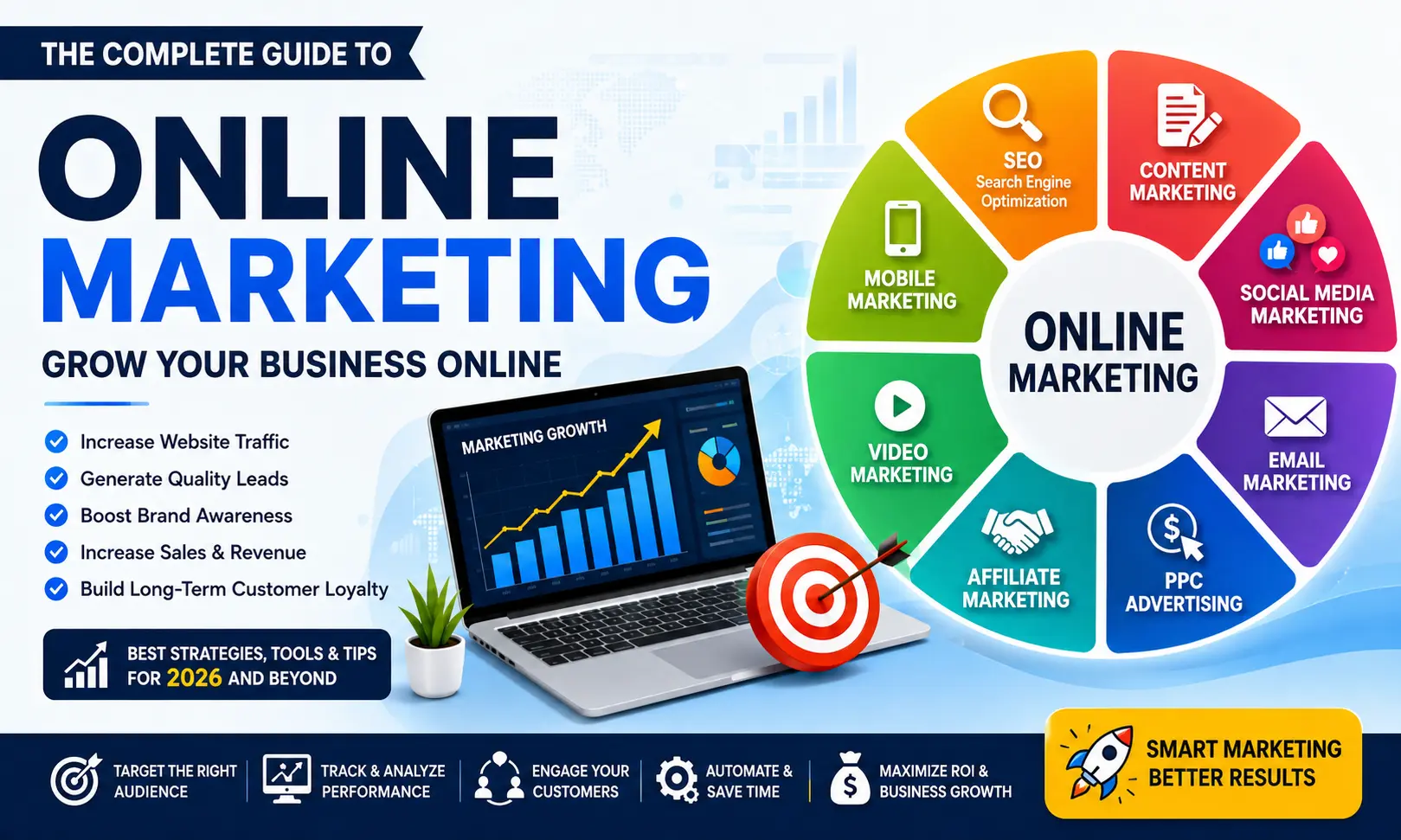
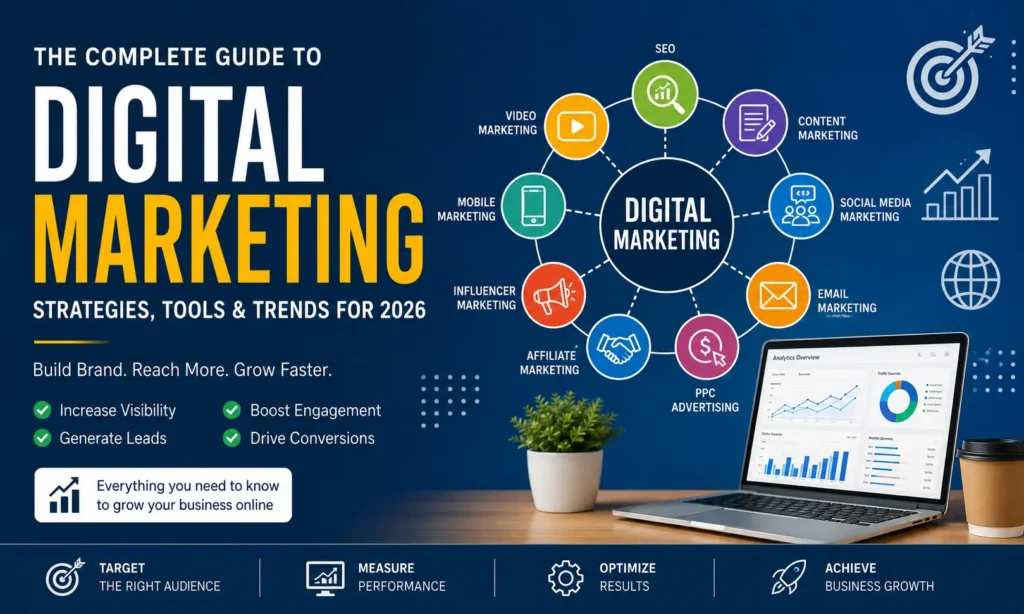
- Types of Online Marketing
- Search Engine Optimization (SEO)
- Content Marketing
- Social Media Marketing
- Email Marketing
- Pay-Per-Click (PPC) Advertising
- Affiliate Marketing
- Influencer Marketing
- Video Marketing
- Mobile Marketing
- Benefits of Online Marketing
- Best Online Marketing Strategies
- Conversion Rate Optimization (CRO)
- Artificial Intelligence (AI) in Online Marketing
- Marketing Automation
- Local Online Marketing
- Online Reputation Management
- Essential Online Marketing Tools
- Step-by-Step Online Marketing Plan
- Common Online Marketing Mistakes to Avoid
- Future Trends in Online Marketing (2026 & Beyond)
- Online Marketing Success Story (Case Study)
- Conclusion
- Frequently Asked Questions (FAQs)
Online Marketing: The Complete Guide to Growing Your Business Online in 2026
The internet has completely transformed how businesses connect with customers. Traditional advertising methods like newspapers, television, and radio still have their place, but today’s consumers spend a significant amount of their time online. This shift has made online marketing one of the most powerful tools for businesses of all sizes.
Whether you own a small local shop, run an eCommerce website, manage a startup, or operate a global enterprise, online marketing helps you attract potential customers, generate leads, increase sales, and build long-term brand awareness.
In 2026, businesses are using advanced technologies such as artificial intelligence (AI), automation, personalized advertising, and data analytics to make online marketing campaigns more effective than ever. Companies that fail to adapt to these changes often struggle to compete in increasingly digital markets.
This comprehensive guide explains everything you need to know about online marketing, including its types, benefits, strategies, tools, and best practices.
What is Online Marketing?
Online marketing, also known as internet marketing or digital marketing, refers to promoting products or services through internet-based channels. Businesses use websites, search engines, social media platforms, email, mobile apps, and online advertising to reach potential customers.
Unlike traditional marketing, online marketing provides measurable results. You can track impressions, clicks, conversions, sales, customer behavior, and return on investment (ROI) in real time.
For example, if someone searches for “best running shoes” on Google and clicks on an online store, that store has successfully used online marketing through SEO or paid advertising to reach a potential buyer.
Online marketing is not limited to selling products. It is equally valuable for generating leads, increasing website traffic, building email subscribers, improving brand awareness, and fostering customer loyalty.
 SEO
SEO
KR Krishna Kushwaha| Jul 04, 2026| 16 min read
Digital Marketing Services: The Ultimate Guide to Growing Your Business Online in 2026
Why Online Marketing is Important
Modern consumers rely on the internet before making purchasing decisions. They search for reviews, compare products, watch videos, and engage with brands on social media.
Businesses that maintain a strong online presence are more likely to gain customer trust and outperform competitors.
Some key reasons why online marketing is essential include:
- Global audience reach
- Cost-effective advertising
- Real-time campaign tracking
- Higher conversion rates
- Personalized customer experiences
- Better customer engagement
- Stronger brand visibility
- Increased website traffic
- Data-driven decision making
- Long-term business growth
Even small businesses with limited budgets can compete with larger companies using well-planned online marketing strategies.
How Online Marketing Works
Online marketing involves multiple interconnected channels working together to attract, engage, and convert customers.
The typical process includes:
Step 1: Understand Your Audience
Research customer demographics, interests, online behavior, and purchasing habits.
Identify:
- Age
- Gender
- Location
- Income
- Interests
- Problems
- Buying intent
Creating buyer personas helps businesses deliver personalized marketing campaigns.
Step 2: Build a Professional Website
A website serves as the foundation of every online marketing strategy.
A high-quality website should include:
- Fast loading speed
- Mobile responsiveness
- SSL security
- Easy navigation
- Clear call-to-action buttons
- Optimized landing pages
- Quality content
Step 3: Generate Website Traffic
Businesses attract visitors using various methods:
- SEO
- Google Ads
- Facebook Ads
- Instagram Marketing
- LinkedIn Marketing
- Pinterest Marketing
- Email Marketing
- YouTube Marketing
- Influencer Marketing
Each traffic source contributes differently depending on business goals.
Step 4: Convert Visitors into Customers
Traffic alone doesn’t generate revenue.
Businesses must optimize:
- Landing pages
- Product pages
- Checkout process
- Contact forms
- Calls-to-action
- Lead magnets
Conversion Rate Optimization (CRO) improves the percentage of visitors who become customers.
Step 5: Measure Results
Marketing analytics help evaluate campaign performance using metrics such as:
- Website traffic
- Bounce rate
- Click-through rate (CTR)
- Cost per click (CPC)
- Conversion rate
- Customer acquisition cost (CAC)
- Return on investment (ROI)
Continuous analysis enables businesses to improve marketing performance over time.
 SEO
SEO
KR Krishna Kushwaha| Jul 04, 2026| 14 min read
Digital Marketing Company – The Complete Guide to Growing Your Business Online in 2026
Types of Online Marketing
Successful businesses rarely rely on a single marketing channel. Instead, they combine multiple approaches to maximize visibility and conversions.
1. Search Engine Optimization (SEO)
SEO focuses on improving website rankings in search engines like Google.
Higher rankings generate organic traffic without paying for every visitor.
SEO includes:
On-Page SEO
- Keyword optimization
- Meta titles
- Meta descriptions
- Header tags
- Internal linking
- Image optimization
Off-Page SEO
- Backlinks
- Brand mentions
- Guest blogging
- Social signals
Technical SEO
- Website speed
- Mobile optimization
- XML sitemap
- Robots.txt
- Structured data
- HTTPS security
SEO delivers long-term traffic and remains one of the highest ROI marketing channels.
2. Content Marketing
Content marketing focuses on creating valuable information that educates, entertains, or solves customer problems.
Popular content formats include:
- Blog posts
- Videos
- Podcasts
- Infographics
- eBooks
- Whitepapers
- Case studies
- Checklists
High-quality content builds trust and improves search engine rankings.
Benefits include:
- Better SEO
- Increased traffic
- More backlinks
- Higher authority
- Better customer engagement
3. Social Media Marketing
Social media has become an essential component of online marketing.
Businesses use platforms like:
- X (formerly Twitter)
- Snapchat
- Threads
- YouTube
- TikTok
Objectives include:
- Brand awareness
- Customer engagement
- Website traffic
- Lead generation
- Sales
Successful social media marketing combines consistent posting, engaging visuals, storytelling, and community interaction.
4. Email Marketing
Email marketing remains one of the highest-converting digital marketing channels.
Businesses use email for:
- Newsletters
- Product launches
- Promotions
- Customer onboarding
- Cart recovery
- Customer retention
Benefits include:
- Personalized communication
- High ROI
- Customer loyalty
- Automation
- Increased repeat purchases
Building an email list should be a priority for every business.
5. Pay-Per-Click (PPC) Advertising
PPC advertising allows businesses to display ads on search engines and social media.
Advertisers only pay when someone clicks the advertisement.
Popular PPC platforms include:
- Google Ads
- Microsoft Ads
- Facebook Ads
- Instagram Ads
- LinkedIn Ads
- YouTube Ads
Advantages include:
- Instant traffic
- Fast results
- Precise targeting
- Budget control
- Measurable ROI
6. Affiliate Marketing
Affiliate marketing enables businesses to partner with publishers or influencers who promote products in exchange for commissions.
Advantages:
- Low risk
- Performance-based payments
- Increased reach
- Brand awareness
- Scalable growth
Many large eCommerce companies generate millions through affiliate partnerships.
7. Influencer Marketing
Influencer marketing leverages trusted creators with engaged audiences.
Types include:
- Nano influencers
- Micro influencers
- Macro influencers
- Celebrity influencers
Consumers often trust recommendations from creators more than traditional advertisements.
8. Video Marketing
Video continues to dominate online engagement.
Popular video formats include:
- Tutorials
- Product reviews
- Live streams
- Webinars
- Customer testimonials
- Shorts
- Reels
Videos improve engagement, boost conversions, and increase website dwell time.
9. Mobile Marketing
More than half of global internet traffic comes from mobile devices, making mobile marketing essential.
Mobile marketing includes:
- SMS campaigns
- Push notifications
- Mobile apps
- Mobile-friendly websites
- QR code campaigns
- Location-based marketing
A responsive mobile experience improves user satisfaction and search engine rankings.
SEO
Krishna Kushwaha| Jul 04, 2026| 14 min read
Digital Marketing Company – The Complete Guide to Growing Your Business Online in 2026
Benefits of Online Marketing
Businesses invest in online marketing because it delivers measurable, scalable, and cost-effective results.
Key benefits include:
1. Global Reach
Unlike traditional advertising, online marketing enables businesses to connect with customers across the world without needing physical stores in every location.
2. Cost Efficiency
Many online marketing strategies, such as SEO and content marketing, provide long-term returns at a much lower cost than traditional advertising channels.
3. Targeted Advertising
Platforms allow businesses to target audiences based on demographics, interests, behaviors, locations, devices, and even previous website visits, improving campaign efficiency.
4. Measurable Results
Marketers can track every stage of the customer journey, from impressions and clicks to conversions and revenue, allowing for data-driven decisions.
5. Increased Brand Awareness
Consistent online visibility across search engines, social media, email, and content helps build recognition and trust over time.
6. Higher Customer Engagement
Interactive content, social media conversations, and personalized email campaigns create stronger relationships with customers, encouraging loyalty and repeat business.
Best Online Marketing Strategies
To achieve sustainable growth in 2026, businesses should combine multiple marketing channels instead of relying on a single tactic.
Focus on SEO
Invest in keyword research, technical SEO, quality content, and authoritative backlinks to attract consistent organic traffic.
Publish High-Quality Content
Create blogs, videos, guides, and case studies that answer customer questions and solve real problems.
Use Social Media Consistently
Post valuable content regularly, interact with your audience, and use analytics to refine your strategy.
Leverage Email Automation
Set up welcome sequences, abandoned cart emails, and personalized newsletters to nurture leads and retain customers.
Run Targeted Paid Campaigns
Use PPC advertising to reach users with high purchase intent while carefully monitoring your budget and optimizing ad performance.
Advanced Online Marketing Strategies
Once you understand the fundamentals of online marketing, the next step is implementing advanced strategies that increase traffic, improve conversion rates, and maximize return on investment (ROI). Businesses that combine multiple channels and continuously optimize their campaigns often achieve sustainable long-term growth.
1. Conversion Rate Optimization (CRO)
Driving traffic to your website is only half the battle. The real goal is converting visitors into customers.
Conversion Rate Optimization (CRO) focuses on improving your website so that more users complete desired actions such as purchasing a product, submitting a contact form, or subscribing to a newsletter.
Best CRO Practices
- Create clear and compelling call-to-action (CTA) buttons.
- Simplify forms by asking only for essential information.
- Improve website loading speed.
- Use trust badges and customer reviews.
- Optimize landing pages for specific campaigns.
- Perform A/B testing to compare different page versions.
- Reduce distractions during the checkout process.
Even a small improvement in conversion rates can significantly increase revenue without spending more on advertising.
AI in Online Marketing
Artificial Intelligence (AI) is transforming digital marketing by automating repetitive tasks and delivering highly personalized customer experiences.
Common AI Applications
- AI-powered chatbots for instant customer support
- Personalized product recommendations
- Predictive customer analytics
- Automated email campaigns
- Content generation assistance
- Smart audience targeting
- Ad performance optimization
- Voice search optimization
Businesses adopting AI-driven marketing tools save time while improving campaign performance and customer engagement.
Marketing Automation
Marketing automation allows businesses to streamline repetitive marketing tasks.
Examples include:
- Welcome email sequences
- Lead nurturing campaigns
- Cart abandonment reminders
- Social media scheduling
- CRM integration
- Customer segmentation
- SMS automation
- Sales follow-up workflows
Automation ensures consistent communication with customers while reducing manual effort.
Local Online Marketing
If you own a local business, local online marketing is essential for attracting nearby customers.
Local Marketing Tips
- Optimize your business profile for local search.
- Encourage customer reviews.
- Use location-based keywords.
- Create city-specific landing pages.
- Build local citations.
- Publish locally relevant blog content.
- Engage with your local community on social media.
These strategies improve visibility for searches with local intent and help drive foot traffic and local inquiries.
Online Reputation Management
A positive online reputation builds trust and influences purchasing decisions.
Ways to Improve Your Reputation
- Respond promptly to customer reviews.
- Address negative feedback professionally.
- Showcase testimonials and success stories.
- Monitor brand mentions across platforms.
- Encourage satisfied customers to leave reviews.
- Deliver consistent customer service.
Strong reputation management enhances credibility and supports long-term business growth.
Online Marketing Tools
The right tools can make your marketing efforts more efficient and measurable.
| Category | Recommended Tools |
|---|---|
| SEO | Google Search Console, Ahrefs, Semrush, Moz |
| Analytics | Google Analytics 4, Looker Studio |
| Content Writing | ChatGPT, Grammarly |
| Graphic Design | Canva, Adobe Express |
| Email Marketing | Mailchimp, Brevo, ConvertKit |
| Social Media Management | Buffer, Hootsuite, Metricool |
| PPC Advertising | Google Ads, Microsoft Ads |
| CRM | HubSpot CRM, Zoho CRM |
| Video Editing | CapCut, Adobe Premiere Pro |
| Project Management | Trello, Asana, ClickUp |
Step-by-Step Online Marketing Plan
Step 1: Define Your Goals
Set SMART goals such as:
- Increase website traffic by 30%
- Generate 500 qualified leads
- Improve conversion rate
- Increase monthly revenue
- Build email subscribers
Step 2: Identify Your Target Audience
Understand:
- Age
- Gender
- Location
- Interests
- Buying behavior
- Pain points
- Preferred platforms
The more you know about your audience, the more relevant your campaigns become.
Step 3: Build a Strong Website
Your website should be:
- Mobile responsive
- Fast-loading
- Secure (HTTPS)
- SEO-friendly
- Easy to navigate
- Optimized for conversions
Step 4: Create High-Quality Content
Develop content that answers customer questions and solves problems.
Examples include:
- Blog posts
- Tutorials
- Videos
- Case studies
- Infographics
- FAQs
- E-books
- Webinars
Step 5: Optimize for Search Engines
Focus on:
- Keyword research
- Internal linking
- Technical SEO
- High-quality backlinks
- Optimized metadata
- Structured headings
- Image optimization
Step 6: Promote Across Multiple Channels
Use:
- SEO
- PPC
- Email marketing
- Social media
- Influencer partnerships
- Video marketing
- Affiliate marketing
An omnichannel approach expands your reach and reinforces your brand message.
Step 7: Analyze and Improve
Track key performance indicators (KPIs) such as:
- Organic traffic
- Bounce rate
- Click-through rate (CTR)
- Cost per acquisition (CPA)
- Conversion rate
- Customer lifetime value (CLV)
- Return on ad spend (ROAS)
Regular analysis helps you identify opportunities for continuous improvement.
 SEO
SEO
Krishna Kushwaha| Jul 04, 2026| 18 min read
Digital Marketing Agency: The Ultimate Guide to Growing Your Business Online in 2026
Common Online Marketing Mistakes
Avoid these frequent mistakes:
- Ignoring SEO fundamentals
- Not defining a target audience
- Publishing inconsistent content
- Neglecting mobile optimization
- Overlooking website speed
- Failing to track analytics
- Running ads without proper targeting
- Sending excessive promotional emails
- Ignoring customer feedback
- Not testing or optimizing campaigns
Learning from these mistakes can save time, reduce costs, and improve marketing effectiveness.
Future of Online Marketing in 2026
The digital marketing landscape continues to evolve rapidly. Key trends include:
AI-Powered Personalization
Businesses will deliver highly customized experiences based on user behavior and preferences.
Voice Search Optimization
Optimizing content for conversational queries and smart assistants will become increasingly important.
Video-First Marketing
Short-form videos, live streaming, and interactive video content will continue to dominate engagement.
Privacy-First Marketing
Marketers will rely more on first-party data and transparent consent practices as privacy regulations evolve.
Interactive Content
Quizzes, polls, calculators, and interactive infographics will encourage deeper user engagement.
Automation
Advanced automation will streamline customer journeys from lead generation to post-purchase communication.
Predictive Analytics
Businesses will use AI to forecast trends, customer behavior, and campaign outcomes for better decision-making.
Online Marketing Success Story
Imagine a small handmade jewelry store that launches a professional website and invests in online marketing.
The business publishes weekly blog posts targeting long-tail keywords, creates engaging short-form videos on social media, builds an email list with exclusive offers, and runs targeted search ads for high-intent customers.
After 12 months, the store experiences:
- Significant growth in organic traffic
- Higher search engine visibility
- Increased email subscribers
- Improved conversion rates
- Stronger brand recognition
- Increased repeat purchases
This example illustrates how a well-rounded online marketing strategy can deliver measurable and sustainable growth.
 SEO
SEO
Krishna Kushwaha| Jul 04, 2026| 14 min read
Digital Marketing: The Complete Beginner’s Guide to Growing Your Business Online in 2026
Conclusion
Online marketing has become one of the most powerful ways for businesses to reach customers, build brand awareness, and drive sustainable growth. Whether you’re a startup, a local business, an eCommerce store, or an established enterprise, a well-planned online marketing strategy can help you attract the right audience, generate qualified leads, and increase sales.
Success in online marketing doesn’t come from relying on a single channel. Instead, it comes from integrating SEO, content marketing, social media marketing, email marketing, PPC advertising, video marketing, affiliate marketing, and marketing automation into a cohesive strategy. By understanding your target audience, creating valuable content, optimizing your website for search engines, and using data to improve campaigns, you can achieve long-term success in an increasingly competitive digital landscape.
As technology continues to evolve, trends such as AI-powered marketing, voice search optimization, personalized customer experiences, and automation will play an even bigger role in shaping the future of online marketing. Businesses that stay informed, embrace innovation, and continuously refine their strategies will be better positioned to outperform competitors and build lasting customer relationships.
Ultimately, online marketing is not just about increasing website traffic—it’s about creating meaningful connections with your audience, delivering value at every stage of the customer journey, and turning visitors into loyal customers. Start with clear goals, remain consistent in your efforts, measure your results, and adapt to changing market trends. With the right strategy and commitment, online marketing can become one of your business’s most valuable assets, driving growth and success well beyond 2026.
Frequently Asked Questions (FAQs) About Online Marketing
Online marketing, also known as internet marketing or digital marketing, is the process of promoting products, services, or brands through internet-based channels such as search engines, websites, social media platforms, email, mobile applications, and online advertisements. The primary objective of online marketing is to attract potential customers, engage them with valuable content, and convert them into paying customers.
Online marketing works by combining multiple strategies, including Search Engine Optimization (SEO), content marketing, social media marketing, email marketing, Pay-Per-Click (PPC) advertising, affiliate marketing, influencer marketing, and video marketing. Businesses first identify their target audience, create valuable and relevant content, optimize their websites for search engines, and promote their products or services across different digital platforms.
One of the biggest advantages of online marketing is its ability to measure campaign performance. Businesses can track website traffic, click-through rates (CTR), conversion rates, customer behavior, and return on investment (ROI) using analytics tools. This data helps marketers continuously improve their campaigns, making online marketing one of the most effective and cost-efficient methods for growing a business in today’s digital world.
Online marketing has become an essential part of every successful business because consumers now rely heavily on the internet to research products, compare prices, read reviews, and make purchasing decisions. Whether a business is small or large, having a strong online presence helps build credibility, attract new customers, and increase sales.
In 2026, online marketing is more important than ever due to the rapid growth of mobile internet usage, artificial intelligence (AI), voice search, and personalized customer experiences. Businesses that invest in online marketing can reach local, national, and international audiences without the high costs associated with traditional advertising methods.
Another major benefit is precise audience targeting. Businesses can show advertisements to users based on demographics, interests, online behavior, location, and purchasing history. This improves conversion rates while reducing wasted advertising spend. Additionally, online marketing enables businesses to build long-term relationships with customers through email campaigns, social media engagement, and valuable educational content, leading to increased customer loyalty and repeat purchases.
For beginners, the best approach to online marketing is to start with a clear plan and focus on the channels that provide the highest long-term value. The first step is creating a professional, mobile-friendly website that is easy to navigate and optimized for search engines. A website acts as the central hub for all online marketing activities.
Next, beginners should invest in Search Engine Optimization (SEO) by conducting keyword research, writing informative blog posts, optimizing page titles and meta descriptions, and improving website speed. Content marketing is another powerful strategy because publishing helpful articles, videos, and guides builds trust while attracting organic traffic from search engines.
Social media marketing is equally important. Platforms like Facebook, Instagram, LinkedIn, YouTube, and X allow businesses to engage directly with their audience, promote products, and build a loyal community. Email marketing should also be implemented early to nurture leads through newsletters, promotions, and personalized messages.
Finally, beginners can use Pay-Per-Click (PPC) advertising through Google Ads or social media ads to generate immediate traffic while waiting for SEO efforts to produce long-term results. Combining these strategies creates a balanced online marketing plan that supports steady business growth.
The timeline for online marketing results depends on the strategies being used, the competitiveness of the industry, and the consistency of execution. Some methods produce immediate results, while others require patience and continuous optimization.
For example, PPC advertising can start generating website traffic and leads within hours or days after launching a campaign. Social media advertising also provides quick visibility and engagement. On the other hand, Search Engine Optimization (SEO) is a long-term strategy that typically takes several months to achieve strong rankings and consistent organic traffic, especially for competitive keywords.
Content marketing often delivers gradual results as blog posts, videos, and educational resources gain visibility over time. Email marketing can generate fast sales from existing subscribers, particularly when using personalized campaigns and automation.
Businesses should regularly monitor key performance indicators (KPIs) such as website traffic, conversion rates, click-through rates, cost per acquisition, and return on investment. Continuous testing, optimization, and improvement are essential for maximizing results. With consistent effort, most businesses begin seeing meaningful improvements within three to six months, while long-term strategies continue delivering value for years.
Many businesses fail to achieve their online marketing goals because they make avoidable mistakes that reduce traffic, lower conversions, and waste advertising budgets. One of the most common errors is neglecting Search Engine Optimization (SEO), which limits organic visibility and makes it difficult for potential customers to find the business online.
\
Another mistake is targeting the wrong audience. Without understanding customer needs, interests, and buying behavior, marketing campaigns become less effective and produce poor results. Businesses also make the mistake of publishing inconsistent or low-quality content, which reduces trust and limits engagement.
Ignoring website performance is another critical issue. Slow-loading pages, poor mobile responsiveness, complicated navigation, and confusing checkout processes can significantly reduce conversion rates. Additionally, failing to track analytics prevents businesses from understanding what is working and where improvements are needed.
Some companies rely too heavily on a single marketing channel instead of creating a diversified strategy that includes SEO, content marketing, social media, email marketing, and paid advertising. Finally, many businesses stop optimizing campaigns after launch. Successful online marketing requires continuous testing, analyzing data, updating content, and adapting to new technologies such as AI, automation, and changing consumer behavior. By avoiding these common mistakes and maintaining a consistent, customer-focused strategy, businesses can achieve sustainable growth and long-term success through online marketing.
Leave a Reply