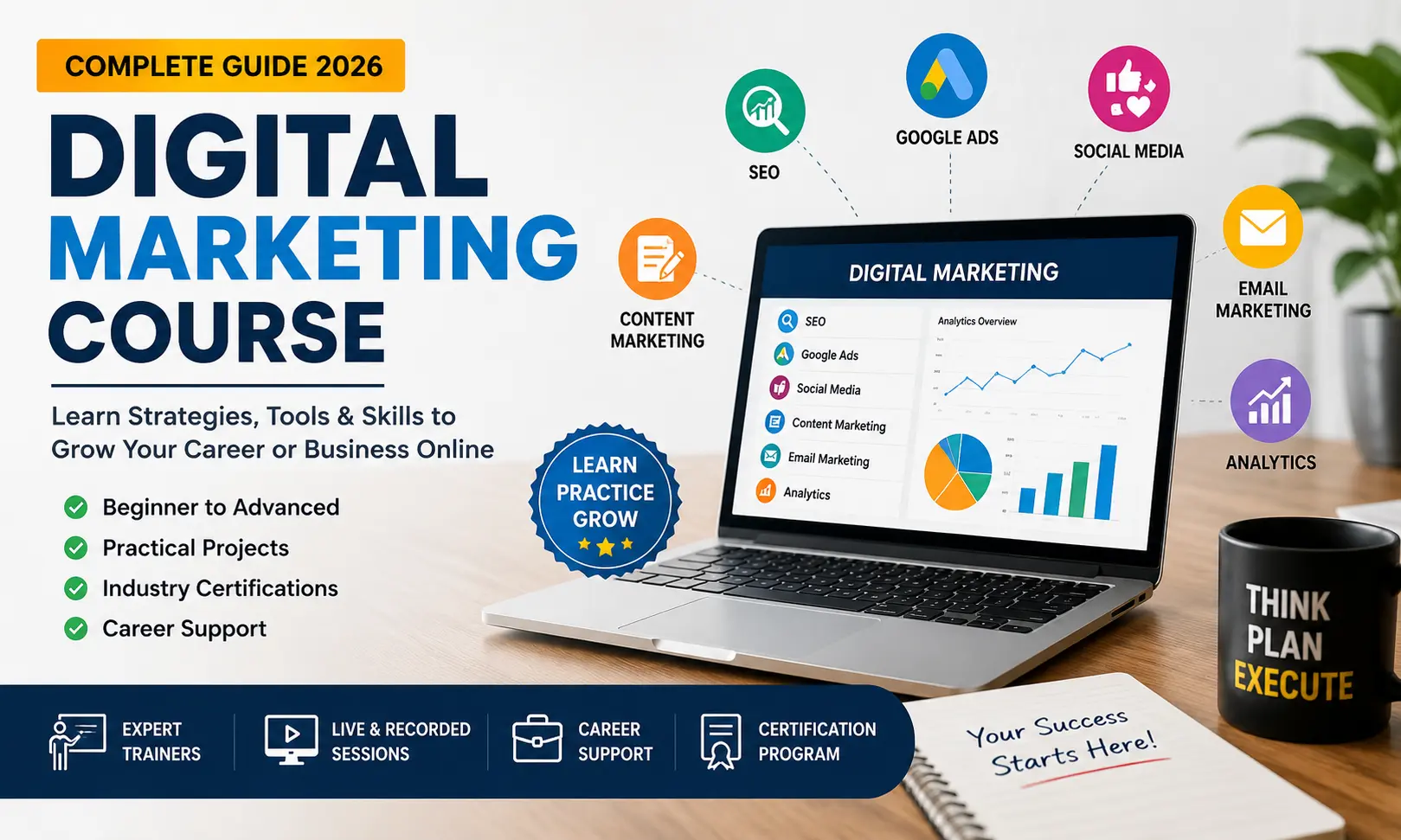
The digital revolution has transformed the way businesses connect with customers. Today, companies no longer rely only on newspapers, television, radio, or billboards to reach their audience. Instead, they use websites, search engines, social media platforms, email campaigns, and online advertising to promote their products and services.
As businesses continue moving online, the demand for skilled digital marketers has reached an all-time high. Whether you want to secure a high-paying job, become a freelancer, start your own agency, or grow your business, enrolling in a Digital Marketing Course is one of the smartest investments you can make in your future.
This comprehensive guide will help you understand everything about digital marketing courses, including what you’ll learn, career opportunities, required skills, certifications, and how to choose the best course for your goals.
Table of Contents
- Introduction
- What Is a Digital Marketing Course?
- Why Learn Digital Marketing in 2026?
- Top Benefits of a Digital Marketing Course
- Who Should Join a Digital Marketing Course?
- Types of Digital Marketing Courses
- Online vs. Offline Digital Marketing Courses
- Digital Marketing Course Duration
- Digital Marketing Course Fees
- Complete Digital Marketing Course Syllabus
- Essential Skills You Will Learn
- Search Engine Optimization (SEO)
- Search Engine Marketing (SEM/PPC)
- Social Media Marketing (SMM)
- Content Marketing
- Email Marketing
- Affiliate Marketing
- Influencer Marketing
- Video Marketing
- Mobile Marketing
- Marketing Automation
- Website Planning and WordPress
- Google Analytics and Data Analysis
- Conversion Rate Optimization (CRO)
- AI Tools in Digital Marketing
- Best Digital Marketing Certifications
- Career Opportunities After a Digital Marketing Course
- Digital Marketing Salary in 2026
- Freelancing as a Digital Marketer
- How to Start Your Own Digital Marketing Agency
- How to Choose the Best Digital Marketing Course
- Common Mistakes Beginners Should Avoid
- Future Scope of Digital Marketing
- Tips for Success in Digital Marketing
- Conclusion
- Frequently Asked Questions (FAQs)
What Is a Digital Marketing Course?
A Digital Marketing Course is a structured training program designed to teach students how to market products, services, or brands using digital platforms and online channels.
Instead of relying on traditional advertising methods, digital marketing focuses on reaching audiences through:
- Search engines
- Social media
- Websites
- Mobile apps
- Email marketing
- Online advertising
- Content marketing
- Video platforms
- Affiliate networks
The course combines theoretical knowledge with practical implementation using real-world tools and projects.
Most professional digital marketing courses also provide live projects, case studies, assignments, certifications, and internship opportunities to prepare students for real industry work.
 SEO
SEO
KR Krishna Kushwaha| Jul 04, 2026| 16 min read
Digital Marketing Services: The Ultimate Guide to Growing Your Business Online in 2026
Why Learn Digital Marketing in 2026?
Digital marketing has become one of the fastest-growing industries globally. Every business—from startups and local shops to multinational corporations—needs an online presence to stay competitive.
Some major reasons to learn digital marketing include:
High Industry Demand
Businesses require skilled marketers to generate leads, increase website traffic, improve search rankings, and boost online sales.
Excellent Career Growth
Digital marketing offers numerous career paths, including SEO specialist, PPC expert, social media manager, content strategist, email marketer, and digital marketing manager.
Freelancing Opportunities
You can work independently and provide digital marketing services to clients worldwide through freelancing platforms.
Business Growth
Entrepreneurs can use digital marketing strategies to increase website traffic, generate sales, and build strong customer relationships.
Remote Work Flexibility
Many digital marketing jobs allow professionals to work remotely from anywhere in the world.
High Salary Potential
Experienced digital marketers often earn competitive salaries because businesses value professionals who can deliver measurable results.
Top Benefits of a Digital Marketing Course
Learning digital marketing provides numerous personal and professional advantages.
1. Practical Skills
Unlike many academic programs, digital marketing courses emphasize hands-on experience.
You’ll learn how to:
- Build campaigns
- Optimize websites
- Analyze traffic
- Generate leads
- Improve conversions
2. Industry Certifications
Most quality courses provide certifications after successful completion.
These certificates improve your resume and demonstrate your expertise to employers.
3. Portfolio Development
Professional courses include practical assignments where students create:
- SEO audits
- Google Ads campaigns
- Social media calendars
- Email marketing campaigns
- Website optimization reports
These projects become valuable portfolio assets.
4. Career Support
Many institutes offer:
- Resume building
- Interview preparation
- Placement assistance
- Internship opportunities
5. Freelancing Skills
A digital marketing course teaches you how to work with clients, create proposals, manage projects, and deliver measurable business results.
Who Should Join a Digital Marketing Course?
One of the biggest advantages of digital marketing is that anyone can learn it.
Ideal candidates include:
Students
Students can build valuable skills before graduation and improve their employment opportunities.
Working Professionals
Professionals can switch careers or improve their current marketing knowledge.
Business Owners
Entrepreneurs can market their own products without depending entirely on advertising agencies.
Freelancers
Digital marketing opens opportunities to earn from international clients.
Bloggers
Bloggers can increase website traffic using SEO, content marketing, and social media.
YouTubers
Creators can learn audience growth strategies, advertising, and monetization.
E-commerce Sellers
Online store owners can increase product visibility and improve sales.
 SEO
SEO
KR Krishna Kushwaha| Jul 04, 2026| 14 min read
Digital Marketing Company – The Complete Guide to Growing Your Business Online in 2026
Types of Digital Marketing Courses
Different learning formats are available depending on your goals.
Beginner Courses
Perfect for individuals with no prior experience.
Topics include:
- Marketing fundamentals
- SEO basics
- Social media
- Content creation
- Google Ads introduction
Intermediate Courses
These courses dive deeper into:
- Keyword research
- Analytics
- Facebook Ads
- Conversion optimization
- Email marketing
Advanced Courses
Advanced training includes:
- Marketing automation
- Funnel building
- AI marketing
- Data analytics
- Performance marketing
- Advanced SEO
Specialized Courses
Some professionals focus on one niche such as:
- SEO
- Google Ads
- Social Media Marketing
- Content Marketing
- Email Marketing
- Affiliate Marketing
- YouTube Marketing
- Amazon Marketing
Online vs Offline Digital Marketing Courses
Online Courses
Advantages:
- Learn from anywhere
- Flexible schedule
- Affordable
- Lifetime access
- Recorded sessions
- Self-paced learning
Disadvantages:
- Requires self-discipline
- Limited classroom interaction
Offline Courses
Advantages:
- Face-to-face interaction
- Classroom networking
- Practical labs
- Immediate doubt resolution
Disadvantages:
- Fixed timings
- Higher fees
- Travel expenses
Essential Skills You Learn
A comprehensive digital marketing course develops multiple technical and creative skills.
These include:
- SEO
- Keyword research
- Website optimization
- Google Ads
- Facebook Ads
- Content writing
- Email marketing
- Graphic basics
- Video marketing
- Data analysis
- Analytics
- Marketing automation
- Conversion optimization
- Copywriting
- Landing page optimization
Soft skills include:
- Communication
- Problem-solving
- Creativity
- Client management
- Presentation
- Strategic planning
 SEO
SEO
KR Krishna Kushwaha| Jul 04, 2026| 18 min read
Digital Marketing Agency: The Ultimate Guide to Growing Your Business Online in 2026
Complete Digital Marketing Course Syllabus
A modern digital marketing course usually includes the following modules:
- Digital Marketing Fundamentals
- Website Planning
- Domain & Hosting
- WordPress
- Search Engine Optimization
- Local SEO
- Technical SEO
- Google Ads
- Search Ads
- Display Ads
- Shopping Ads
- YouTube Ads
- Social Media Marketing
- Facebook Marketing
- Instagram Marketing
- LinkedIn Marketing
- Twitter (X) Marketing
- Pinterest Marketing
- Content Marketing
- Blogging
- Email Marketing
- Affiliate Marketing
- Influencer Marketing
- Analytics
- Google Tag Manager
- Conversion Tracking
- Marketing Automation
- AI Tools
- Freelancing
- Client Acquisition
- Agency Building
Search Engine Optimization (SEO)
SEO is one of the most valuable topics in every digital marketing course.
SEO helps websites rank higher in search engine results, increasing organic traffic without paying for advertisements.
Students learn:
- Keyword research
- On-page SEO
- Off-page SEO
- Technical SEO
- Link building
- Site speed optimization
- Core Web Vitals
- Schema markup
- SEO tools
- Competitor analysis
Practical exercises often include optimizing blog posts, improving page speed, fixing technical issues, and creating content strategies.
Search Engine Marketing (SEM/PPC)
Paid advertising enables businesses to appear at the top of search results instantly.
A digital marketing course teaches:
- Google Ads
- Search campaigns
- Display campaigns
- Shopping ads
- Performance Max campaigns
- Keyword bidding
- Ad copywriting
- Landing page optimization
- Quality Score
- Budget management
- Conversion tracking
Students gain hands-on experience creating campaigns that generate measurable results.
Social Media Marketing (SMM)
Social media has become one of the strongest marketing channels for businesses.
A digital marketing course covers:
- Facebook Marketing
- Instagram Marketing
- LinkedIn Marketing
- X (Twitter) Marketing
- Pinterest Marketing
- Snapchat Marketing
- Threads
- Community management
- Content calendars
- Paid social advertising
- Engagement strategies
Students learn how to grow followers, increase engagement, and generate leads.
Content Marketing
Content remains one of the most effective long-term digital marketing strategies.
Topics include:
- Blog writing
- SEO writing
- Copywriting
- Storytelling
- Content planning
- Topic research
- Keyword integration
- Content optimization
- Evergreen content
- Content promotion
Quality content improves search rankings while building trust with customers.
Email Marketing
Despite the rise of social media, email marketing continues to deliver one of the highest returns on investment.
Students learn:
- Email list building
- Lead magnets
- Newsletter creation
- Automation
- Drip campaigns
- Segmentation
- Personalization
- A/B testing
- Open rate optimization
- Click-through rate improvement
Affiliate Marketing
Affiliate marketing allows individuals to earn commissions by promoting products and services online.
Students learn:
- Affiliate networks
- Product selection
- Content creation
- Tracking links
- Conversion optimization
- Commission strategies
- Performance monitoring
Influencer Marketing
Modern businesses collaborate with influencers to reach targeted audiences.
Course topics include:
- Influencer research
- Campaign planning
- Brand partnerships
- Contract basics
- ROI measurement
- Audience analysis
Video Marketing
Video content dominates today’s digital landscape.
Students learn:
- YouTube optimization
- Shorts strategy
- Reels
- Video SEO
- Script writing
- Thumbnail optimization
- Audience retention
- Monetization
Mobile Marketing
Since most internet users access content through smartphones, mobile marketing is essential.
Topics include:
- Mobile-friendly websites
- SMS marketing
- App marketing
- Push notifications
- Mobile SEO
- Responsive design
- User experience
Marketing Automation
Automation helps businesses save time while improving customer engagement.
Students learn to automate:
- Email campaigns
- Customer journeys
- CRM workflows
- Lead nurturing
- Sales funnels
- Reporting
Popular automation tools are also introduced for practical implementation.
Digital Marketing Course Duration
One of the most common questions beginners ask is, “How long does it take to learn digital marketing?” The answer depends on your learning goals and the type of course you choose.
Short-Term Courses
Short-term courses typically last between 1 and 3 months. These programs cover the fundamentals of digital marketing and are ideal for beginners, students, or professionals looking to gain basic knowledge quickly.
Professional Certification Courses
Professional certification programs usually range from 3 to 6 months. They include practical assignments, live projects, and industry-recognized certifications, making them suitable for those preparing for jobs or freelance work.
Advanced Diploma Courses
Advanced diploma programs generally take 6 to 12 months and cover advanced topics such as performance marketing, technical SEO, analytics, AI-powered marketing, automation, and campaign optimization.
Self-Paced Online Courses
Many online learning platforms offer self-paced courses where you can learn at your own convenience. Depending on your schedule, you may complete the course in a few weeks or spread it over several months.
 SEO
SEO
KR Krishna Kushwaha| Jul 04, 2026| 14 min read
Digital Marketing: The Complete Beginner’s Guide to Growing Your Business Online in 2026
Digital Marketing Course Fees
Course fees vary based on the institute, trainer, course depth, certification, and placement support.
Approximate fee ranges:
- Beginner Online Course: $20–$200
- Professional Certification: $200–$1,000
- Advanced Diploma: $500–$3,000
- Premium Bootcamps: $1,000–$5,000+
Before enrolling, compare:
- Course syllabus
- Trainer experience
- Live projects
- Certifications
- Placement assistance
- Internship opportunities
- Student reviews
- Lifetime access to learning materials
The cheapest course isn’t always the best value. Practical learning and mentor support often make a bigger difference than price alone.
Best Digital Marketing Certifications
Industry certifications help demonstrate your skills to employers and clients.
Popular certifications include:
- Google Ads Certification
- Google Analytics Certification
- HubSpot Content Marketing Certification
- HubSpot Email Marketing Certification
- Meta Blueprint Certification
- LinkedIn Marketing Certification
- Semrush SEO Certification
- Ahrefs SEO Certification
- Microsoft Advertising Certification
While certifications strengthen your profile, employers also value practical experience and a strong portfolio.
Career Opportunities After a Digital Marketing Course
Digital marketing offers diverse career paths across industries.
SEO Executive
Optimizes websites to improve search engine rankings, increase organic traffic, and enhance website performance.
PPC Specialist
Creates and manages paid advertising campaigns on platforms like Google Ads to generate leads and sales.
Social Media Manager
Develops content strategies, manages social media communities, runs paid campaigns, and analyzes engagement metrics.
Content Marketing Specialist
Creates SEO-friendly blog posts, landing pages, videos, and other content that attracts and converts customers.
Email Marketing Specialist
Designs newsletters, automation workflows, segmentation strategies, and lead nurturing campaigns.
Digital Marketing Executive
Handles multiple marketing channels including SEO, PPC, content, analytics, and social media.
Performance Marketing Manager
Focuses on measurable business outcomes such as leads, sales, return on ad spend (ROAS), and customer acquisition cost.
Marketing Automation Specialist
Builds automated customer journeys using CRM platforms and marketing automation tools.
E-commerce Marketing Manager
Manages online store growth through SEO, paid advertising, email marketing, product optimization, and conversion rate improvements.
Digital Marketing Manager
Leads marketing teams, develops strategies, manages budgets, and drives overall digital growth.
Digital Marketing Salary
Salaries depend on experience, location, employer, and specialization.
Approximate annual salary ranges:
- Fresher: $4,000–$8,000
- 1–3 Years Experience: $8,000–$18,000
- 3–5 Years Experience: $18,000–$35,000
- Senior Manager: $35,000–$70,000+
- Freelancers and Agency Owners: Income varies based on clients, services, and business growth.
Professionals with expertise in SEO, paid advertising, analytics, automation, and conversion optimization often command higher compensation.
Freelancing After a Digital Marketing Course
Freelancing is one of the biggest advantages of learning digital marketing.
Popular freelance services include:
- Search Engine Optimization (SEO)
- Google Ads Management
- Facebook & Instagram Ads
- Social Media Management
- Content Writing
- Website Audits
- Local SEO
- Email Marketing
- Conversion Optimization
- Marketing Consultation
To build a successful freelance career:
- Create a professional portfolio.
- Develop case studies showcasing results.
- Build a personal website.
- Network through professional communities.
- Deliver consistent, high-quality work.
- Ask satisfied clients for testimonials and referrals.
 SEO
SEO
KR Krishna Kushwaha| Jun 03, 2026| 10 min read
How to Find Low-Competition Keywords: The Complete SEO Guide for Beginners and Experts
Starting Your Own Digital Marketing Agency
Many experienced marketers eventually launch their own agencies.
Essential steps:
- Choose your niche (SEO, paid ads, content, social media, etc.).
- Build a professional website.
- Showcase your portfolio and client results.
- Offer clear service packages.
- Generate leads through SEO and content marketing.
- Use CRM software to manage clients.
- Hire specialists as your business grows.
- Focus on long-term client relationships and measurable results.
How to Choose the Best Digital Marketing Course
Not every course provides the same value.
Before enrolling, evaluate:
- Updated curriculum
- Practical assignments
- Live projects
- Experienced instructors
- Student reviews
- Placement support
- Internship opportunities
- Certification quality
- Community access
- Lifetime content updates
- Recorded sessions
- AI and automation modules
- Analytics training
- Portfolio development
A course that combines theory with hands-on experience generally prepares learners better for real-world work.
Future Scope of Digital Marketing
Digital marketing continues to evolve rapidly.
Emerging trends include:
- AI-assisted marketing
- Voice search optimization
- Generative AI for content creation
- Predictive analytics
- First-party data strategies
- Marketing automation
- Conversational marketing
- Video-first content
- Short-form video platforms
- Omnichannel customer experiences
- Personalization at scale
- Privacy-focused advertising
Businesses that adapt to these trends will be better positioned to reach customers and grow sustainably.
Tips for Success in Digital Marketing
To build a long-term career:
- Learn continuously.
- Practice every day.
- Build your own website.
- Create and optimize content regularly.
- Stay updated with industry trends.
- Master analytics and reporting.
- Develop copywriting skills.
- Build a strong professional network.
- Work on real projects.
- Track and improve campaign performance.
Consistent learning and practical implementation are key to long-term success.
Common Mistakes Beginners Should Avoid
Many beginners slow their progress by making avoidable mistakes.
Some common pitfalls include:
- Focusing only on theory.
- Ignoring analytics.
- Expecting instant SEO results.
- Copying competitors without strategy.
- Neglecting mobile optimization.
- Publishing low-quality content.
- Not testing advertising campaigns.
- Avoiding keyword research.
- Ignoring user experience.
- Failing to build a portfolio.
Avoiding these mistakes will help you learn faster and deliver better marketing results.
Conclusion
A Digital Marketing Course is more than just a certification—it’s an investment in skills that businesses increasingly rely on to reach customers online. Whether your goal is to secure a rewarding job, become a freelancer, grow an e-commerce business, or build your own agency, learning digital marketing opens the door to a wide range of opportunities.
The field combines creativity, data analysis, communication, and technology. By mastering SEO, content marketing, paid advertising, social media, email marketing, analytics, and automation, you’ll be well-equipped to plan and execute effective campaigns that deliver measurable business outcomes.
The most successful digital marketers never stop learning. Search engine algorithms evolve, advertising platforms introduce new features, and customer behavior changes over time. Staying curious, practicing consistently, and keeping your skills up to date will help you remain competitive and continue growing throughout your career.
If you’re ready to build a future-proof skill set, there’s no better time to begin your digital marketing journey than today.
Frequently Asked Questions (FAQs)
A Digital Marketing Course is a training program that teaches individuals how to promote businesses, products, and services through online channels such as search engines, social media platforms, websites, email marketing, and paid advertising. A comprehensive course covers essential topics like Search Engine Optimization (SEO), Google Ads, Social Media Marketing (SMM), Content Marketing, Email Marketing, Affiliate Marketing, Web Analytics, and Marketing Automation. Most modern courses also include practical assignments, live projects, and certifications to help students gain real-world experience. Whether you’re a beginner or an experienced professional, a digital marketing course equips you with valuable skills that are in high demand across industries.
A Digital Marketing Course is suitable for almost everyone, including students, fresh graduates, working professionals, entrepreneurs, freelancers, bloggers, YouTubers, and e-commerce business owners. Students can improve their career prospects before graduation, while professionals can upgrade their skills or switch careers. Business owners can learn how to promote their products online and generate more leads without relying entirely on agencies. Freelancers can use digital marketing skills to offer services to clients worldwide, making it a flexible and rewarding career option.
The duration of a Digital Marketing Course depends on the course type and learning format. Beginner courses generally take between one and three months, while professional certification programs usually last three to six months. Advanced diploma courses may take six to twelve months and include in-depth training, internships, and live projects. Self-paced online courses offer flexibility, allowing learners to complete the program according to their own schedule. Consistent practice and working on real-world projects are just as important as completing the course itself.
After completing a Digital Marketing Course, you can pursue various career paths such as SEO Executive, PPC Specialist, Social Media Manager, Content Marketing Specialist, Email Marketing Executive, Digital Marketing Executive, Performance Marketer, Marketing Automation Specialist, E-commerce Marketing Manager, or Digital Marketing Manager. You can also choose freelancing, consulting, affiliate marketing, blogging, or start your own digital marketing agency. As businesses continue expanding their online presence, the demand for skilled digital marketers is expected to remain strong for years to come.
Yes, a Digital Marketing Course is a worthwhile investment in 2026 because digital marketing skills are increasingly valuable across industries. Businesses of all sizes rely on online marketing to attract customers, increase brand awareness, and drive sales. A well-structured course helps you build practical skills, earn recognized certifications, create a professional portfolio, and stay updated with the latest trends such as AI-powered marketing, automation, and data analytics. Whether your goal is to secure a high-paying job, become a successful freelancer, or grow your own business, learning digital marketing can provide long-term career growth and earning potential.
Leave a Reply