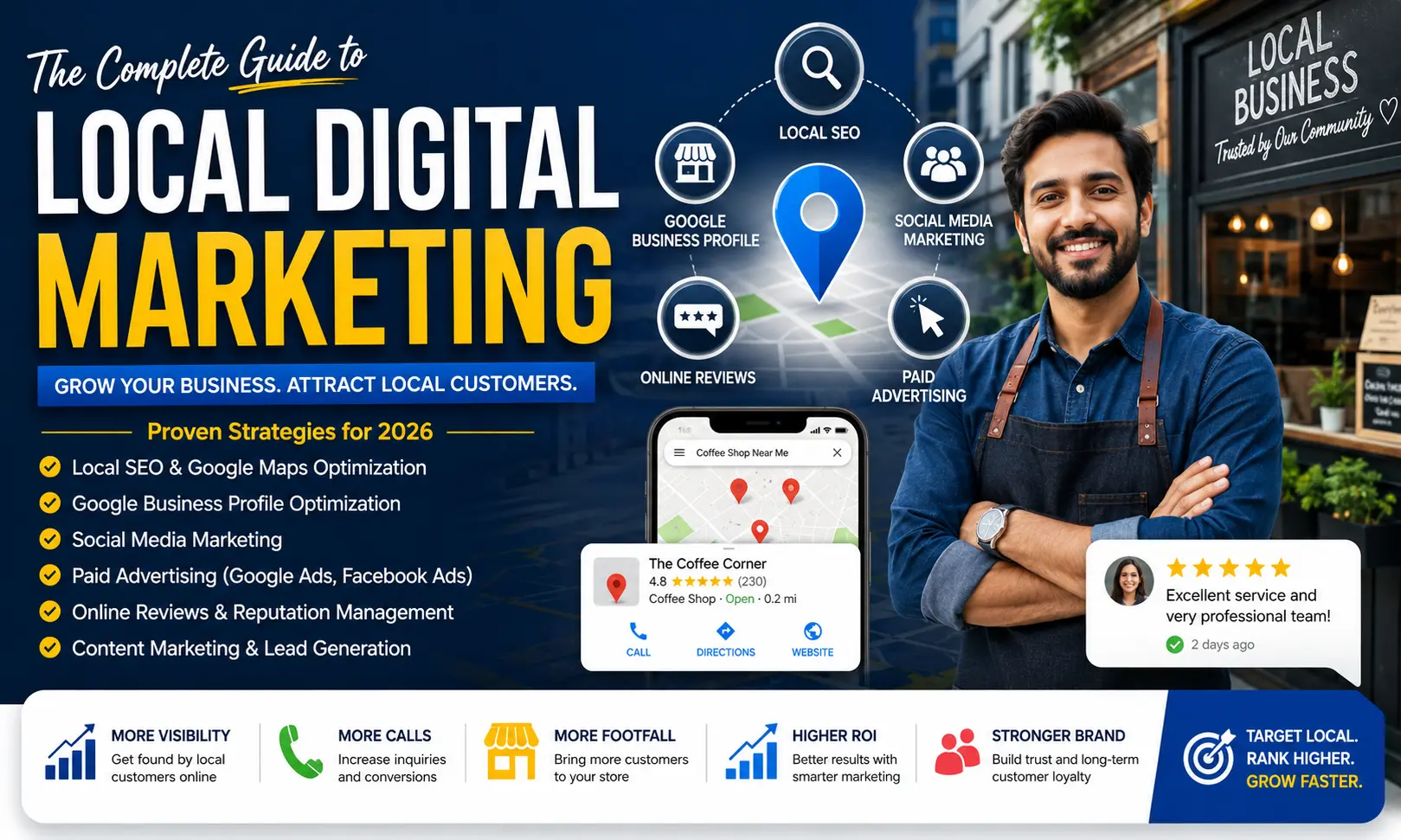
Introduction
In today’s digital world, people no longer rely only on newspapers, flyers, or word-of-mouth recommendations when searching for local businesses. Whether someone wants a nearby restaurant, dentist, gym, plumber, salon, or digital marketing agency, their first step is almost always a Google search.
Searches like:
- Best restaurant near me
- Digital marketing agency near me
- Plumber in Delhi
- Local SEO expert
- Coffee shop open now
are performed millions of times every day.
This is where Local Digital Marketing becomes essential.
Local digital marketing helps businesses connect with nearby customers who are actively looking for products or services. Instead of advertising to everyone, it focuses on attracting people within a specific geographic area.
Whether you own:
- A local store
- Medical clinic
- Law firm
- Restaurant
- Salon
- Fitness center
- Real estate agency
- Coaching institute
- Service business
local digital marketing can dramatically increase visibility, leads, and sales.
This comprehensive guide explains everything you need to know to dominate your local market in 2026.
Table of Contents
- Introduction
- What Is Local Digital Marketing?
- Why Local Digital Marketing Matters in 2026
- Benefits of Local Digital Marketing
- Understanding Local Search Intent
- Core Components of Local Digital Marketing
Section A – Building a Strong Local Online Presence
- Understanding Local SEO
- Key Local SEO Ranking Factors
- Optimizing Your Google Business Profile
- Local Keyword Research
- Building a Local-Friendly Website
- Creating Location-Specific Landing Pages
- Using Local Business Schema Markup
- Mobile Optimization for Local Search
Section B – Building Trust and Customer Engagement
- Importance of Online Reviews
- Online Reputation Management
- Local Content Marketing Strategies
- Business Citations and NAP Consistency
- Social Media Marketing for Local Businesses
- Customer Engagement and Community Building
Section C – Advanced Local Digital Marketing Strategies
- Advanced Local SEO Techniques
- Voice Search Optimization
- Hyperlocal Content Marketing
- Local Link Building Strategies
- Customer Case Studies and Testimonials
- Competitor Analysis for Local Businesses
Section D – Paid Advertising and Business Growth
- Google Ads for Local Businesses
- Facebook and Instagram Local Advertising
- Remarketing and Retargeting Campaigns
- Email Marketing for Local Customers
- SMS Marketing Strategies
- Conversion Rate Optimization (CRO)
Section E – Automation, Analytics, and Future Trends
- AI Tools for Local Digital Marketing
- Marketing Automation
- Measuring Local Marketing Performance
- Key Performance Indicators (KPIs)
- Common Local Digital Marketing Mistakes to Avoid
- Future Trends in Local Digital Marketing (2026)
- Local Digital Marketing Checklist
- Real-World Case Study
- Conclusion
- Frequently Asked Questions (FAQs)
What Is Local Digital Marketing?
Local digital marketing is the process of promoting a business online to customers within a defined geographic location. It combines multiple digital channels to increase visibility among people who are most likely to become paying customers.
These channels include:
- Local SEO
- Google Business Profile
- Social media marketing
- Local paid advertising
- Content marketing
- Email marketing
- SMS marketing
- Online reviews
- Directory listings
- Mobile marketing
The goal is simple:
Help nearby customers discover your business when they need your products or services.
 SEO
SEO
Krishna Kushwaha| Jul 13, 2026| 17 min read
Digital Marketing Consultant: The Complete Guide to Growing Your Business in 2026
Why Local Digital Marketing Matters
Consumer behavior has changed significantly over the past decade.
Today, before visiting a store or booking a service, most people:
- Search online
- Compare ratings
- Read reviews
- Check photos
- View business hours
- Visit websites
- Look at social media pages
Businesses that are easy to find online often receive more inquiries and more sales than those with little or no online presence.
Major Benefits
- Increased local visibility
- Higher-quality leads
- Better customer trust
- More website traffic
- More phone calls
- Increased foot traffic
- Better conversion rates
- Lower advertising costs
- Long-term business growth
For small businesses with limited budgets, local digital marketing can provide one of the highest returns on investment.
Understanding Local Search Intent
Not every search has the same purpose. Local searches often indicate strong buying intent.
Examples include:
- “Best pizza near me”
- “Emergency electrician”
- “Hair salon open today”
- “Digital marketing company in Mumbai”
These users are usually ready to make a decision soon. Appearing prominently in these searches can lead directly to calls, bookings, or store visits.
The Core Components of Local Digital Marketing
Successful local marketing combines several strategies:
- Local SEO
- Google Business Profile
- Website optimization
- Reviews
- Content marketing
- Social media
- Paid advertising
- Local directories
- Analytics
- Customer retention
When these elements work together, they create a strong online presence that helps businesses attract and retain customers.
Building a Strong Local Online Presence
Understanding Local SEO
Local SEO (Search Engine Optimization) is the process of improving your online visibility so that your business appears in location-based search results.
Unlike traditional SEO, local SEO focuses on geographic relevance.
For example:
Instead of targeting “digital marketing,” a local campaign would target:
- Digital marketing agency in Lucknow
- SEO expert in Kanpur
- Local digital marketing services in Delhi
This helps attract customers who are searching in a specific area.
Key Ranking Factors
Search engines consider several factors when ranking local businesses:
- Business relevance
- Distance from the searcher
- Prominence
- Website quality
- Customer reviews
- Local backlinks
- Business citations
- Consistent contact information
Improving these factors increases your chances of appearing in local search results and map listings.
 SEO
SEO
Krishna Kushwaha| Jul 12, 2026| 19 min read
Digital Marketing Expert: The Ultimate Guide to Becoming a Successful Digital Marketing Professional in 2026
Optimize Your Google Business Profile
One of the most effective tools for local visibility is your Google Business Profile.
A well-optimized profile can help your business appear in Google Maps and local search results.
Important optimization steps include:
- Use your exact business name
- Select the correct business category
- Add accurate contact details
- Specify business hours
- Upload high-quality photos
- Add videos where relevant
- Respond to customer reviews
- Publish regular updates
- Include products or services
- Keep information current
A complete profile improves trust and encourages potential customers to contact your business.
Local Keyword Research
Choosing the right keywords is fundamental to attracting the right audience.
Instead of broad terms, focus on location-specific phrases that reflect how people search for businesses nearby.
Examples:
- Local digital marketing agency
- Digital marketing services in Jaipur
- SEO consultant in Pune
- Social media marketing near me
- Affordable local SEO services
Include these naturally in:
- Page titles
- Meta descriptions
- URLs
- Headings
- Service pages
- Blog posts
- Image alt text
Avoid stuffing keywords, as readability and user experience remain important.
Build a Local-Friendly Website
Your website serves as the central hub of your online presence. It should provide clear information, load quickly, and be easy to navigate.
Essential elements include:
- Mobile-responsive design
- Fast page speed
- Clear navigation
- Contact information
- Service pages
- Location-specific landing pages
- Embedded maps
- Customer testimonials
- Calls to action
- Secure HTTPS connection
A well-designed website not only helps with SEO but also improves user trust and conversions.
Create Dedicated Location Pages
If your business serves multiple cities or regions, create separate landing pages for each location.
For example:
- /digital-marketing-delhi
- /digital-marketing-noida
- /digital-marketing-gurgaon
Each page should contain unique, locally relevant content, including services, nearby landmarks, testimonials, and contact details.
Use Structured Data
Adding Local Business Schema helps search engines better understand your business information, such as:
- Name
- Address
- Phone number
- Opening hours
- Services
- Reviews
This can enhance your visibility in search results and support richer search features.
Building Trust and Reputation
Why Online Reviews Matter
Online reviews influence purchasing decisions and local rankings.
Many customers read reviews before choosing a business, making reputation management a key part of local digital marketing.
Encourage satisfied customers to leave honest feedback and respond professionally to all reviews—positive or negative.
Local Content Marketing
Publishing useful, locally relevant content helps attract visitors and demonstrates expertise.
Ideas include:
- Neighborhood guides
- Local event coverage
- Customer success stories
- Seasonal tips
- FAQs
- Community news
- Industry updates
- How-to articles related to your services
This content can improve SEO and keep your audience engaged.
Build Accurate Business Citations
A business citation is any online mention of your business name, address, and phone number (NAP).
Ensure this information is consistent across:
- Local directories
- Industry-specific listings
- Social media profiles
- Review platforms
- Your website
Consistency helps search engines trust your business information.
Optimize for Mobile Users
A large share of local searches happen on smartphones.
Your website should:
- Load quickly
- Display correctly on all screen sizes
- Offer click-to-call functionality
- Make directions easy to access
- Use readable fonts and clear buttons
A mobile-friendly experience increases the likelihood that visitors will become customers.
Measuring Local Marketing Success
Track key performance indicators such as:
- Organic traffic
- Local keyword rankings
- Phone calls
- Contact form submissions
- Direction requests
- Google Business Profile interactions
- Website conversions
- Review growth
- Customer acquisition cost
Regular analysis allows you to refine your strategy and focus on what delivers the best results.
 SEO
SEO
Krishna Kushwaha| Jul 12, 2026| 19 min read
Digital Marketing Strategy: The Complete Guide to Building a Successful Online Marketing Plan in 2026
Advanced Local Digital Marketing Strategies
1. Advanced Local SEO Techniques
Once the basics are in place, it’s time to refine your Local SEO strategy. Advanced optimization can help you outrank competitors and capture more high-intent local searches.
Optimize for Voice Search
Voice assistants such as Google Assistant, Siri, and Alexa have changed how people search online. Users often ask complete questions like:
- “Where is the best digital marketing agency near me?”
- “Who offers affordable SEO services in Jaipur?”
- “Which bakery is open now?”
To optimize for voice search:
- Use conversational keywords.
- Add FAQ sections with natural-language questions.
- Include concise answers (40–60 words) where appropriate.
- Ensure your Google Business Profile information is accurate.
2. Build High-Quality Local Backlinks
Backlinks remain one of Google’s strongest ranking signals. For local businesses, focus on earning links from relevant local sources.
Good backlink opportunities include:
- Local news websites
- Chamber of Commerce websites
- Local business associations
- Community blogs
- Local event sponsorships
- Schools and universities
- Non-profit organizations
- Industry directories
Avoid buying backlinks or participating in link schemes, as these can harm your rankings.
3. Create Hyperlocal Content
Hyperlocal content focuses on neighborhoods, communities, or specific areas rather than entire cities.
Examples:
- “Best SEO Tips for Small Businesses in South Delhi”
- “Digital Marketing Trends for Restaurants in Lucknow”
- “How Local Retail Stores in Mumbai Can Increase Sales”
Hyperlocal content improves relevance and attracts highly targeted visitors.
4. Publish Customer Success Stories
Case studies and testimonials build credibility and demonstrate real results.
A strong case study should include:
- The client’s challenge
- Your solution
- Measurable outcomes
- Customer feedback
- Visuals or screenshots (where appropriate)
This content helps potential customers understand the value of your services.
 SEO
SEO
Krishna Kushwaha| Jul 10, 2026| 20 min read
Digital Advertising: The Complete Guide to Growing Your Business Online in 2026
Paid Advertising for Local Businesses
Organic marketing is powerful, but paid advertising can deliver faster results when managed effectively.
Google Ads
Google Ads allow your business to appear at the top of search results for location-based queries.
Popular campaign types include:
- Search Ads
- Display Ads
- Performance Max
- Local campaigns (where available)
- Call campaigns
Tips for success:
- Use location targeting.
- Focus on high-intent keywords.
- Write compelling ad copy.
- Add call extensions and location extensions.
- Track conversions to measure performance.
Facebook and Instagram Ads
Social media platforms offer detailed geographic targeting, making them effective for local businesses.
You can target users by:
- City
- ZIP/Postal code
- Radius around your business
- Interests
- Behaviors
- Age
- Gender
Effective ad formats include:
- Carousel ads
- Video ads
- Lead generation forms
- Promotional offers
- Event advertisements
Remarketing Campaigns
Many visitors don’t convert on their first visit. Remarketing helps you reconnect with those users through targeted ads after they’ve left your website.
Benefits include:
- Higher conversion rates
- Increased brand recall
- Better return on ad spend
- More qualified leads
Social Media Marketing for Local Businesses
A consistent social media presence helps businesses engage with local audiences and build trust.
Recommended Platforms
- LinkedIn (for B2B)
- YouTube
- Pinterest (for visual industries)
Content ideas:
- Behind-the-scenes videos
- Customer testimonials
- Local event coverage
- Team introductions
- Product demonstrations
- Educational tips
- Polls and Q&A sessions
Encourage customers to tag your business and share their experiences to expand your reach organically.
Email Marketing for Local Customer Retention
Acquiring new customers is important, but retaining existing ones is often more cost-effective.
Email campaigns can include:
- Monthly newsletters
- Exclusive discounts
- Product updates
- Local event announcements
- Holiday promotions
- Educational content
Personalized emails based on customer preferences generally achieve better engagement.
SMS Marketing
SMS remains an effective communication channel due to high open rates.
Use it for:
- Appointment reminders
- Flash sales
- Limited-time offers
- Event invitations
- Order updates
Always obtain customer consent before sending marketing messages and comply with applicable regulations.
Conversion Rate Optimization (CRO)
Driving traffic is only half the battle. Your website should encourage visitors to take action.
Ways to improve conversions:
- Clear calls-to-action
- Fast loading speed
- Easy navigation
- Trust badges
- Customer testimonials
- Simple contact forms
- Click-to-call buttons
- Live chat support
Regularly test different layouts, headlines, and button text to identify what performs best.
AI Tools for Local Digital Marketing
Artificial intelligence can streamline marketing tasks and improve efficiency.
Common applications include:
- Content creation assistance
- Keyword research
- Chatbots for customer support
- Email personalization
- Review monitoring
- Ad optimization
- Analytics and reporting
Use AI to support your workflow, while ensuring that important content is reviewed by a human for accuracy and brand consistency.
Marketing Automation
Automation saves time and helps maintain consistent communication.
You can automate:
- Welcome emails
- Lead nurturing sequences
- Review requests
- Appointment confirmations
- Social media scheduling
- CRM follow-ups
- Customer segmentation
Automation allows small teams to scale their marketing efforts without sacrificing quality.
Online Reputation Management
A positive online reputation influences customer decisions and supports local SEO.
Best practices:
- Ask satisfied customers for reviews.
- Respond professionally to all feedback.
- Address concerns promptly.
- Monitor review platforms regularly.
- Keep business information up to date.
A thoughtful response to negative feedback can demonstrate professionalism and build trust.
Measuring Local Marketing Performance
Track key performance indicators (KPIs) to evaluate your strategy.
Important metrics include:
- Organic traffic
- Local keyword rankings
- Google Business Profile views
- Phone calls
- Direction requests
- Contact form submissions
- Conversion rate
- Cost per lead
- Customer lifetime value
- Return on investment (ROI)
Use analytics tools to identify trends and make data-driven improvements.
Common Local Digital Marketing Mistakes
Avoid these frequent issues:
- Ignoring Google Business Profile updates
- Inconsistent business information across directories
- Keyword stuffing
- Slow website speed
- Poor mobile experience
- Buying fake reviews
- Publishing duplicate content
- Neglecting customer feedback
- Running ads without conversion tracking
- Failing to analyze campaign results
Correcting these mistakes can significantly improve both user experience and search performance.
Future Trends in Local Digital Marketing (2026)
The local marketing landscape continues to evolve. Key trends include:
- Greater use of AI-powered search experiences
- Increased importance of voice search
- Personalized customer journeys
- Short-form video content
- Hyperlocal targeting
- First-party data strategies
- Enhanced privacy practices
- Automation across marketing channels
- Visual search improvements
- Stronger emphasis on customer experience
Businesses that adapt to these trends will be better positioned for long-term success.
Local Digital Marketing Checklist
Use this checklist to strengthen your online presence:
- ✅ Claim and optimize your Google Business Profile
- ✅ Maintain consistent Name, Address, and Phone (NAP) information
- ✅ Build location-specific service pages
- ✅ Optimize for mobile devices
- ✅ Publish high-quality local content
- ✅ Earn genuine customer reviews
- ✅ Build reputable local backlinks
- ✅ Use location-based keywords naturally
- ✅ Monitor analytics and conversions
- ✅ Test and improve your website regularly
Case Study Example
Imagine a local dental clinic that wanted to increase new patient appointments.
The clinic:
- Optimized its Google Business Profile
- Created separate pages for each service
- Published educational blog posts
- Encouraged patients to leave reviews
- Ran Google Search Ads targeting nearby users
- Improved website speed and mobile usability
Over several months, the clinic saw:
- Increased visibility in local search
- More website visits
- Higher call volume
- More appointment requests
- Stronger online reputation
While results vary by industry, this illustrates how combining multiple local marketing tactics can create sustainable growth.
Final Thoughts
Local digital marketing is no longer optional for businesses that rely on nearby customers. Whether you operate a restaurant, retail store, clinic, agency, or service-based business, your online presence plays a major role in how potential customers discover and evaluate your brand.
Success doesn’t come from a single tactic. Instead, it comes from combining Local SEO, an optimized Google Business Profile, valuable content, positive customer reviews, targeted advertising, social media engagement, and ongoing performance analysis into a cohesive strategy.
Rather than trying every marketing channel at once, focus on building a strong foundation, measuring results, and improving over time. Consistency and customer value are the keys to long-term local growth.
Conclusion
Local digital marketing has become one of the most effective ways for businesses to attract nearby customers, build credibility, and achieve sustainable growth in today’s competitive marketplace. As more consumers rely on search engines, online reviews, social media, and mobile devices to find local products and services, businesses with a strong digital presence have a significant advantage over those that rely only on traditional marketing methods.
A successful local digital marketing strategy is built on several key pillars: an optimized Google Business Profile, effective Local SEO, a fast and mobile-friendly website, high-quality local content, consistent business information across online directories, authentic customer reviews, and targeted advertising campaigns. When these elements work together, they increase your visibility in local search results, drive qualified traffic, and convert online visitors into loyal customers.
However, local digital marketing is not a one-time effort. Search engine algorithms, consumer behavior, and digital marketing technologies continue to evolve. To stay competitive in 2026 and beyond, businesses should regularly update their website, monitor analytics, engage with customers on social media, respond to reviews, and refine their marketing campaigns based on performance data.
Artificial intelligence, automation, voice search, and hyperlocal targeting are also reshaping the future of local marketing. Businesses that embrace these innovations while maintaining a customer-focused approach will be better positioned to grow and outperform their competitors.
Whether you own a small retail shop, restaurant, healthcare clinic, law firm, digital marketing agency, or any other local business, investing in a comprehensive local digital marketing strategy can generate long-term benefits. By consistently providing value, building trust, and improving your online presence, you can attract more local customers, increase brand awareness, and create a sustainable foundation for business success.
The most successful local businesses are not always the biggest—they are often the ones that are easiest to find, most trusted by their customers, and committed to delivering an outstanding experience both online and offline. Start implementing these strategies today, measure your progress, and continuously optimize your efforts. With patience, consistency, and the right digital marketing approach, your local business can achieve lasting growth and become a trusted leader in your community.
Frequently Asked Questions (FAQs)
Local digital marketing is the process of promoting a business online to customers within a specific geographic area. It includes strategies such as Local SEO, Google Business Profile optimization, social media marketing, paid advertising, email marketing, online reputation management, and local content marketing. The primary goal is to make it easier for nearby customers to find your business when they search for products or services online. For small businesses, local digital marketing is one of the most cost-effective marketing methods because it targets people who are already interested in buying locally. A strong local marketing strategy can increase website traffic, phone calls, store visits, online bookings, and customer trust while helping businesses compete effectively with larger brands.
Although both Local SEO and traditional SEO aim to improve search engine rankings, their focus is different. Traditional SEO targets a national or global audience by optimizing websites for broad keywords, while Local SEO focuses on attracting customers from a specific city, region, or neighborhood. Local SEO emphasizes optimizing a Google Business Profile, maintaining consistent business information across directories, earning customer reviews, creating location-based landing pages, and targeting keywords such as “digital marketing agency in Delhi” or “best coffee shop near me.” Businesses that depend on local customers, such as restaurants, clinics, salons, retail stores, and service providers, benefit significantly from Local SEO because it increases visibility in local search results and Google Maps.
Google Business Profile is one of the most valuable tools for local businesses because it allows them to appear in Google Search and Google Maps when potential customers search for nearby services. A fully optimized profile includes accurate business information, contact details, operating hours, categories, photos, products, services, and customer reviews. Keeping this information updated improves credibility and makes it easier for customers to contact or visit your business. Regularly posting updates, responding to reviews, and adding new images can also improve customer engagement. Since many local searches lead directly to calls, direction requests, or website visits, an optimized Google Business Profile plays a vital role in generating local leads and improving online visibility.
The most effective local digital marketing strategy combines multiple channels instead of relying on a single method. Businesses should start by optimizing their website for Local SEO and creating a complete Google Business Profile. Publishing high-quality local content, collecting genuine customer reviews, maintaining consistent business information across directories, and actively engaging on social media help build trust and visibility. Paid advertising through Google Ads and Facebook or Instagram Ads can generate faster results by targeting nearby audiences. Email marketing and SMS campaigns help retain existing customers and encourage repeat business. Tracking analytics and continuously optimizing campaigns ensures long-term success and better return on investment (ROI).
The time required to see measurable results depends on factors such as your industry, competition, website quality, and the strategies you implement. Paid advertising campaigns can generate leads within days or weeks, while Local SEO typically takes three to six months to produce noticeable improvements in rankings and organic traffic. Businesses operating in highly competitive markets may require additional time and ongoing optimization. Consistently publishing quality content, improving website performance, earning authentic customer reviews, building reputable local backlinks, and monitoring analytics all contribute to steady growth. Local digital marketing is a long-term investment, and businesses that remain consistent with their efforts are more likely to achieve sustainable visibility, stronger customer relationships, and increased revenue over time.
Leave a Reply