Introduction
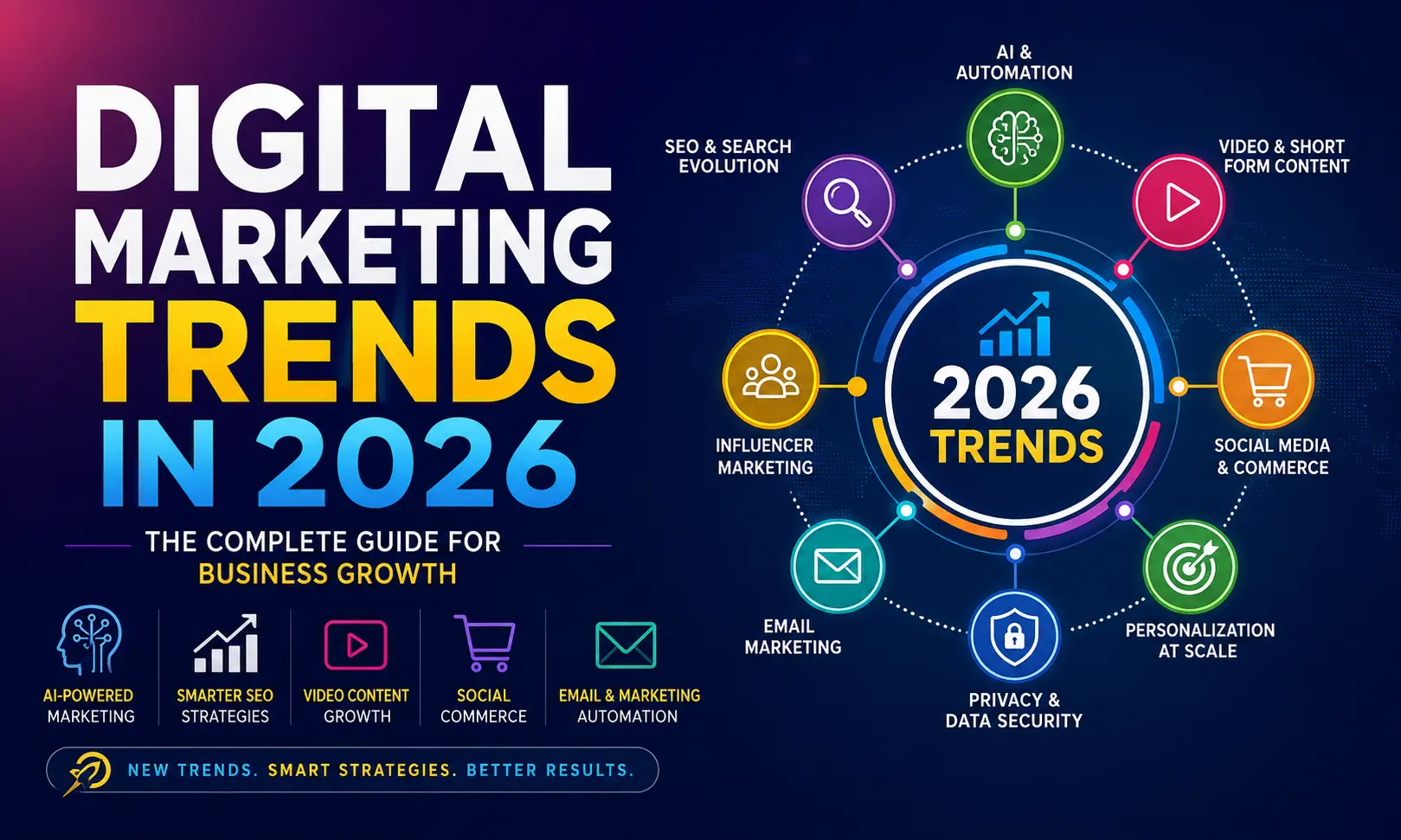
Digital marketing changes faster than almost any other industry. What worked a year ago may no longer deliver the same results today. Search engine algorithms evolve, consumer behavior shifts, artificial intelligence becomes smarter, and new social media platforms constantly emerge.
Businesses that stay updated with the latest digital marketing trends gain a competitive advantage. They attract more visitors, generate better leads, increase conversions, and build stronger customer relationships.
Whether you’re a business owner, blogger, freelancer, SEO professional, or digital marketer, understanding the newest marketing trends is essential for long-term success.
This comprehensive guide explores the biggest digital marketing trends shaping 2026 and explains how you can use them to grow your online presence.
Table of Contents
- Introduction
- What Are Digital Marketing Trends?
- Why Digital Marketing Trends Matter in 2026
- AI-Powered Marketing: The Future of Digital Growth
- Search Engine Optimization (SEO) Trends
- Search Intent Optimization
- Topical Authority
- E-E-A-T and Helpful Content
- Technical SEO Best Practices
- Voice Search Optimization
- Visual Search Marketing
- The Rise of Video Marketing
- Short-Form Video Content Strategy
- Influencer Marketing Trends
- Social Commerce and Online Shopping
- AI-Driven Personalization
- Email Marketing Trends
- Marketing Automation
- Content Marketing Trends
- Local SEO Strategies
- Zero-Click Search Optimization
- First-Party Data and Privacy-First Marketing
- Social Media Marketing Trends
- Interactive Content Marketing
- Omnichannel Marketing Strategy
- Predictive Analytics in Digital Marketing
- Conversion Rate Optimization (CRO)
- Mobile-First Marketing
- AI Search Optimization
- Emerging Digital Marketing Technologies
- How to Stay Ahead of Digital Marketing Trends
- Common Digital Marketing Mistakes to Avoid
- Expert Tips for Long-Term Digital Marketing Success
- Future of Digital Marketing Beyond 2026
- Final Conclusion
- Frequently Asked Questions (FAQs)
What Are Digital Marketing Trends?
Digital marketing trends are the latest strategies, technologies, consumer behaviors, and online marketing practices that influence how businesses promote their products and services.
These trends include:
- Artificial Intelligence
- Search Engine Optimization
- Video Marketing
- Content Marketing
- Social Media Marketing
- Email Marketing
- Influencer Marketing
- Marketing Automation
- Voice Search
- Visual Search
- Personalization
- Data Analytics
Companies that adapt quickly usually outperform competitors that continue using outdated methods.
 SEO
SEO
Krishna Kushwaha| Jul 14, 2026| 19 min read
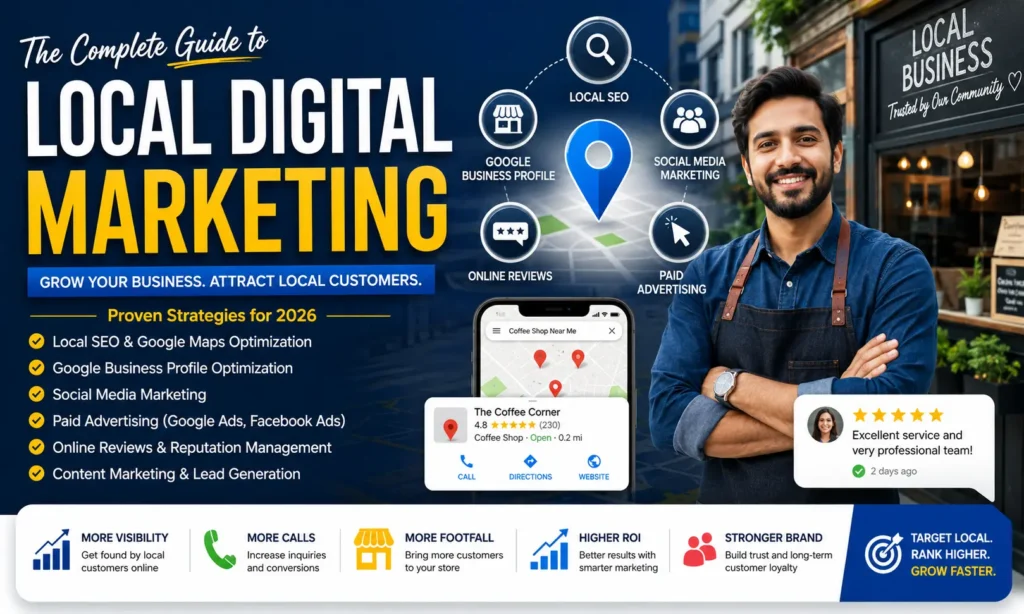
Local Digital Marketing: The Complete Guide to Growing Your Local Business in 2026
Why Digital Marketing Trends Matter
Keeping up with marketing trends provides several benefits.
Better Customer Experience
Modern consumers expect fast-loading websites, personalized recommendations, and instant customer support.
Businesses that deliver these experiences enjoy higher customer satisfaction and loyalty.
Higher Search Rankings
Google continuously updates its algorithms.
Following current SEO trends helps websites maintain or improve rankings and organic traffic.
Increased Conversion Rates
Modern marketing strategies focus on customer intent rather than simply increasing traffic.
This results in:
- Better qualified leads
- Higher sales
- Lower advertising costs
- Improved ROI
Competitive Advantage
Your competitors are investing in AI, automation, and advanced analytics.
Ignoring these trends could cause your business to fall behind.
AI-Powered Marketing: The Biggest Trend of 2026
Artificial Intelligence has transformed digital marketing.
Today, AI assists marketers with:
- Content creation
- SEO optimization
- Keyword research
- Customer support
- Email campaigns
- Ad targeting
- Data analysis
- Predictive marketing
Benefits of AI Marketing
Faster Content Creation
AI tools can generate:
- Blog outlines
- Product descriptions
- Social media captions
- Email newsletters
- Advertising copy
This saves time while improving productivity.
Better Customer Support
AI-powered chatbots provide:
- 24/7 support
- Instant responses
- Lead qualification
- Appointment booking
- Product recommendations
Customers receive faster assistance, improving satisfaction.
Improved Advertising
AI analyzes customer behavior to optimize:
- Facebook Ads
- Google Ads
- Instagram Ads
- LinkedIn Campaigns
This leads to:
- Lower cost per click
- Higher conversion rates
- Better targeting
- Improved return on investment
 SEO
SEO
Krishna Kushwaha| Jul 13, 2026| 17 min read
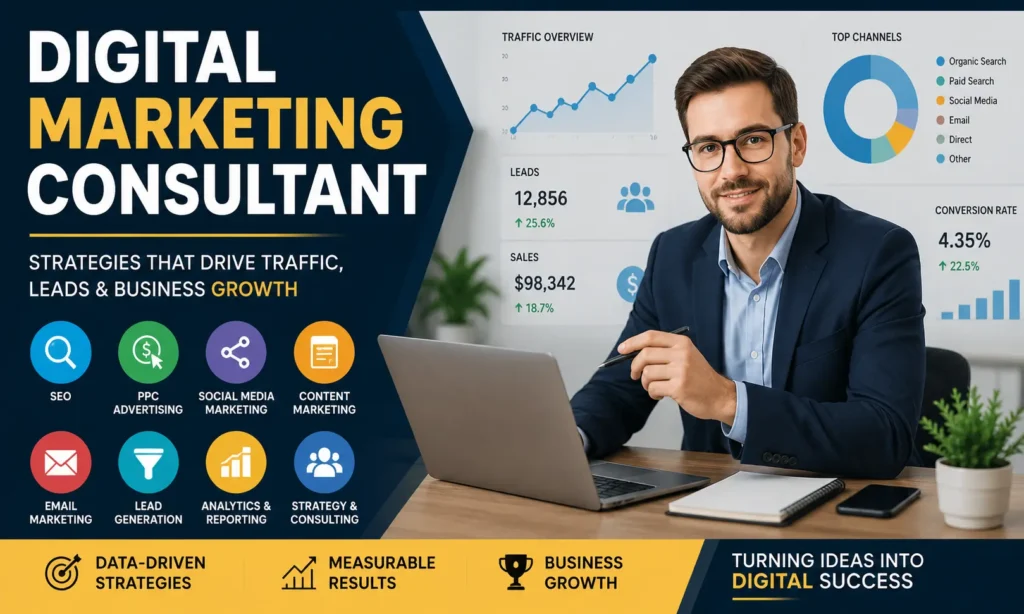
Digital Marketing Consultant: The Complete Guide to Growing Your Business in 2026
SEO Trends in 2026
Search Engine Optimization remains one of the highest ROI marketing channels.
However, SEO continues evolving.
Search Intent Becomes More Important
Google now prioritizes content that genuinely answers user questions.
Instead of focusing only on keywords, marketers should create content that solves real problems.
Good content should be:
- Helpful
- Original
- Accurate
- Comprehensive
- Easy to read
Topical Authority
Rather than publishing isolated articles, websites should create complete topic clusters.
Example:
Main Topic:
Digital Marketing
Supporting Articles:
- SEO Guide
- PPC Guide
- Social Media Guide
- Email Marketing
- Affiliate Marketing
- Local SEO
- Content Marketing
This improves topical authority and search visibility.
User Experience (UX)
Google increasingly rewards websites that provide an excellent user experience.
Key ranking factors include:
- Fast loading speed
- Mobile responsiveness
- Clear navigation
- Secure HTTPS
- Minimal intrusive ads
- Accessible design
High-Quality Content
Content remains the foundation of successful SEO.
Winning content should include:
- Original insights
- Statistics
- Expert opinions
- Practical examples
- Updated information
- Clear formatting
Long-form guides often perform well when they address a topic thoroughly and match user intent.
Voice Search Optimization
Millions of people use voice assistants daily.
Examples include:
- Google Assistant
- Siri
- Alexa
Voice searches are usually conversational.
Traditional search:
“best digital marketing agency”
Voice search:
“What is the best digital marketing agency near me?”
Businesses should optimize content using natural language and question-based headings.
Tips for Voice SEO
Use:
- FAQ sections
- Long-tail keywords
- Conversational writing
- Local SEO
- Structured data (Schema Markup)
Visual Search Marketing
Visual search continues growing.
Users can upload an image instead of typing keywords.
Popular platforms include:
- Google Lens
- Pinterest Lens
Businesses should optimize:
- Image filenames
- Alt text
- Captions
- Image quality
- Structured image data
 SEO
SEO
Krishna Kushwaha| Jul 12, 2026| 19 min read
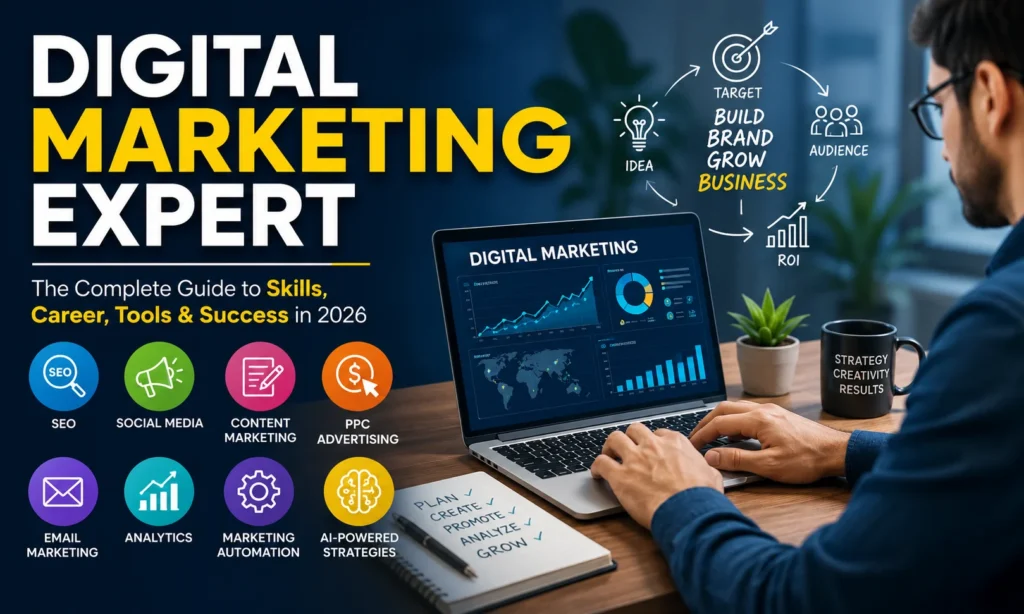
Digital Marketing Expert: The Ultimate Guide to Becoming a Successful Digital Marketing Professional in 2026
Video Marketing Continues to Dominate
Video remains one of the most effective forms of digital marketing.
Consumers prefer watching videos rather than reading lengthy text for many topics.
Popular formats include:
- Tutorials
- Product demonstrations
- Customer testimonials
- Live streams
- Educational content
- Behind-the-scenes videos
Benefits of Video Marketing
Video helps businesses:
- Increase engagement
- Improve conversions
- Build trust
- Explain complex topics
- Boost brand awareness
Search engines also favor pages with engaging multimedia when it improves user experience.
Short-Form Video Content
Platforms such as Instagram Reels, YouTube Shorts, and TikTok have changed how audiences consume content.
Successful short-form videos are:
- Under 60 seconds
- Visually engaging
- Educational or entertaining
- Optimized with captions
- Designed for mobile viewing
Brands use these videos to increase reach, drive website traffic, and build stronger communities.
Influencer Marketing Trends
Influencer marketing has evolved from celebrity endorsements to authentic creator partnerships.
Businesses increasingly collaborate with:
- Nano influencers
- Micro influencers
- Industry experts
- Niche content creators
Smaller creators often achieve higher engagement because of stronger audience trust.
Best practices include:
- Choosing relevant creators
- Prioritizing authenticity
- Tracking campaign performance
- Building long-term partnerships
Social Commerce Growth
Social media platforms are becoming shopping destinations.
Consumers can discover products, read reviews, and complete purchases without leaving the app.
Popular social commerce features include:
- Product catalogs
- Live shopping
- Shoppable posts
- Creator storefronts
Businesses should optimize product images, descriptions, and customer reviews to improve conversions.
Personalization Using AI
Customers expect personalized experiences.
AI helps businesses deliver:
- Personalized product recommendations
- Customized email campaigns
- Dynamic website content
- Targeted advertisements
- Behavior-based offers
Personalization improves engagement, customer satisfaction, and repeat purchases.
Email Marketing Innovations
Email marketing remains one of the highest-performing digital channels.
Modern email campaigns focus on:
- Behavioral triggers
- Personalized subject lines
- Interactive content
- Automated sequences
- AI-powered optimization
Important email metrics include:
- Open rate
- Click-through rate
- Conversion rate
- Unsubscribe rate
Regular testing helps improve campaign performance over time.
Marketing Automation
Automation enables businesses to save time while delivering consistent customer experiences.
Common automated workflows include:
- Welcome emails
- Lead nurturing
- Cart abandonment reminders
- Customer onboarding
- Re-engagement campaigns
When combined with AI, automation can improve efficiency without sacrificing personalization.
16. Content Marketing Trends
Content marketing remains the backbone of successful digital marketing. However, the focus has shifted from creating a high volume of content to producing content that is original, authoritative, and genuinely helpful. Search engines reward websites that demonstrate expertise, experience, authoritativeness, and trustworthiness (E-E-A-T).
Focus on Helpful Content
Businesses should create content that answers users’ questions in depth. Instead of publishing multiple short articles on similar topics, it’s often better to develop comprehensive guides that solve a problem completely.
Helpful content should include:
- Step-by-step tutorials
- Real-world examples
- Case studies
- Original research
- Expert opinions
- Frequently updated information
- Visual aids such as charts and infographics
Topic Clusters
Rather than writing isolated blog posts, build topic clusters around a central pillar page.
Example:
Pillar Page: Digital Marketing
Supporting Articles:
- SEO Guide
- Local SEO
- Technical SEO
- Content Marketing
- Email Marketing
- PPC Advertising
- Affiliate Marketing
- Social Media Marketing
- AI Marketing
This strategy improves internal linking, user navigation, and topical authority.
 SEO
SEO
Krishna Kushwaha| Jul 12, 2026| 19 min read
Digital Marketing Strategy: The Complete Guide to Building a Successful Online Marketing Plan in 2026
17. Local SEO Trends
Local businesses continue to benefit from optimized local search strategies.
Consumers frequently search for:
- Digital marketing agency near me
- Best SEO company nearby
- Website designer in my city
- Social media marketing expert near me
Optimize Your Business Profile
Maintain accurate business information:
- Business name
- Address
- Phone number
- Website
- Business hours
- Categories
- High-quality photos
Encourage satisfied customers to leave reviews, as positive ratings significantly influence local rankings and customer trust.
Localized Content
Publish blog posts targeting your service areas, such as:
- Best Digital Marketing Services in Delhi
- SEO Tips for Small Businesses in Mumbai
- How Local Businesses Can Improve Google Rankings
18. Zero-Click Search Optimization
Search engines increasingly provide answers directly on the results page through featured snippets, AI-generated summaries, and knowledge panels. This creates more “zero-click” searches.
To increase visibility:
- Answer common questions clearly.
- Use concise definitions.
- Structure content with headings.
- Include FAQ sections.
- Add schema markup where appropriate.
Even if users don’t click immediately, appearing prominently can strengthen brand recognition.
19. First-Party Data Becomes Essential
As third-party cookies continue to decline, businesses are relying more on first-party data—information collected directly from customers.
Examples include:
- Email subscribers
- Customer purchase history
- Website behavior
- Survey responses
- Loyalty program data
Collecting data transparently and with user consent helps businesses personalize marketing while respecting privacy expectations.
20. Privacy-Focused Marketing
Consumers are increasingly aware of how their data is collected and used.
Businesses should:
- Explain their privacy practices clearly.
- Obtain consent where required.
- Provide easy preference management.
- Protect customer information with strong security measures.
Building trust through transparent data practices can become a competitive advantage.
21. Social Media Trends
Social media continues evolving rapidly.
Current priorities include:
Community Building
Instead of chasing follower counts, successful brands focus on creating active communities.
Ways to build engagement:
- Respond to comments
- Host live sessions
- Create discussion posts
- Encourage user-generated content
- Run polls and Q&A sessions
Authentic Content
Audiences increasingly prefer authentic, educational, and relatable content over overly polished advertisements.
Behind-the-scenes videos, customer stories, and practical tips often perform exceptionally well.
22. Interactive Content
Interactive experiences encourage users to spend more time engaging with your brand.
Popular formats include:
- Quizzes
- Polls
- Calculators
- Surveys
- Interactive infographics
- Product recommendation tools
These formats also provide valuable insights into customer preferences.
23. Omnichannel Marketing
Customers interact with businesses through multiple channels before making a purchase.
These may include:
- Search engines
- Social media
- Websites
- Mobile apps
- Messaging platforms
An omnichannel strategy ensures consistent branding, messaging, and customer experiences across every touchpoint.
24. Predictive Analytics
Predictive analytics uses historical data and machine learning to forecast future customer behavior.
Businesses can predict:
- Customer churn
- Purchase likelihood
- Product demand
- Marketing campaign performance
- Seasonal trends
This enables smarter decision-making and more efficient allocation of marketing budgets.
25. Marketing Automation Becomes Smarter
Automation is no longer limited to scheduled emails.
Modern platforms automate:
- Lead scoring
- Customer segmentation
- Personalized recommendations
- Follow-up messages
- Retargeting campaigns
- Customer lifecycle communications
Automation allows marketing teams to focus more on strategy and creativity.
26. Conversion Rate Optimization (CRO)
Driving traffic is only half the equation. Improving conversion rates ensures more visitors become customers.
Effective CRO techniques include:
- Faster page speed
- Clear calls to action
- Simplified forms
- Mobile-friendly design
- Trust signals such as reviews and testimonials
- A/B testing of landing pages
Even small improvements in conversion rates can significantly increase revenue.
27. Mobile-First Marketing
Most users now browse and shop on mobile devices.
To succeed:
- Use responsive website design.
- Optimize page loading speed.
- Create mobile-friendly navigation.
- Compress images without reducing quality.
- Ensure buttons and forms are easy to use on smaller screens.
A poor mobile experience can lead to lost traffic and lower search rankings.
28. AI Search Optimization
As AI-powered search experiences become more common, content should be structured so it can be easily understood and summarized.
Best practices include:
- Clear headings
- Logical organization
- Concise explanations
- Accurate information
- Original insights
- Strong internal linking
Publishing trustworthy, well-structured content improves the chances of being surfaced in AI-assisted search experiences.
29. Future Digital Marketing Technologies
Emerging technologies expected to shape marketing include:
- Generative AI for content creation
- Advanced customer analytics
- Conversational AI assistants
- Augmented Reality (AR) experiences
- Virtual Reality (VR) product demonstrations
- Blockchain-based advertising transparency
- AI-powered personalization at scale
Businesses don’t need to adopt every new technology immediately, but staying informed helps identify opportunities.
30. How to Stay Ahead of Digital Marketing Trends
To remain competitive:
- Follow reputable industry publications.
- Monitor analytics regularly.
- Test new marketing strategies.
- Invest in ongoing learning and training.
- Create high-quality, user-focused content.
- Keep your website technically optimized.
- Build an engaged audience rather than relying on one platform.
- Review and refine campaigns based on data.
Consistency and continuous improvement are key to long-term success.
Common Mistakes to Avoid
Avoid these common pitfalls:
- Ignoring SEO fundamentals
- Publishing AI-generated content without review
- Neglecting mobile optimization
- Focusing only on traffic instead of conversions
- Inconsistent branding
- Ignoring analytics
- Not updating older content
- Overlooking customer feedback
- Depending entirely on paid advertising
- Failing to test marketing campaigns
Expert Tips for Digital Marketing Success
- Focus on solving customer problems before promoting products.
- Build topical authority with comprehensive content clusters.
- Invest in email marketing to own your audience.
- Diversify traffic sources across SEO, social media, and email.
- Use analytics to guide decisions rather than assumptions.
- Optimize every piece of content for both users and search intent.
- Prioritize trust, transparency, and long-term relationships over short-term gains.
Final Conclusion: Digital Marketing Trends in 2026
Digital marketing is no longer just about having a website or running online advertisements. In 2026, it has become a dynamic ecosystem powered by artificial intelligence, automation, data analytics, personalized customer experiences, and high-quality content. Businesses that embrace innovation while staying focused on customer needs will be better positioned to succeed in an increasingly competitive digital landscape.
Throughout this guide, we’ve explored the most impactful digital marketing trends shaping the future, including AI-powered marketing, advanced SEO strategies, voice and visual search optimization, short-form video content, influencer marketing, social commerce, marketing automation, privacy-first data practices, omnichannel marketing, predictive analytics, and mobile-first experiences. Each of these trends represents an opportunity to improve customer engagement, strengthen brand visibility, and drive measurable business growth.
However, adopting every trend isn’t necessary. The most successful businesses focus on the strategies that best align with their goals, target audience, and available resources. Start with a strong foundation by creating valuable, user-focused content, optimizing your website for search engines and mobile devices, building an engaged email list, and maintaining a consistent presence across relevant social media platforms. From there, gradually integrate AI tools, automation, and advanced analytics to improve efficiency and decision-making.
SEO continues to be one of the most cost-effective long-term marketing investments. Search engines increasingly reward websites that demonstrate expertise, trustworthiness, and a commitment to helping users. Instead of chasing keyword density or quick ranking tricks, focus on creating comprehensive, original, and authoritative content that answers real questions and solves real problems. Building topical authority through interconnected content clusters and regularly updating existing articles will help improve both search rankings and user experience.
Artificial intelligence is transforming how marketers create content, optimize campaigns, analyze customer behavior, and automate repetitive tasks. While AI can significantly improve productivity, human creativity, strategic thinking, and authenticity remain irreplaceable. The most effective marketing combines AI-powered efficiency with genuine storytelling, empathy, and a deep understanding of customer needs.
Social media platforms continue to evolve from communication channels into complete shopping and community-building ecosystems. Brands that prioritize meaningful engagement, educational content, and authentic interactions will earn greater trust than those relying solely on promotional messaging. Likewise, video marketing—especially short-form videos—remains one of the most effective ways to capture attention, educate audiences, and increase conversions.
Data privacy and transparency have also become essential. Customers expect businesses to handle their information responsibly and communicate clearly about how their data is collected and used. Companies that prioritize ethical marketing practices and build trust through transparency will strengthen customer loyalty over the long term.
The future of digital marketing will be driven by continuous innovation. Emerging technologies such as generative AI, augmented reality (AR), virtual reality (VR), conversational AI, predictive analytics, and advanced personalization will continue to reshape customer experiences. Businesses that remain adaptable, invest in continuous learning, and test new strategies will stay ahead of competitors and respond effectively to changing market conditions.
Ultimately, digital marketing success is not about following every trend—it’s about understanding your audience, delivering genuine value, and continuously improving your marketing efforts based on real data and customer feedback. Consistency, adaptability, and a customer-first mindset will always outperform short-term tactics.
Whether you’re a small business owner, entrepreneur, freelancer, digital marketer, blogger, or large enterprise, the opportunities in digital marketing have never been greater. By implementing the strategies and trends discussed in this guide, you can build a stronger online presence, generate high-quality leads, increase conversions, strengthen customer relationships, and create sustainable business growth.
The digital world will continue to evolve, but one principle will always remain true: businesses that educate, inspire, solve problems, and put customers first will achieve lasting success. Start implementing these digital marketing trends today, measure your results, refine your approach, and continue learning. The future belongs to those who innovate, adapt, and consistently deliver exceptional value.
Frequently Asked Questions (FAQs) About Digital Marketing Trends in 2026
Digital marketing in 2026 is driven by technology, customer experience, and data-driven decision-making. The most important trend is the integration of Artificial Intelligence (AI) into nearly every aspect of marketing. AI helps businesses automate repetitive tasks, generate high-quality content, analyze customer behavior, personalize marketing campaigns, and improve advertising performance. However, AI works best when combined with human creativity and strategic thinking.
Search Engine Optimization (SEO) also remains one of the most valuable long-term marketing strategies. Google’s algorithms increasingly prioritize high-quality, user-focused content that demonstrates Experience, Expertise, Authoritativeness, and Trustworthiness (E-E-A-T). Businesses that publish comprehensive, original, and regularly updated content are more likely to rank well in search results.
Another major trend is the rapid growth of video marketing. Short-form videos on platforms like YouTube Shorts, Instagram Reels, and TikTok have become essential for engaging audiences and increasing brand visibility. Video content helps explain products, educate customers, and improve engagement rates.
Voice search and visual search are also becoming more popular as consumers use smart devices and image-based searches to find information. Businesses should optimize their websites with conversational keywords, structured data, and high-quality images.
Marketing automation continues to improve efficiency by automating email campaigns, lead nurturing, customer segmentation, and follow-up communications. Personalization is another key trend, allowing businesses to deliver customized recommendations, targeted advertisements, and tailored customer experiences based on user behavior.
Finally, privacy-focused marketing and first-party data collection are becoming increasingly important as businesses adapt to changing privacy regulations and the decline of third-party cookies. Companies that prioritize transparency, trust, and customer consent will build stronger long-term relationships and improve brand loyalty.
Although AI and social media continue to transform digital marketing, Search Engine Optimization (SEO) remains one of the most effective and sustainable ways to generate long-term organic traffic. Unlike paid advertising, which stops producing results when your budget ends, SEO can continue driving visitors for months or even years after quality content is published.
Modern SEO is no longer about stuffing keywords into articles. Instead, it focuses on understanding user intent and creating content that genuinely answers users’ questions. Search engines reward websites that provide valuable information, excellent user experiences, fast-loading pages, mobile-friendly designs, and secure browsing.
SEO also supports every other digital marketing channel. Well-optimized content can be shared across social media, included in email newsletters, and repurposed into videos, podcasts, or infographics. Strong SEO increases brand visibility, builds authority, and helps businesses compete effectively without relying solely on paid advertising.
Technical SEO remains equally important. Optimizing page speed, fixing broken links, implementing structured data, improving Core Web Vitals, and ensuring mobile responsiveness all contribute to better rankings and user satisfaction.
As AI-powered search experiences continue to evolve, websites that publish clear, well-structured, and trustworthy content are more likely to appear in AI-generated search summaries and featured results. Therefore, SEO is not becoming less important—it is evolving into a more user-centered and quality-focused discipline.
Small businesses often have limited budgets, but digital marketing trends provide cost-effective opportunities to compete with larger brands. One of the biggest advantages is that many modern marketing tools are affordable and accessible, allowing small businesses to automate tasks, improve customer communication, and reach highly targeted audiences.
A strong SEO strategy enables small businesses to attract local customers searching for products or services online. Optimizing a Google Business Profile, collecting positive customer reviews, and publishing localized content can significantly improve visibility in local search results.
Social media platforms provide another excellent opportunity for growth. Instead of spending heavily on advertising, small businesses can build loyal communities by sharing helpful content, educational videos, customer success stories, and behind-the-scenes updates. Authentic engagement often produces better long-term results than overly promotional content.
Email marketing remains one of the highest-return marketing channels. By building an email list, businesses can communicate directly with customers, announce promotions, share valuable resources, and encourage repeat purchases through personalized campaigns.
AI tools can help small businesses save time by generating content ideas, writing email drafts, analyzing campaign performance, and providing customer support through chatbots. Marketing automation further improves efficiency by sending welcome emails, appointment reminders, abandoned cart notifications, and follow-up messages without manual effort.
The key is to focus on delivering value, understanding customer needs, and consistently improving marketing strategies based on data and customer feedback rather than trying to implement every trend at once.
Artificial Intelligence has become one of the most influential technologies in modern digital marketing. Rather than replacing marketers, AI enhances productivity by automating repetitive tasks, analyzing large datasets, and providing valuable insights that support better decision-making.
AI-powered tools assist with content creation by generating blog outlines, social media captions, email campaigns, product descriptions, and advertising copy. These tools help marketers save time while maintaining consistency across multiple channels. However, human review remains essential to ensure originality, accuracy, and alignment with brand voice.
In advertising, AI improves audience targeting by analyzing customer behavior, purchase history, and engagement patterns. This allows businesses to deliver more relevant advertisements, reduce wasted ad spend, and improve return on investment.
AI also powers advanced personalization. Businesses can recommend products based on browsing history, customize email campaigns, display dynamic website content, and deliver individualized customer experiences that increase engagement and conversions.
Customer service has also improved through AI-powered chatbots and virtual assistants that provide instant responses, answer common questions, qualify leads, and schedule appointments around the clock. These tools improve customer satisfaction while reducing operational costs.
Additionally, AI supports predictive analytics by identifying future trends, forecasting customer behavior, estimating campaign performance, and detecting opportunities for improvement. Marketers can use these insights to make more informed strategic decisions.
Despite its many benefits, AI should always complement—not replace—human creativity, ethical judgment, and relationship-building. The most successful businesses combine AI’s efficiency with authentic storytelling, empathy, and customer-focused marketing.
Preparing for the future of digital marketing requires a commitment to continuous learning, adaptability, and customer-focused innovation. Since technology evolves rapidly, businesses should regularly evaluate new tools, monitor industry developments, and refine their marketing strategies based on performance data.
The first priority should be building a strong digital foundation. This includes maintaining a fast, secure, and mobile-friendly website, publishing high-quality content, optimizing for search engines, and creating a consistent brand presence across multiple online channels.
Businesses should invest in first-party data collection by encouraging email subscriptions, loyalty programs, surveys, and customer accounts. This approach supports personalized marketing while reducing dependence on third-party tracking technologies.
Developing a comprehensive content strategy is equally important. Businesses should create educational blog posts, videos, case studies, webinars, and downloadable resources that address customer questions and demonstrate industry expertise. Updating existing content regularly ensures continued relevance and improved search performance.
Marketing teams should embrace AI and automation thoughtfully. Rather than automating everything, they should focus on repetitive processes such as email workflows, lead nurturing, reporting, and customer segmentation while preserving authentic human communication where it matters most.
Measuring performance through analytics is another essential practice. Monitoring website traffic, conversion rates, customer engagement, bounce rates, keyword rankings, and return on investment helps identify strengths and opportunities for improvement.
Finally, businesses should prioritize building trust by protecting customer data, communicating transparently, delivering exceptional customer experiences, and consistently providing valuable content. Companies that remain flexible, embrace innovation responsibly, and focus on solving customer problems will be best positioned to succeed in the ever-changing digital marketing landscape.
Leave a Reply