Introduction
Search engine optimization (SEO) has evolved significantly over the years. Gone are the days when website owners could stuff keywords into content repeatedly and expect high rankings on search engine results pages (SERPs). Modern search engines, particularly Google, use sophisticated algorithms that analyze content quality, relevance, user intent, semantic relationships, and overall user experience.
Despite these advancements, keywords remain a fundamental component of SEO. They help search engines understand what a page is about and assist users in finding relevant information. However, success today depends not just on choosing the right keywords but also on placing them strategically throughout your content.
Keyword placement refers to the locations where target keywords appear on a webpage. Proper placement improves search engine understanding, enhances relevance signals, and creates a better user experience. Poor placement, on the other hand, can lead to keyword stuffing penalties, reduced readability, and lower engagement.
This comprehensive guide explores keyword placement best practices, helping you optimize content effectively while maintaining a natural reading experience.
Understanding Keyword Placement
Before discussing specific placement strategies, it’s important to understand why keyword placement matters.
Search engines analyze various elements of a webpage to determine its topic and relevance. While algorithms now rely heavily on contextual understanding and semantic analysis, keyword signals still provide valuable clues.
Strategic keyword placement helps:
- Clarify page topics
- Improve search relevance
- Support ranking opportunities
- Increase click-through rates
- Enhance content organization
- Improve user experience
The goal is not to insert keywords everywhere possible. Instead, keywords should appear naturally in areas that help both search engines and readers understand the content
 SEO
SEO
KR Krishna Kushwaha| Jun 02, 2026| 8 min read
On-Page SEO Topics
The Importance of Search Intent
Keyword placement begins with understanding search intent.
Search intent refers to the reason behind a user’s search query. Generally, intent falls into four categories:
Informational Intent
Users seek information.
Examples:
- What is SEO?
- How to bake bread
- Keyword placement best practices
Navigational Intent
Users want a specific website.
Examples:
- Facebook login
- Amazon homepage
Commercial Intent
Users compare products or services.
Examples:
- Best SEO tools
- Top keyword research software
Transactional Intent
Users are ready to take action.
Examples:
- Buy SEO software
- Hire SEO consultant
When your content matches user intent, keyword placement becomes more effective because it aligns naturally with user expectations
 SEO
SEO
KR Krishna Kushwaha| Jun 02, 2026| 8 min read
SEO Terminology Explained
Primary Keyword Placement Locations
Certain areas of a webpage carry more SEO weight than others. These locations should receive special attention.
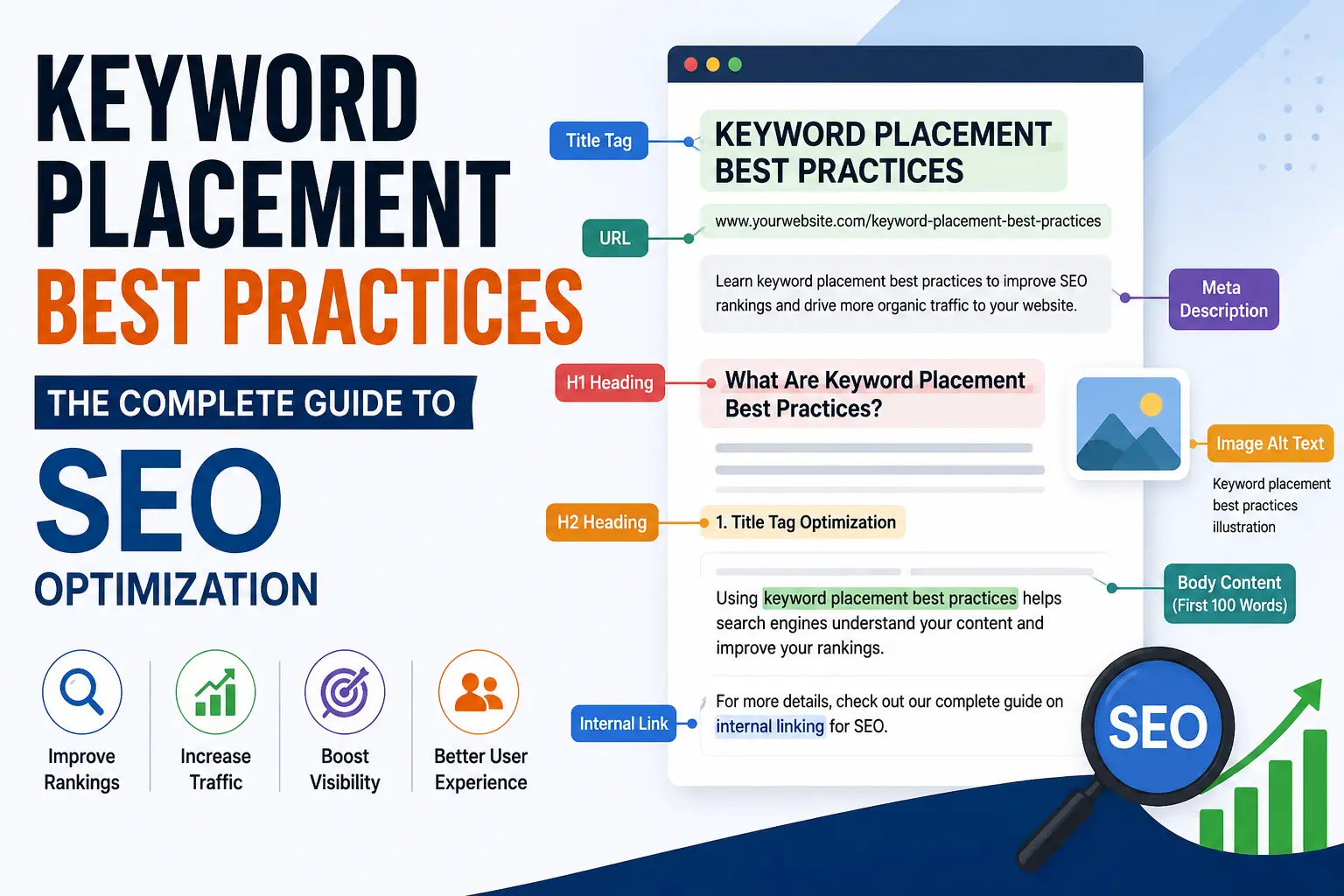
1. Title Tag
The title tag remains one of the most important places for keyword placement.
Best Practices
- Place the primary keyword near the beginning.
- Keep titles under 60 characters when possible.
- Make titles compelling for users.
- Avoid keyword stuffing.
Example
Good:
Keyword Placement Best Practices: Complete SEO Guide
Poor:
Keyword Placement, SEO Keyword Placement, Best Keyword Placement Tips
The first example is clear and user-friendly. The second appears spammy
 SEO
SEO
KR Krishna Kushwaha| Jun 02, 2026| 9 min read
Organic Traffic vs Paid Traffic
2. URL Structure
URLs help search engines understand page content.
Best Practices
- Include the primary keyword.
- Use hyphens between words.
- Keep URLs short.
- Remove unnecessary parameters.
Example
Good:
/keyword-placement-best-practices
Poor:
/seo-page?id=12345&cat=keywords
Simple URLs are easier for users and search engines
 SEO
SEO
KR Krishna Kushwaha| Jun 02, 2026| 9 min read
Why SEO Is Important for Businesses
3. Meta Description
Meta descriptions are not direct ranking factors, but they influence click-through rates.
Best Practices
- Include the primary keyword naturally.
- Stay within 150–160 characters.
- Encourage clicks.
Example
Learn keyword placement best practices to improve SEO rankings, increase traffic, and create optimized content that search engines love.
When users see their searched keyword highlighted in the description, they are more likely to click
 SEO
SEO
KR Krishna Kushwaha| Jun 02, 2026| 8 min read
SEO for Beginners: Complete Guide
4. H1 Heading
The H1 serves as the main headline of the page.
Best Practices
- Use only one H1.
- Include the primary keyword.
- Keep it readable and engaging.
Example
Keyword Placement Best Practices for Better SEO Rankings
The H1 should clearly communicate the topic.
5. Introduction Paragraph
The opening section is one of the first areas search engines analyze.
Best Practices
- Mention the primary keyword within the first 100–150 words.
- Keep it natural.
- Introduce the topic clearly.
Example
Keyword placement best practices play a critical role in modern SEO. Strategic placement helps search engines understand content while improving user experience.
This reinforces relevance immediately.
Keyword Placement in Headings
Headings help structure content and improve readability.
Search engines use headings to understand content hierarchy.
H2 Headings
Include primary or secondary keywords where appropriate.
Example:
Best Keyword Placement Strategies
H3 Headings
Use related keyword variations.
Example:
Using Keywords in Meta Tags
Keyword Placement in Blog Content
Headings should always prioritize readability over optimization.
Keyword Placement Throughout Body Content
The body content is where most keyword usage occurs.
Maintain Natural Frequency
Rather than aiming for a specific keyword density, focus on natural usage.
Modern search engines understand:
- Synonyms
- Related terms
- Contextual relevance
- Semantic relationships
Instead of repeating:
“keyword placement best practices”
Use variations such as:
- keyword optimization
- strategic keyword use
- SEO keyword positioning
- content optimization
Use Keywords Early
Including the primary keyword within the first few paragraphs sends a strong relevance signal.
However, avoid forcing it.
Natural writing should always come first.
Spread Keywords Naturally
Keywords should appear throughout the article rather than being concentrated in one section.
Good distribution creates balanced relevance signals.
For example:
- Introduction
- Main sections
- Subheadings
- Conclusion
This approach feels natural and improves readability.
Semantic Keywords and Related Terms
Google’s algorithms understand topics, not just exact-match keywords.
This makes semantic optimization increasingly important.
What Are Semantic Keywords?
Semantic keywords are closely related concepts and phrases.
For keyword placement, related terms include:
- SEO optimization
- search rankings
- content marketing
- keyword research
- search intent
- SERPs
- organic traffic
Using these naturally helps build topical authority.
Benefits of Semantic Keywords
Semantic optimization helps:
- Improve contextual relevance
- Increase ranking opportunities
- Reduce keyword stuffing risk
- Enhance content depth
Modern SEO focuses on topic coverage rather than repetitive keyword usage.
Image Keyword Placement
Images offer valuable SEO opportunities.
File Names
Rename image files before uploading.
Good:
keyword-placement-guide.jpg
Poor:
IMG_12345.jpg
Alt Text
Alt text improves accessibility and image SEO.
Best Practices
- Describe the image accurately.
- Include keywords only when relevant.
- Avoid stuffing.
Example:
Alt text: Diagram showing keyword placement best practices in SEO content.
Image Captions
Captions receive significant reader attention.
When appropriate, include relevant keywords naturally.
Internal Link Keyword Placement
Internal links help search engines understand site structure.
Anchor Text Optimization
Anchor text should describe the linked content.
Good:
Learn more about keyword research techniques.
Poor:
Click here
Keyword-rich anchor text provides context.
Avoid Over-Optimization
Using identical keyword anchors repeatedly may appear manipulative.
Mix variations naturally.
Examples:
- keyword research guide
- SEO keyword strategy
- content optimization tips
Variation creates a healthier link profile.
External Link Keyword Placement
External links contribute to credibility and topical relevance.
When linking externally:
- Use descriptive anchor text.
- Link to authoritative sources.
- Avoid excessive exact-match anchors.
Relevant external references strengthen content quality.
Keyword Placement for Featured Snippets
Featured snippets occupy prime SERP real estate.
Optimized keyword placement can improve eligibility.
Use Question-Based Headings
Examples:
What Is Keyword Placement?
Why Does Keyword Placement Matter?
Provide Concise Answers
Immediately after the heading, provide a direct answer.
Example:
Keyword placement refers to strategically positioning target keywords throughout webpage elements to improve relevance and SEO performance.
This format aligns well with snippet extraction.
Mobile SEO and Keyword Placement
Mobile-first indexing means Google primarily evaluates mobile versions of websites.
Keyword placement should support mobile users.
Mobile Best Practices
- Short paragraphs
- Clear headings
- Readable formatting
- Natural keyword usage
Mobile readers often skim content, making strategic placement especially important.
Voice Search Optimization
Voice searches continue growing through smart devices and mobile assistants.
Voice queries tend to be:
- Longer
- Conversational
- Question-based
Example:
Typed Search:
keyword placement SEO
Voice Search:
What are the best keyword placement practices for SEO?
Include natural language variations throughout content.
Common Keyword Placement Mistakes
Many websites struggle because of avoidable optimization errors.
Keyword Stuffing
Repeating keywords excessively harms readability and SEO.
Example:
Keyword placement is important because keyword placement helps keyword placement strategies improve keyword placement performance.
This appears spammy.
Ignoring User Experience
Content should serve readers first.
Poor optimization often prioritizes search engines over humans.
Always ask:
Would this sentence sound natural to a reader?
Over-Optimized Headings
Stuffed headings reduce quality.
Poor Example:
SEO Keyword Placement Best Practices Keyword SEO Placement Guide
Better Example:
Keyword Placement Strategies for Better Rankings
Using Exact Matches Everywhere
Modern SEO rewards natural language.
Use:
- synonyms
- related phrases
- semantic variations
instead of repeating identical keywords.
Keyword Placement for Different Content Types
Different content formats require different approaches.
Blog Posts
Focus on:
- title
- introduction
- headings
- conclusion
Product Pages
Prioritize:
- product title
- product description
- image alt text
- feature sections
Landing Pages
Emphasize:
- headline
- subheadline
- call-to-action areas
- benefits sections
Service Pages
Include keywords in:
- service descriptions
- FAQs
- testimonials
- location references
Keyword Placement and E-E-A-T
Google emphasizes:
- Experience
- Expertise
- Authoritativeness
- Trustworthiness
Keyword placement should support expertise rather than replace it.
High-quality content demonstrates knowledge while naturally incorporating keywords.
Strong E-E-A-T signals often outperform heavily optimized but low-quality pages.
Measuring Keyword Placement Success
Optimization should be monitored regularly.
Key metrics include:
Organic Traffic
Track visitor growth from search engines.
Keyword Rankings
Monitor target keyword positions.
Click-Through Rate
Measure SERP engagement.
Bounce Rate
Evaluate content relevance.
Time on Page
Assess user engagement.
Improved keyword placement often positively affects these metrics.
Advanced Keyword Placement Strategies
Experienced SEO professionals often implement advanced techniques.
Topic Clusters
Create interconnected content around a central topic.
Example:
Main Topic:
Keyword Placement
Supporting Topics:
- Keyword Research
- On-Page SEO
- Content Optimization
- Search Intent
- Internal Linking
This strengthens topical authority.
Entity Optimization
Search engines increasingly understand entities rather than simple keywords.
Include:
- brands
- tools
- concepts
- industry terminology
This improves contextual understanding.
NLP Optimization
Natural Language Processing allows search engines to interpret content meaning.
Optimize by:
- answering questions directly
- using natural language
- covering topics comprehensively
- incorporating semantic keywords
NLP-friendly content often ranks better than keyword-heavy pages.
Creating a Keyword Placement Checklist
Before publishing, verify:
✓ Primary keyword in title tag
✓ Primary keyword in URL
✓ Primary keyword in H1
✓ Keyword in introduction
✓ Keywords in subheadings where appropriate
✓ Natural keyword distribution
✓ Semantic keywords included
✓ Optimized image alt text
✓ Internal links added
✓ Strong conclusion
✓ No keyword stuffing
A checklist helps maintain consistency across content.
Future of Keyword Placement
SEO continues evolving.
Artificial intelligence, machine learning, and advanced language models increasingly influence search results.
Future keyword placement strategies will emphasize:
- user intent
- topical depth
- semantic relevance
- conversational language
- content quality
Keywords will remain important, but context and expertise will carry even greater weight.
Successful marketers will focus on comprehensive topic coverage rather than exact-match repetition.
Conclusion
Keyword placement remains one of the most important aspects of on-page SEO, but modern optimization requires a strategic and user-focused approach. Search engines have become remarkably sophisticated, evaluating context, intent, and content quality alongside traditional keyword signals.
The most effective keyword placement strategy involves incorporating target keywords naturally into high-impact locations such as title tags, URLs, headings, introductions, image alt text, and body content. At the same time, semantic keywords, related phrases, and topic-focused writing help create a comprehensive content experience that aligns with search engine expectations.
Avoid outdated tactics like keyword stuffing and over-optimization. Instead, prioritize readability, user intent, and valuable information. When content genuinely helps readers while strategically placing keywords in important locations, both rankings and engagement tend to improve.
As SEO continues evolving, the winning formula will remain consistent: create exceptional content, understand your audience, and use keywords strategically to reinforce relevance. By following these keyword placement best practices, businesses, marketers, and content creators can improve search visibility, increase organic traffic, and build long-term SEO success.
FAQs
Keyword placement refers to the strategic positioning of target keywords within different elements of a webpage, such as the title tag, URL, headings, meta description, image alt text, and body content. Proper keyword placement helps search engines understand the topic of a page while improving its chances of ranking for relevant search queries. Effective keyword placement should always feel natural and provide value to readers rather than focusing solely on search engine optimization.
Keyword placement helps search engines identify the primary topic and relevance of a webpage. When keywords are placed in important areas like the title, headings, and introductory paragraphs, search engines can better understand the content’s purpose. Strategic placement also improves user experience by clearly communicating what the content is about, which can lead to higher click-through rates and better engagement metrics
The primary keyword should ideally appear in several key locations, including the title tag, URL, H1 heading, meta description, introduction, subheadings where relevant, image alt text, and conclusion. However, the keyword should be integrated naturally rather than forced into every section. The goal is to maintain readability while signaling relevance to search engines.
There is no fixed number or ideal keyword density recommended by modern search engines. Instead of focusing on frequency, content creators should prioritize natural usage. Include the keyword where it makes sense and supplement it with related terms, synonyms, and semantically relevant phrases. This approach helps create comprehensive content without risking keyword stuffing.
Keyword stuffing occurs when a keyword is repeated excessively in an attempt to manipulate search rankings. This practice can make content difficult to read and may negatively impact SEO performance. Search engines prioritize high-quality, user-focused content, so overusing keywords can harm rankings rather than improve them. Always aim for natural language and a positive user experience.
Leave a Reply