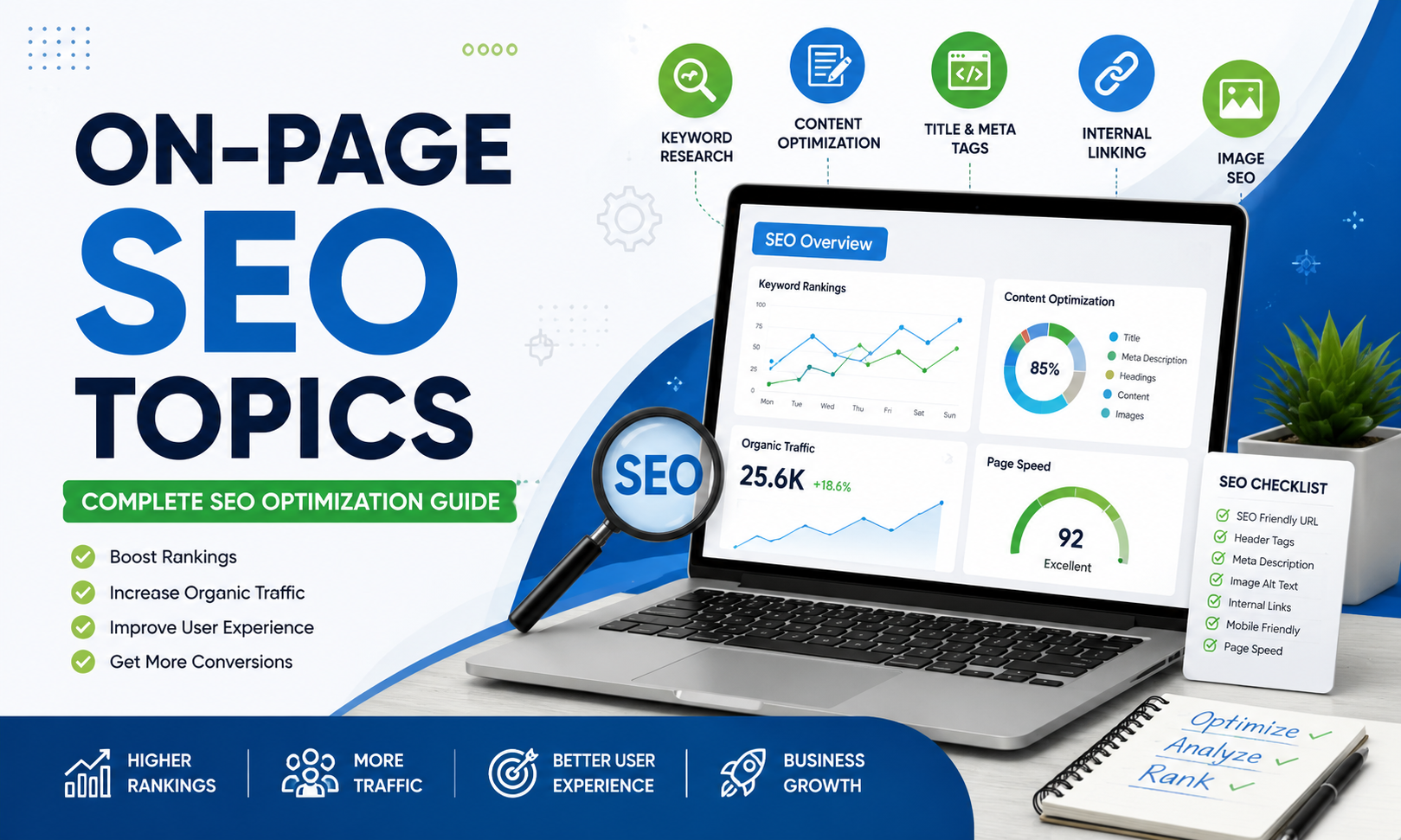
On-Page SEO Topics: The Complete Advanced Guide to Ranking Higher in Google
Introduction
Search Engine Optimization (SEO) has become one of the most important digital skills in today’s online world. Every business, blogger, affiliate marketer, and content creator relies on SEO to gain visibility in search engines like Google, Bing, and Yahoo. Without SEO, even high-quality content can remain invisible.
On-Page SEO is the foundation of all SEO strategies. It refers to all the optimizations made directly on a webpage to improve its ranking in search engine results pages (SERPs). Unlike Off-Page SEO, which depends on backlinks and external signals, On-Page SEO is completely under your control.
Modern search engines have evolved beyond simple keyword matching. Today, Google uses advanced algorithms like RankBrain, BERT, and helpful content systems to understand context, meaning, user intent, and content quality.
This guide explores On-Page SEO in extreme depth, covering every major topic, technique, and optimization strategy you need to master.
What is On-Page SEO?
On-Page SEO is the process of optimizing individual web pages to improve rankings and attract more relevant organic traffic. It includes both content optimization and HTML source code optimization.
On-Page SEO ensures that search engines understand:
- What your page is about
- Which keywords it should rank for
- How valuable your content is
- How users interact with your page
At the same time, it ensures users have a smooth and engaging experience.
On-Page SEO includes:
- High-quality content creation
- Keyword optimization
- Title and meta tag optimization
- Header structure optimization
- Internal linking strategy
- Image SEO
- URL structure optimization
- Mobile optimization
- Page speed improvements
- User experience enhancements
Without strong On-Page SEO, even high-authority websites struggle to rank.
Why On-Page SEO Matters in 2026
On-Page SEO is more important today than ever before because search engines have become more intelligent and competitive.
1. Google Focuses on Content Quality
Google no longer ranks pages based only on keywords. It evaluates:
- Content depth
- Expertise
- Relevance
- User satisfaction
2. AI-Powered Search Engines
With AI integration in search results, Google can understand context like humans, making On-Page SEO more about meaning than keyword repetition.
3. Increased Competition
Millions of blog posts are published daily. Proper On-Page SEO helps your content stand out.
4. Better User Engagement
Well-optimized pages improve:
- Time on site
- Click-through rates
- Conversion rates
5. Higher ROI Than Paid Ads
Organic traffic is free and long-lasting compared to paid advertising.
Keyword Research: The Backbone of On-Page SEO
Keyword research is the foundation of all SEO strategies. Without it, your content has no direction.
Understanding User Intent
Before choosing keywords, you must understand why users are searching.
Types of Search Intent
1. Informational Intent
Users want knowledge.
Example:
“What is On-Page SEO?”
2. Navigational Intent
Users want a specific website.
Example:
“YouTube login”
3. Commercial Intent
Users compare options.
Example:
“Best SEO tools 2026”
4. Transactional Intent
Users want to take action or buy.
Example:
“Buy SEO course online”
Types of Keywords in Depth
Short-Tail Keywords
- High competition
- Broad meaning
- Example: SEO, marketing, blogging
Long-Tail Keywords
- Lower competition
- Higher conversion
- Example: how to improve On-Page SEO for beginners
LSI Keywords
Related semantic keywords that help Google understand context.
Example for “On-Page SEO”:
- meta tags
- content optimization
- ranking factors
- keyword placement
Keyword Placement Strategy
Keywords should be placed naturally in:
- Title
- Introduction
- Headings
- Body content
- Image alt text
- Conclusion
Avoid keyword stuffing at all costs.
Creating High-Quality SEO Content
Content is the most powerful ranking factor in modern SEO.
What Makes Content High Quality?
1. Depth of Information
Content should fully cover the topic.
2. Problem Solving
Your content must solve real user problems.
3. Originality
Avoid copying or rewriting thin content.
4. Engagement
Use storytelling, examples, and structure.
Search Intent Optimization
Every page must match search intent perfectly.
If users search “On-Page SEO guide,” they expect:
- Definition
- Techniques
- Examples
- Checklist
Not unrelated content.
Content Structure Strategy
Well-structured content improves readability:
- Introduction
- Main sections
- Subsections
- Examples
- Summary
Use headings to guide readers.
Title Tag Optimization
- First thing users see
- Impacts CTR
- Helps search engines understand topic
Advanced Optimization Tips
- Place keyword at beginning
- Use emotional triggers
- Add numbers when relevant
- Keep under 60 characters
Example:
✔ On-Page SEO Topics: Complete Guide to Ranking Higher
Meta Description Optimization
Meta descriptions do not directly affect rankings but strongly influence click-through rates.
How to Write High-Converting Meta Descriptions
- Use action words
- Include main keyword
- Add value proposition
- Keep within 150–160 characters
Example:
“Learn advanced On-Page SEO topics including keyword research, content optimization, and ranking strategies to boost organic traffic and visibility.”
Header Tags Optimization Strategy
Header tags structure your content for both users and search engines.
Importance of Header Hierarchy
- H1 defines topic
- H2 defines main sections
- H3 breaks down details
- H4 adds deeper explanation
SEO Benefits
- Improves readability
- Helps Google understand structure
- Enhances featured snippet chances
URL Structure Optimization (Deep Guide)
SEO-friendly URLs improve indexing and clickability.
Best Practices
- Keep URLs short and clean
- Avoid unnecessary parameters
- Use hyphens instead of underscores
- Include target keyword
Example:
✔ /on-page-seo-topics-guide
Keyword Placement (Advanced Strategy)
Strategic keyword placement improves relevance signals.
Where to Include Keywords
- First 100 words
- Headings
- Anchor text
- Image alt text
- Meta tags
Natural Integration
Modern SEO requires semantic writing instead of repetition.
Content Length and Depth Strategy
Long-form content performs better in competitive niches.
Why Long Content Ranks Better
- Covers topic comprehensively
- Increases dwell time
- Earns backlinks
- Improves authority
Ideal Length
- Standard blogs: 1500–3000 words
- Authority pages: 3000–6000+ words
Internal Linking Strategy (Advanced SEO)
Internal links connect your website structure.
Benefits
- Helps Google crawl pages
- Distributes page authority
- Improves navigation
- Reduces bounce rate
Best Practices
- Use keyword-rich anchor text
- Link to related pages
- Avoid over-linking
External Linking Strategy
External links improve trust and credibility.
Why External Links Matter
- Shows research quality
- Adds authority signals
- Improves user experience
Best Practice
Link only to high-authority websites.
Image SEO Optimization (Expanded)
Images are important for both UX and SEO.
Advanced Image SEO Tips
- Use descriptive file names
- Write keyword-rich alt text
- Compress images properly
- Use next-gen formats like WebP
Example Alt Text
“On-Page SEO strategy diagram showing ranking factors and optimization techniques”
Mobile Optimization (Critical Ranking Factor)
Mobile-first indexing means Google evaluates your mobile site first.
Mobile SEO Best Practices
- Responsive design
- Fast loading pages
- Clean layout
- Easy navigation
- Readable fonts
Page Speed Optimization (Deep Guide)
Speed is a confirmed ranking factor.
Why Speed Matters
- Improves user experience
- Reduces bounce rate
- Increases conversions
Advanced Optimization Techniques
- Lazy loading images
- Using CDN
- Server optimization
- Code minification
User Experience (UX) and SEO
UX is directly tied to rankings.
Key UX Signals
- Time on page
- Bounce rate
- Scroll depth
- Interaction rate
How to Improve UX
- Clean design
- Easy navigation
- Structured content
- Fast loading pages
E-E-A-T Optimization (Google’s Quality Standard)
E-E-A-T stands for:
Experience
Real-world knowledge of topic
Expertise
Deep subject knowledge
Authoritativeness
Recognition in industry
Trustworthiness
Accurate and safe content
Schema Markup (Structured Data SEO)
Schema helps search engines understand content.
Benefits
- Rich snippets
- Better visibility
- Higher CTR
Common Types
- Article schema
- FAQ schema
- Review schema
Featured Snippet Optimization
Featured snippets are position zero in Google.
How to Rank
- Answer questions clearly
- Use bullet points
- Add definitions
- Keep answers short
Content Freshness Strategy
Updated content ranks better.
How to Keep Content Fresh
- Update statistics
- Add new sections
- Improve examples
- Fix outdated information
Readability Optimization
Readable content improves engagement.
Techniques
- Short sentences
- Simple language
- Bullet points
- Subheadings
Voice Search Optimization
Voice search is growing rapidly.
Optimization Tips
- Use conversational language
- Target question-based keywords
- Include FAQ sections
Core Web Vitals Optimization
Core Web Vitals measure user experience.
Metrics
- LCP (Loading speed)
- INP (Responsiveness)
- CLS (Visual stability)
Improving these improves rankings.
Content Formatting Strategy
Proper formatting increases readability.
Best Practices
- Use headings properly
- Add spacing
- Use lists
- Highlight important points
Call-to-Action Optimization
CTAs guide users to action.
Examples
- Subscribe now
- Download guide
- Contact us
Common On-Page SEO Mistakes
Avoid these errors:
- Keyword stuffing
- Duplicate content
- Poor mobile design
- Missing meta tags
- Slow website speed
On-Page SEO Checklist (Final)
✔ Keyword research
✔ Optimized title
✔ Meta description
✔ SEO-friendly URL
✔ Proper headings
✔ Internal links
✔ Image optimization
✔ Mobile optimization
✔ Fast speed
✔ High-quality content
✔ Schema markup
Future of On-Page SEO
SEO is evolving rapidly.
Future Trends
- AI-driven search results
- Semantic SEO
- Zero-click searches
- Voice search dominance
- User behavior ranking signals
Conclusion
On-Page SEO is the foundation of successful digital marketing. It ensures your content is visible, readable, and valuable for both users and search engines. As search engines become more intelligent, focusing on user experience, content quality, and semantic relevance is more important than ever.
Mastering On-Page SEO topics such as keyword research, content optimization, page structure, internal linking, and technical enhancements will give you a strong competitive advantage in search rankings.
Consistent optimization leads to higher visibility, increased organic traffic, and long-term success in the digital world.
Leave a Reply