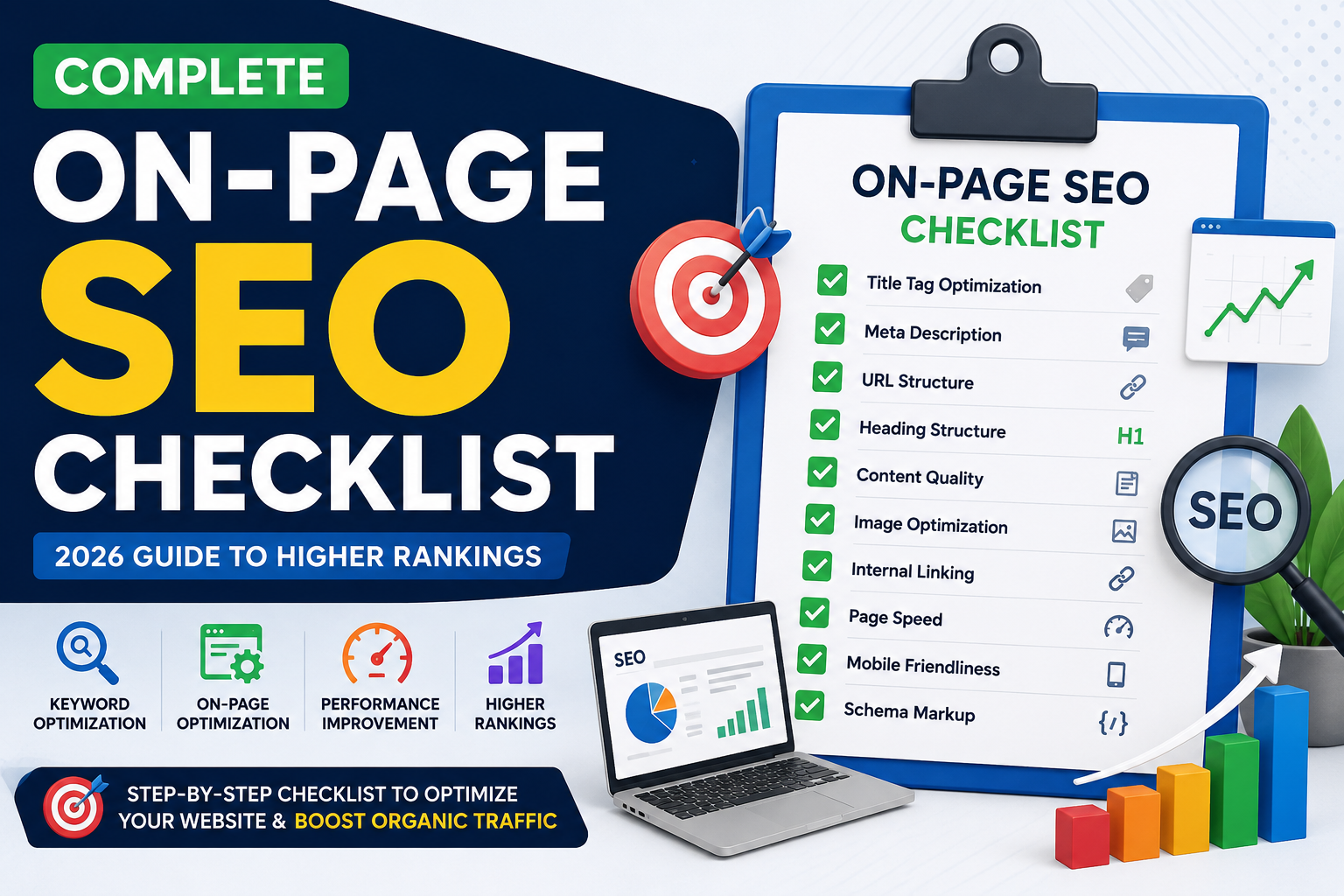
Complete On-Page SEO Checklist (2026 Guide – Advanced Version)
On-page SEO is the backbone of every successful website. It determines how search engines understand your pages, how users interact with your content, and how well your website performs in organic search results.
Unlike off-page SEO (which depends on backlinks and external signals), on-page SEO is fully under your control. That means every improvement you make directly increases your chances of ranking higher.
Modern SEO is not just about inserting keywords—it is about intent matching, semantic relevance, user satisfaction, and technical clarity.
What is On-Page SEO?
On-page SEO refers to the process of optimizing individual web pages so they can rank higher in search engines like Google and attract more relevant organic traffic.
It includes everything that exists on the page itself, such as content, HTML structure, keywords, images, internal links, and user experience elements.
Search engines use on-page signals to understand:
- What your content is about
- Whether it satisfies user intent
- How useful and readable your page is
- Whether it is trustworthy and authoritative
In today’s SEO ecosystem, on-page optimization is directly connected to ranking success because search engines now rely heavily on content relevance and user behavior signals.
Search Engine Optimization is built on three pillars: on-page SEO, off-page SEO, and technical SEO, but on-page SEO remains the most foundational and controllable part.
Why On-Page SEO Matters
On-page SEO is important because it acts as the “communication bridge” between your website and search engines.
When your on-page SEO is strong, search engines can easily interpret your content, which improves ranking potential.
A well-optimized page helps in:
- Increasing organic search visibility
- Improving keyword rankings across multiple queries
- Boosting click-through rate (CTR) from search results
- Enhancing user engagement and time on page
- Reducing bounce rates
- Building topical authority over time
Without proper on-page SEO, even high-quality content may fail to rank because search engines cannot fully understand its purpose or relevance.
In competitive niches, small on-page improvements can lead to significant ranking gains.
1. Keyword Research Optimization (Deep Strategy)
Keyword research is the foundation of every successful SEO campaign. It is not just about finding search terms—it is about understanding user intent behind those terms.
A strong keyword strategy ensures that your content matches what users are actively searching for.
Expanded Checklist:
- Identify primary keyword with high relevance and moderate competition
- Find secondary and LSI keywords for semantic coverage
- Analyze search intent deeply (informational, commercial, transactional, navigational)
- Study competitor pages ranking in top 10 results
- Identify content gaps in competitor articles
- Use long-tail keywords for easier ranking opportunities
- Group keywords into topic clusters
Advanced Strategy:
Instead of targeting a single keyword, modern SEO focuses on topic authority. This means one page should cover multiple related queries naturally.
For example:
- Primary: On-Page SEO Checklist
- Supporting: SEO optimization steps, website ranking factors, SEO audit checklist
This helps Google understand that your page is a complete resource, not just a short article.
2. SEO-Friendly Title Tag Optimization (CTR Focus)
The title tag is one of the most important ranking and click-through factors. It is the first thing users see in search results.
A well-optimized title not only improves ranking but also increases clicks.
Expanded Checklist:
- Keep title between 50–60 characters
- Place primary keyword near the beginning
- Make it emotionally appealing and clickable
- Use numbers or power words (Ultimate, Complete, Proven, Advanced)
- Match search intent clearly
- Avoid keyword stuffing or repetition
Advanced Strategy:
Search engines often rewrite poor titles. To avoid this:
- Make titles natural and readable
- Focus on user benefit, not just keywords
- Include freshness signals like “2026 Guide”
A strong title improves both SEO and CTR, which indirectly improves ranking performance.
3. Meta Description Optimization (CTR Booster)
Meta descriptions do not directly affect rankings but significantly influence click-through rates.
Expanded Checklist:
- Keep within 150–160 characters
- Include primary keyword naturally
- Write persuasive and benefit-driven copy
- Add emotional triggers (learn, boost, improve, grow)
- Include a soft call-to-action
Advanced Strategy:
Think of meta descriptions as mini advertisements for your page. They should answer:
- What will the user get?
- Why should they click?
- What problem does it solve?
A well-written meta description can outperform higher-ranked competitors by attracting more clicks.
4. URL Structure Optimization (Clean SEO Architecture)
URLs help both users and search engines understand page structure.
Expanded Checklist:
- Keep URLs short and readable
- Include primary keyword
- Use lowercase letters only
- Use hyphens instead of underscores
- Avoid unnecessary parameters
- Maintain consistent structure across website
Advanced Strategy:
Good URLs improve:
- Crawl efficiency
- Indexing speed
- User trust
For SEO-friendly websites, URLs should look clean and logical:
✔ /on-page-seo-checklist
❌ /index.php?id=seo123&page=checklist
5. Heading Structure Optimization (Content Hierarchy)
Headings help organize content and improve readability.
Expanded Checklist:
- Use only one H1 per page
- Include primary keyword in H1 naturally
- Use H2 for main sections
- Use H3/H4 for sub-sections
- Maintain logical hierarchy flow
Advanced Strategy:
Headings also help Google understand:
- Content structure
- Topic importance
- Section relevance
Well-structured headings improve both SEO and user experience, especially for long-form content.
6. High-Quality Content Optimization (Core Ranking Factor)
Content is the most powerful ranking factor in modern SEO.
Expanded Checklist:
- Write in-depth content (2000–5000 words if needed)
- Fully satisfy user intent
- Use simple, clear language
- Include real-world examples
- Avoid keyword stuffing
- Maintain readability with short paragraphs
Advanced Strategy:
Google now prioritizes helpful content systems, meaning:
- Content must be original
- Must demonstrate expertise
- Must fully solve user queries
Thin or repetitive content will not rank, even with strong backlinks.
7. Keyword Placement Strategy (Natural Optimization)
Keyword placement ensures relevance without over-optimization.
Expanded Checklist:
- Include keyword in first 100–150 words
- Use in at least one H2 heading
- Sprinkle naturally across content
- Add in conclusion section
- Use variations and synonyms
Advanced Strategy:
Instead of repeating keywords, use semantic SEO:
- Related terms
- Contextual phrases
- Natural language variations
This helps improve topical depth and avoids penalties.
8. Internal Linking Strategy (SEO Architecture Building)
Internal linking distributes authority across your website.
Expanded Checklist:
- Link related blog posts naturally
- Use descriptive anchor text
- Avoid overlinking in a single paragraph
- Create topic clusters (pillar + supporting posts)
Advanced Strategy:
Internal links help:
- Improve crawl depth
- Increase page authority flow
- Reduce bounce rate
- Strengthen topic relevance
A strong internal linking system can significantly boost rankings of older pages.
9. External Linking Strategy (Trust Building)
Outbound links show search engines that your content is well-researched.
Expanded Checklist:
- Link to authoritative websites
- Use relevant sources only
- Avoid spam or low-quality sites
- Open links in new tab
Advanced Strategy:
Outbound links help establish:
- Content credibility
- Research depth
- Trust signals for search engines
10. Image Optimization (Visual SEO)
Images improve engagement and ranking potential in Google Images.
Expanded Checklist:
- Compress images without losing quality
- Use descriptive filenames
- Add keyword-rich alt text
- Use modern formats like WebP
- Enable lazy loading
Advanced Strategy:
Image SEO improves:
- Page speed
- Accessibility
- Image search traffic
11. Mobile Optimization (Core Ranking Factor)
Google uses mobile-first indexing.
Expanded Checklist:
- Fully responsive design
- Easy navigation on small screens
- Fast mobile loading speed
- No overlapping elements
Advanced Strategy:
Mobile usability directly affects:
- Bounce rate
- Session duration
- Conversion rate
12. Page Speed Optimization (Performance SEO)
Page speed is a confirmed ranking factor.
Expanded Checklist:
- Optimize image sizes
- Enable browser caching
- Minify CSS and JavaScript
- Use CDN
- Reduce server response time
13. User Experience (UX Optimization)
UX influences SEO through engagement metrics.
Expanded Checklist:
- Clean design layout
- Easy navigation
- Clear CTA buttons
- Avoid intrusive ads
- Improve readability
14. Schema Markup (Structured SEO)
Schema helps search engines understand content context.
Expanded Checklist:
- Use Article schema
- Add FAQ schema
- Add Breadcrumb schema
- Validate with Google tools
15. E-E-A-T Optimization (Authority Building)
E-E-A-T is crucial for ranking competitive content.
Expanded Checklist:
- Demonstrate experience
- Show expertise
- Build authority signals
- Increase trustworthiness
- Add author bio and credentials
16. Content Freshness (Ranking Maintenance)
Fresh content ranks better.
Expanded Checklist:
- Update old posts regularly
- Add new statistics
- Refresh keywords
- Fix broken links
17. CTR Optimization (Ranking Boost Strategy)
CTR impacts rankings indirectly.
Expanded Checklist:
- Use emotional titles
- Add numbers and brackets
- Use strong power words
- Improve meta descriptions
18. Common On-Page SEO Mistakes
Avoid these critical errors:
- Keyword stuffing
- Thin content
- Duplicate pages
- Broken internal links
- Missing meta tags
- Poor mobile experience
19. Final Summary (Complete SEO System)
A fully optimized page includes:
- Strong keyword research
- High-quality content
- Clean technical structure
- Fast loading speed
- Mobile-friendly design
- Internal + external linking
- Schema markup
- UX optimization
Final Thoughts
On-page SEO is not a one-time task—it is an ongoing optimization process. Search engines constantly evolve, and your content must evolve with them.
If you consistently apply this checklist, your website will develop strong authority, better rankings, and long-term organic traffic growth.
If you want next level upgrade, I can also convert this into:
- WordPress SEO post (ready to publish)
- PDF checklist
- SEO blog with images + alt text
- Or 30-day SEO content plan for your website
Leave a Reply