Introduction
In today’s digital world, having a website is no longer enough. Millions of websites compete for visibility on search engines, making it increasingly difficult to attract visitors without a proper optimization strategy. Search Engine Optimization (SEO) helps websites stand out by improving their visibility in organic search results.
When users search for information, products, or services online, they rarely go beyond the first page of search engine results. Studies consistently show that the majority of clicks go to the top-ranking pages. This makes SEO one of the most valuable long-term digital marketing investments for businesses, bloggers, eCommerce stores, and content creators.
SEO is not a one-time task. It is an ongoing process that requires content improvements, technical maintenance, and authority-building efforts. Search engine algorithms change frequently, meaning websites must continuously adapt to maintain and improve rankings.
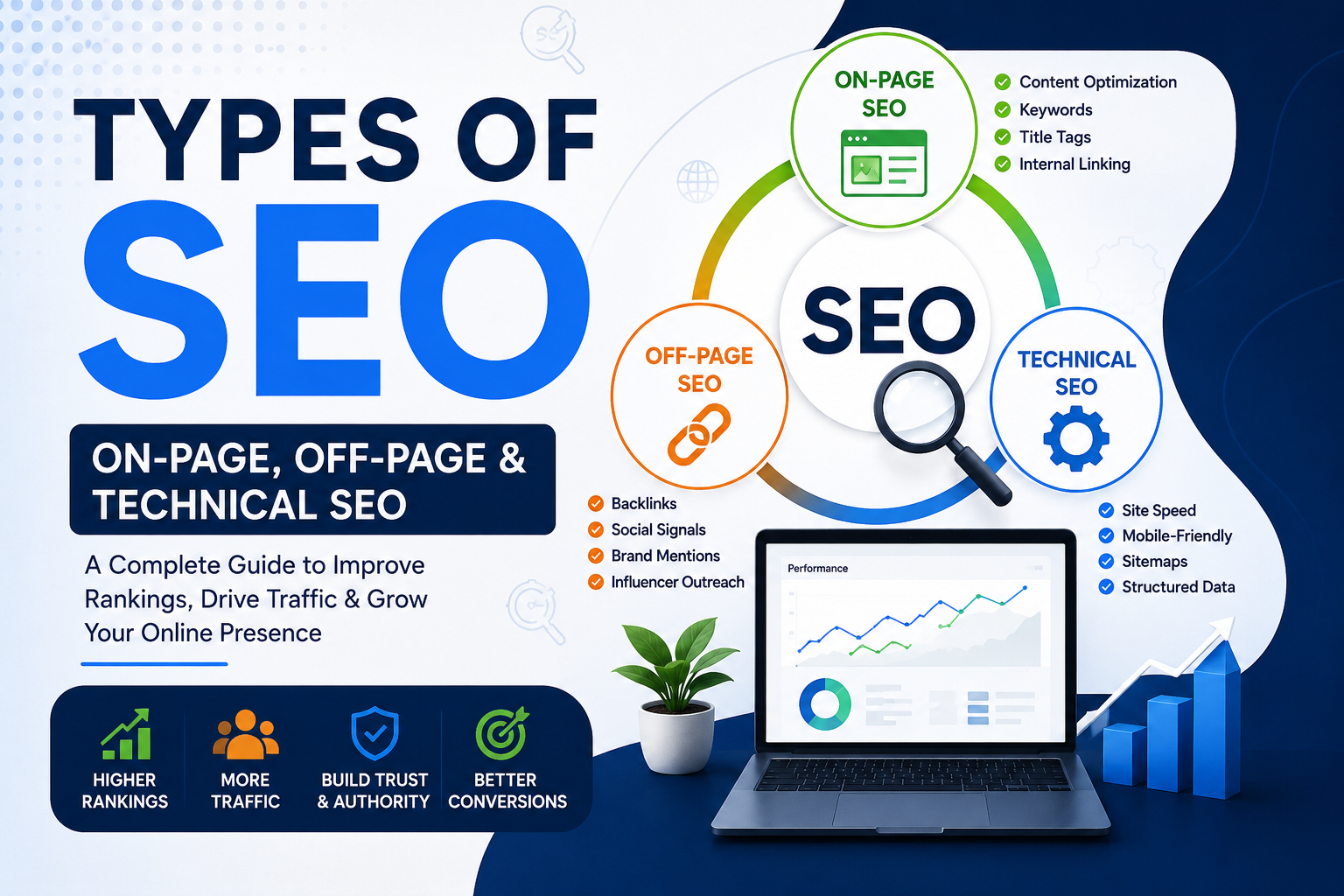
Understanding the three core types of SEO—On-Page SEO, Off-Page SEO, and Technical SEO—is the first step toward building a successful online presence. Each type plays a unique role, and together they create a comprehensive strategy that helps websites achieve sustainable growth.
What Is SEO?
Search Engine Optimization is the practice of enhancing a website’s visibility in search engine results pages (SERPs). The objective is to ensure that a website appears when users search for keywords related to its content, products, or services.
Search engines use complex algorithms to determine which pages should rank highest for a specific query. These algorithms evaluate hundreds of ranking factors, including content relevance, page quality, website authority, user experience, and technical performance.
SEO can be considered a bridge between search engines and users. It helps search engines understand your content while ensuring users find valuable and relevant information.
A successful SEO campaign does more than improve rankings. It builds trust, strengthens brand credibility, increases customer engagement, and drives qualified traffic that is more likely to convert into leads or sales.
Why Are Different Types of SEO Important?
Many website owners focus only on creating content and neglect other important aspects of SEO. However, search engines evaluate websites from multiple perspectives.
Imagine building a beautiful house. High-quality content is like the interior design, Technical SEO is the foundation and structure, and Off-Page SEO is the reputation of the neighborhood. If any one of these elements is weak, the overall value decreases.
On-Page SEO helps search engines understand what your content is about. Technical SEO ensures that search engines can access and index your content efficiently. Off-Page SEO demonstrates that other websites trust and recommend your content.
Without balancing all three types of SEO, websites often struggle to achieve their full ranking potential. This is why modern SEO strategies integrate all three pillars into a unified approach.
On-Page SEO (Expanded)
On-Page SEO is often the starting point for most SEO campaigns because it gives website owners direct control over optimization. Every webpage should be carefully optimized to satisfy both search engines and users.
Modern On-Page SEO extends far beyond inserting keywords into content. Search engines now prioritize content quality, user intent, readability, and overall usefulness. Pages that genuinely help users solve problems are more likely to rank highly.
On-Page SEO also includes optimizing visual elements, internal navigation, page structure, and user engagement signals. The ultimate goal is to create content that is comprehensive, trustworthy, and easy to consume.
Importance of On-Page SEO
The importance of On-Page SEO cannot be overstated. Search engines rely heavily on page-level signals to determine relevance and quality.
When On-Page SEO is implemented correctly, it helps search engines understand:
- The main topic of the page
- The target audience
- The relationship between different content sections
- The value offered to users
Good On-Page SEO can significantly improve rankings even without extensive backlink profiles. It also enhances user satisfaction by making content easier to read, navigate, and understand.
Businesses that invest in On-Page SEO often experience higher engagement rates, longer session durations, and improved conversion rates.
Keyword Research
Keyword research is the foundation of every successful SEO strategy. It helps identify the exact words and phrases users type into search engines.
Effective keyword research goes beyond finding high-volume keywords. It also involves understanding search intent. For example, a user searching “What is SEO?” has informational intent, while someone searching “SEO services near me” likely has transactional intent.
Keyword research allows businesses to create content that directly matches user needs. This increases the likelihood of ranking well and attracting qualified visitors.
Long-tail keywords are particularly valuable because they often have lower competition and higher conversion rates. Instead of targeting “SEO,” a website might target “best SEO techniques for small businesses.”
Content Optimization
Content optimization is the process of making content more valuable, relevant, and accessible to users and search engines.
High-quality content should answer user questions comprehensively. It should provide practical insights, examples, statistics, and actionable advice.
Search engines increasingly prioritize content that demonstrates expertise, experience, authority, and trustworthiness. This means content creators should focus on accuracy, credibility, and depth.
Regular content updates are also essential. Fresh content signals relevance and helps maintain rankings over time. Updating outdated statistics, examples, and information can significantly improve performance.
Off-Page SEO
Off-Page SEO focuses on activities that occur outside your website but influence its rankings. It helps search engines determine how trustworthy and authoritative your website is compared to competitors.
Think of Off-Page SEO as your website’s reputation. Even if your content is excellent, search engines may hesitate to rank it highly if no other websites acknowledge or reference it.
Building authority takes time. Successful Off-Page SEO strategies focus on earning trust naturally through valuable content, meaningful relationships, and consistent brand building.
Backlinks: The Core of Off-Page SEO
Backlinks remain one of the strongest ranking signals in SEO. Each quality backlink acts as a vote of confidence from another website.
However, not all backlinks are equal. A single backlink from a highly authoritative website may be more valuable than dozens of links from low-quality sites.
Search engines analyze several factors when evaluating backlinks, including:
- Domain authority
- Relevance
- Anchor text
- Link placement
- Trustworthiness
Natural backlinks are generally the most valuable because they indicate genuine recognition of your content.
A strong backlink profile can dramatically improve rankings, increase referral traffic, and enhance brand credibility.
Guest Posting
Guest posting is one of the most effective Off-Page SEO strategies when done correctly. It involves writing content for another website in exchange for exposure and often a backlink.
Successful guest posting requires focusing on quality rather than quantity. Articles should provide genuine value to readers and align with the host website’s audience.
Guest posting offers multiple benefits beyond backlinks. It helps establish industry authority, expand brand reach, and create networking opportunities within your niche.
When selecting websites for guest posting, prioritize relevance, authority, and audience engagement rather than simply seeking link opportunities.
Technical SEO
Technical SEO serves as the foundation of a website’s SEO performance. Without proper technical optimization, search engines may struggle to crawl, index, and understand content effectively.
Technical SEO ensures that search engine bots can access website resources efficiently. It also improves performance, security, and user experience.
Many website owners overlook Technical SEO because it is less visible than content creation. However, technical issues can significantly limit organic growth regardless of content quality.
A technically optimized website provides a solid framework that supports all other SEO efforts.
Website Speed Optimization
Website speed has become increasingly important as user expectations continue to rise. Research consistently shows that users abandon websites that take too long to load.
A slow website affects:
- User experience
- Bounce rate
- Conversion rate
- Search rankings
Even a one-second delay can negatively impact engagement and revenue.
Improving speed often involves optimizing images, reducing server response times, implementing caching, minimizing code, and using content delivery networks (CDNs).
Fast websites create better experiences for users and are rewarded by search engines with improved visibility.
Mobile-Friendly Design
Mobile optimization is no longer optional. The majority of internet traffic now comes from smartphones and tablets.
Google uses mobile-first indexing, meaning it primarily evaluates the mobile version of a website when determining rankings.
A mobile-friendly website should feature:
- Responsive design
- Fast loading speed
- Easy navigation
- Readable text
- Touch-friendly buttons
Poor mobile experiences can lead to lost traffic, reduced engagement, and lower rankings.
Businesses that prioritize mobile usability often achieve better SEO results and higher customer satisfaction.
Core Web Vitals
Core Web Vitals are a set of performance metrics designed to measure real-world user experience.
These metrics evaluate:
- Loading performance
- Responsiveness
- Visual stability
Strong Core Web Vitals indicate that users can interact with a website quickly and smoothly.
Improving these metrics often involves optimizing images, reducing unnecessary scripts, improving server performance, and minimizing layout shifts.
As search engines continue emphasizing user experience, Core Web Vitals are expected to remain an important ranking factor.
Conclusion
SEO is a long-term investment that requires consistent effort and a strategic approach. Success does not come from focusing on a single aspect of optimization. Instead, it results from integrating On-Page SEO, Off-Page SEO, and Technical SEO into a unified strategy.
On-Page SEO ensures content is relevant and valuable. Off-Page SEO builds trust and authority. Technical SEO provides the infrastructure necessary for search engines to access and understand your website.
Businesses that embrace all three pillars create stronger online visibility, attract more qualified visitors, and achieve sustainable growth. While SEO requires patience, the long-term benefits—including increased traffic, higher conversions, and stronger brand recognition—make it one of the most effective digital marketing strategies available today.
Leave a Reply