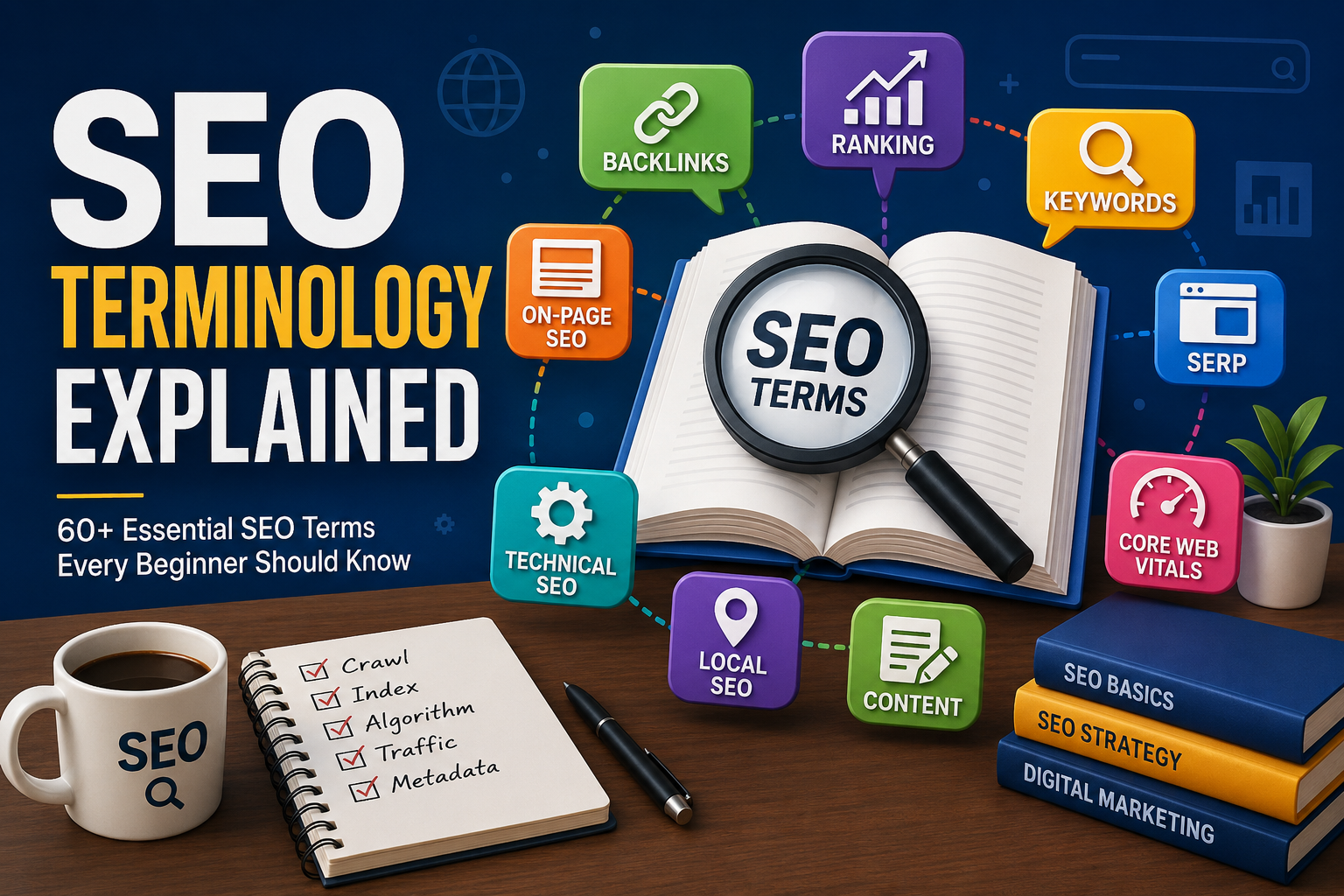
What Is SEO?
Search Engine Optimization (SEO) is the practice of improving a website so that it appears higher in search engine results pages (SERPs). Every day, billions of searches are performed on Google, and SEO helps websites become visible to users who are actively looking for information, products, or services.
SEO is important because users rarely go beyond the first page of search results. Websites that rank higher typically receive more clicks, more visitors, and more opportunities to generate leads and sales. Unlike paid advertising, SEO focuses on earning traffic naturally through quality content and website optimization.
Modern SEO combines technical improvements, content creation, user experience optimization, and authority building. Businesses that invest in SEO often experience sustainable long-term growth because organic traffic continues to arrive even when advertising budgets are reduced.
Basic SEO Terminology
Understanding basic SEO terminology is the first step toward mastering search engine optimization. These foundational terms appear frequently in SEO reports, marketing discussions, and website analytics. Learning them helps website owners better understand how search engines work and how users interact with online content.
SEO terminology serves as a common language for marketers, developers, content writers, and business owners. Without understanding these concepts, it becomes difficult to measure performance or implement effective optimization strategies.
Search Engine
A search engine is a sophisticated software system designed to discover, organize, and deliver information from across the internet. Search engines use automated programs called crawlers or bots to scan websites, collect data, and store information in massive databases known as indexes.
When a user enters a search query, the search engine analyzes millions of indexed pages and ranks them according to relevance and quality. This process happens in fractions of a second.
Google dominates the global search market because of its advanced ranking algorithms and ability to provide highly relevant results. However, other search engines such as Bing and DuckDuckGo also have dedicated user bases and unique features.
Understanding how search engines work is crucial because SEO strategies are designed to align with their ranking systems.
SERP (Search Engine Results Page)
The Search Engine Results Page, commonly called SERP, is the page users see immediately after entering a search query. Modern SERPs contain much more than traditional blue links.
Today’s SERPs may include:
- Featured snippets
- People Also Ask sections
- Video results
- Image packs
- Shopping results
- News articles
- Local business listings
- Knowledge panels
Google continuously modifies SERP layouts to improve user experience and answer questions more quickly. As a result, SEO professionals optimize content not only for rankings but also for enhanced SERP features.
Appearing in featured snippets or local packs can dramatically increase visibility and traffic.
Organic Traffic
Organic traffic is often considered the most valuable source of website visitors because it comes from users actively searching for information. Unlike paid advertising, businesses do not pay for every click generated through organic search.
Organic visitors tend to have stronger intent because they are seeking solutions, answers, or products. This often leads to higher engagement and better conversion rates.
Building organic traffic requires patience because rankings take time to improve. However, once strong rankings are established, organic traffic can become a consistent and cost-effective source of visitors.
Many successful websites receive the majority of their traffic from organic search due to the long-term benefits of SEO.
Keyword
Keywords are the bridge between what users search for and the content websites provide. Search engines use keywords to understand page topics and determine which pages should appear for specific searches.
Modern keyword research goes beyond identifying popular search terms. SEO professionals analyze user intent, competition levels, and content opportunities.
Keywords can be informational, transactional, navigational, or commercial. Selecting the right keywords helps attract visitors who are most likely to engage with content or make purchases.
Effective keyword usage involves integrating target terms naturally throughout content rather than forcing them into every paragraph.
Search Query
A search query is the exact phrase typed into a search engine by a user. Understanding search queries helps marketers create content that directly answers user needs.
For example, someone searching “best budget smartphones under $300” has a very different intent than someone searching “buy iPhone online.”
Analyzing search queries provides valuable insights into customer behavior, common questions, and market demand. Businesses often use search query data to develop new content ideas and improve existing pages.
Google increasingly focuses on understanding the meaning behind queries rather than matching exact words, making search intent more important than ever.
Keyword SEO Terminology
Keywords remain one of the most important aspects of SEO. Although search engines have become more sophisticated, keywords still help connect users with relevant content.
Effective keyword strategies involve balancing search volume, competition, relevance, and user intent. Businesses that target the right keywords are more likely to attract qualified traffic and achieve higher conversion rates.
A strong keyword strategy forms the foundation of successful SEO campaigns.
Short-Tail Keywords
Short-tail keywords typically consist of one or two words and attract large search volumes. Because they are broad, they often face intense competition.
For example, ranking for a keyword like “SEO” is extremely difficult because thousands of authoritative websites compete for that term.
While short-tail keywords can generate significant traffic, they may not always attract highly targeted visitors. Users searching broad terms often have unclear intentions.
Businesses frequently use short-tail keywords to build brand awareness while relying on more specific terms to drive conversions.
Long-Tail Keywords
Long-tail keywords are longer, more specific phrases that usually indicate stronger user intent. Although individual long-tail keywords may receive fewer searches, they often produce higher conversion rates.
For example, a user searching “best SEO tools for small businesses in 2026” is likely much closer to making a decision than someone searching simply “SEO tools.”
Long-tail keywords are particularly valuable for new websites because they typically face less competition. Creating content around multiple long-tail keywords can generate substantial cumulative traffic over time.
Keyword Density
Keyword density refers to how frequently a target keyword appears within content relative to the total word count.
In the early days of SEO, keyword density was heavily emphasized. Today, search engines focus more on content quality and context than exact keyword percentages.
Rather than aiming for a specific density, content creators should prioritize readability and user value. Keywords should appear naturally in headings, introductions, and body text where relevant.
Over-optimization can negatively affect user experience and search performance.
Keyword Stuffing
Keyword stuffing is an outdated SEO tactic involving excessive repetition of keywords. Search engines view this practice as manipulative because it prioritizes rankings over user experience.
Examples of keyword stuffing include:
- Repeating the same phrase unnaturally
- Adding irrelevant keywords
- Hiding keywords in page elements
Modern algorithms are highly effective at detecting keyword stuffing and may penalize offending pages.
Instead of focusing on repetition, content creators should use related terms, synonyms, and comprehensive topic coverage.
On-Page SEO Terminology
On-page SEO refers to all optimization activities performed directly on a webpage. It helps search engines understand content while improving the experience for visitors.
Effective on-page optimization involves balancing technical requirements with user-focused content creation. Websites with strong on-page SEO typically rank better because they clearly communicate relevance and quality.
Every page should be optimized individually to maximize its ranking potential.
Title Tag
The title tag is one of the strongest on-page SEO signals. It serves as the headline displayed in search results and browser tabs.
A well-crafted title tag should:
- Include the primary keyword
- Clearly describe page content
- Encourage clicks
- Remain within recommended character limits
Title tags influence both rankings and click-through rates. Even small improvements can significantly impact organic traffic.
Businesses often test different title formats to determine which generates the best engagement.
Meta Description
Although meta descriptions are not direct ranking factors, they play a major role in attracting clicks from search results.
A compelling meta description provides users with a concise summary of page content while encouraging them to visit the website.
Effective meta descriptions typically include:
- Relevant keywords
- Clear benefits
- Action-oriented language
- Unique selling points
Higher click-through rates can indirectly support SEO performance by increasing user engagement.
Technical SEO Terminology
Technical SEO ensures that search engines can efficiently crawl, understand, and index website content.
Without strong technical foundations, even excellent content may struggle to rank. Technical SEO focuses on website architecture, speed, security, indexing, and mobile usability.
Regular technical audits help identify issues before they negatively impact search visibility.
Crawling
Crawling is the discovery phase of search engine operations. Search engine bots continuously travel across the web following links and collecting information.
The efficiency of crawling depends on factors such as:
- Site architecture
- Internal linking
- Page speed
- XML sitemaps
Poor crawlability can prevent important pages from appearing in search results.
Large websites often prioritize crawl optimization to ensure search engines focus on valuable content.
Indexing
After crawling a page, search engines decide whether it should be stored in their index. Indexed pages become eligible to appear in search results.
Search engines evaluate numerous factors during indexing, including:
- Content quality
- Relevance
- Duplicate content issues
- Technical accessibility
Monitoring indexing status is essential because non-indexed pages cannot generate organic traffic.
Google Search Console provides valuable indexing reports and diagnostics.
You can continue expanding the remaining headings (Backlinks, Domain Authority, Google Analytics, Core Web Vitals, Local SEO, Algorithm Updates, Semantic SEO, Topic Clusters, Entity SEO, SEO Audit, etc.) in the same detailed format to reach 5,000–6,000+ words, making the article more comprehensive and suitable for competitive SEO rankings.
Leave a Reply